How a Power Bank Rental Business Works in the US: A 2026 Guide
JB Charging Team

A power bank rental business is a route business. You buy self-service charging stations, place them in bars, hotels and other rooms where people stay a while on a dying phone, and keep 80% of what renters pay, before any venue share and your own costs. The hardware is the easy part. Most of what goes wrong happens after delivery, when stations sit in the wrong room or never leave the garage.
The power bank rental business at a glance
| Question | Short answer |
|---|---|
| What you buy | Stations that come with their power banks, a tap-to-pay card reader and built-in 4G |
| What it costs to start | About $1,235 delivered for one J8 Pro countertop station, about $4,745 for five, about $3,550 for a J24 Pro tower (list prices and shipping at the time of writing) |
| Where they go | Rooms where people stay a while and need their phone: late-night bars, hotels, malls, entertainment venues, events |
| Who pays | Renters. They tap a card or phone, take a power bank, and pay by time at a price you set |
| What you keep | 80% of rental revenue, before any venue share and your costs, plus 100% of any ads you sell on the station's screen (you find the advertisers) |
| What JB Charging keeps | 20%, which covers payment processing, 4G data, the software and portal, and support |
| What the venue gets | A guest amenity. Many host for free; others take a share you negotiate, paid out of your 80% |
| What keeps costing | No monthly fees or SIM bill. You pay any venue share, replacement power banks, travel, insurance and your own time |
| When you're paid | Monthly, on the 1st, by direct deposit, once your payout details are set up in the portal |
| Your job | Find venues, install stations, keep them online and stocked, look after the venue relationships |
| What decides results | Which venue, where inside it, whether the station stays online, then pricing |
Here's the range, as a hypothetical. Say you buy the five-station J8 Pro bundle for about $4,745 delivered, and assume each rental averages $5, the venue takes 10%, and banks and gas cost you $15 a month per station. If two stations each get 2 rentals a day and the other three get about 5 a week, the order covers itself in about 9 months, before your time, insurance and taxes. Put the same five in rooms that see a couple of rentals a week and it takes about 6 years. At a couple a month, they never cover their own running costs.
Same hardware, same price, same software. The difference is placement, and placement is your job.
Three ways into the business
| Model | What you pay | What you handle | Ask before you sign |
|---|---|---|---|
| Build your own | Hardware, bought direct from a factory or marketplace | Everything: payments, cellular data, software, renter checkout and support, repairs and parts | Who updates the firmware, and where do parts come from? |
| Join a network (distributor program) | The stations, plus a share of each rental to the company | Venues, installs, restocking and ad sales. The company runs payments, software, connectivity, renter support and payouts | What the share covers, what other fees exist, and what the contract says about your stations |
| Buy an existing route | The seller's price for the stations and any venue contracts | Everything the seller handled, from day one. The seller owes you nothing after closing unless it's in writing | How many stations are placed and earning today, venue by venue, and do the venue agreements transfer to you? |
Build your own looks cheapest on the invoice and costs the most work afterward, because a station without payments, data, software and support is a box of batteries. See buying a station off Alibaba vs joining a network.
Buying a route sounds like a shortcut, so check what's actually earning. A listing can count stations owned, not stations placed. Get six months of revenue per venue from the network's portal and call two of those venues yourself. If most of the fleet is in storage, you're buying inventory and starting from zero on venues.
JB Charging runs the network model. Whichever company you look at, us included, bring these 10 questions to the first call.
How the JB Charging model works
You buy stations. We run the payments, software, 4G connection and renter support. You find the venues and run the route.
There are three stations:
- J8 Pro. Countertop, 8 power banks, 10.1" screen, about 9.4" x 8.7" on a counter, stand or wall mount, with a lit "Charge Your Phone" header.
- J24 Pro. Floor tower, 24 power banks, 23.8" screen, 72.8 lb.
- J48 Pro. Floor tower, 48 power banks, 43" screen, built to order for the largest rooms.
Prices are in the cost table below. Here's how the money works:
- 80/20. You keep 80% of rental revenue. On a $3 rental, $2.40 is yours and $0.60 is ours, before any venue share and your own costs.
- Venue share. Many venues host for free as a guest amenity. Others want a share, which you negotiate and agree in writing before you install. It comes out of your 80%, not our 20%, and the venue's share is paid to the venue monthly by direct deposit.
- Screen ads. Beyond the price and a "Rent a power bank" button, the screen is ad space you control, and you keep 100% of what you sell. You find the advertisers, and there's no promise any will buy.
- No monthly fees. Every station we sell ships with a built-in 4G SIM at no charge, with Wi-Fi as a backup, so it can run without the venue's Wi-Fi.
- Payouts. Monthly on the 1st by direct deposit, with earnings in real time in the portal and statements in its Billing tab.
- Warranty. A 3-year limited warranty from delivery covers manufacturing defects and hardware malfunctions, not normal wear such as power banks past 500+ cycles.
We don't place stations for you. You get guidance on approaching venues and send venue agreements from the portal, and each venue decides for itself. To follow one rental from the renter's card to your account, read where the money goes on a power bank rental.
How a rental works
The renter taps a phone or card (Apple Pay, Google Pay or any contactless card) or scans the QR code, and a charged bank slides out with Lightning and USB-C cables built in. There's no app or account, it takes about 30 seconds, and staff hand nothing over. When they're done, they return it to any free slot at any JB Charging station, and billing stops on its own. In a town where yours are the only JB stations, that means yours, so cluster them close enough that returning is easy.
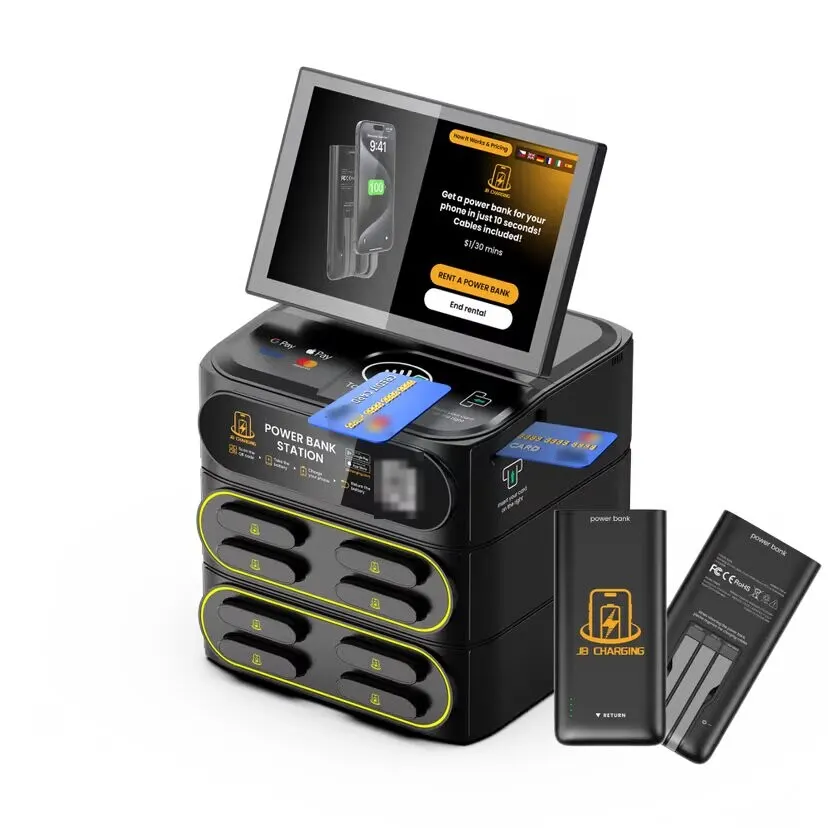
You set each station's price per 30 minutes, per hour or per day, plus a daily maximum. The default is $3 per 30 minutes with a $20 daily maximum, and you can add a free first period of up to 60 minutes. By default, a renter who keeps a bank past 24 hours is charged a $40 non-return fee and keeps it. Both settings are yours to change, and the venue is never charged.
What it costs to start, and what keeps costing
All prices are list prices at the time of writing. Shipping is as shown at checkout.
| Item | List price | Shipping or freight | Roughly delivered |
|---|---|---|---|
| J8 Pro, single | $1,199.99 | $35 | $1,235 |
| J8 Pro Essential (5) | $4,499.95 | $245 | $4,745, about $950 per station |
| J24 Pro | $3,299 | $250 | $3,550 |
| J48 Pro (built to order) | $4,299 | $300 | $4,600 |
| Station stand | $150 | ||
| Spare power banks | $200 per 10 |
Bundles of 10 and 20 bring a J8 Pro to about $886 and $852 delivered; see 1, 5 or 20 stations. The bundles include lit headers, some display stands and brochures for venue pitches.
A five-station starter budget, at list: the Essential bundle, $4,745 delivered; three more stands so all five can go on stands, $450 plus shipping; 10 spare banks, $200. Call it about $5,400 before shipping on the extras, insurance and gas.
Then come the costs that continue:
- Any venue share you agree to.
- Replacement power banks. They wear out with use, and when a renter keeps one, they're charged the non-return fee but you still restock.
- Travel: gas, parking and tolls.
- Your time, which becomes a wage if you hire help.
- Insurance. Plan on your own general liability policy; malls and property managers often ask for a certificate. See insurance and COIs.
- Taxes. Payouts are business income. Set aside part of each one and ask an accountant how your state treats it.
How revenue builds as you place stations: a hypothetical
We don't publish typical or average results, because the spread between venues is too wide for an average to mean anything. Here instead is the five-station route from the top of this guide, run five ways. Every number is an assumption, for illustration only:
- Five J8 Pro stations from the Essential bundle, $4,745 delivered.
- Each rental brings in $5. (Some renters return in 30 minutes for $3; some keep the bank an hour for $6.)
- Say the venue takes 10% of what renters pay (shares vary, and many venues take none), leaving you 70%.
- Each placed station costs $15 a month in replacement banks and gas.
- Say one station does 60 rentals a month (2 a day), another 20 (about 5 a week), another 8 (about 2 a week), another 2. These are round numbers for illustration, not a guide to what a venue will do. Some stations do fewer rentals than any row here.
- Not counted: your time, insurance, taxes, stands beyond the two in the bundle, and slow seasons, so real months-to-cover would be longer than the table shows. No screen ads are sold.
| Hypothetical route | Rentals a month | Renters pay | You keep (70%) | After costs | Months to cover $4,745 |
|---|---|---|---|---|---|
| All five placed, 2 rentals a month each | 10 | $50 | $35 | -$40 | Never: you lose about $40 a month on top of the hardware |
| Two placed at 8 a month, three still in boxes | 16 | $80 | $56 | $26 | About 180 (15 years) |
| All five placed at 8 a month | 40 | $200 | $140 | $65 | About 73 (6 years) |
| All five placed: 1 at 60, 2 at 20, 2 at 8 | 116 | $580 | $406 | $331 | About 14 |
| All five placed: 2 at 60, 3 at 20 | 180 | $900 | $630 | $555 | About 9 |
Examples are illustrative only, not a forecast or a typical result. What a station earns depends on the venue, placement, pricing, local demand, and how actively you run it.
Three lessons from the table:
- Stations in boxes earn nothing. Getting all five placed matters before anything else does.
- Venue choice moves the result more than any other input. In this model, moving a station from a room doing 8 rentals a month to one doing 20 adds about $42 a month. Talking every venue in row four down to a 0% share gets you to about 12 months; moving its two 8-a-month stations into 20-a-month rooms gets you to about 11.
- Plan for the weak rows, not the best one. Revenue isn't guaranteed. You may earn less than your costs or lose what you invest. The better rows show what good venue choices make possible, not what to expect.
Count your time, too. Say these five take 8 hours a month once placed and you value that at $25 an hour: that $200 stretches row four from about 14 months to about 36.
Towers open a second door: events. If an organizer pays you $600 to bring a J24 Pro that cost you about $4,000 with freight, spare banks and a hand truck, about seven events cover it, before travel and your time. Book a dozen a year and you're well past it; see running stations at events. To estimate a single venue you have in mind, use the worksheet in how much a phone charging kiosk can make.
How to start a power bank rental business, step by step
- Pick your model from the table above.
- List venues in one area where people stay a while and stay up late, and talk to a few managers before you order.
- Buy only what you can place soon. Once stations ship, they can only be returned if they're defective.
- Set up the portal: payout details and venue agreements. When a station arrives, plug it in (it comes online over 4G), add its venue in the portal, set its price, and do a test rental and return yourself.
- Run the weekly loop below, and move any station that isn't earning.
What the work looks like each week
The portal tells you where to go, and you still have to go. Here's a normal week for a hypothetical operator with a dozen stations in one metro.
| When | What to do | Done when |
|---|---|---|
| Every morning, on your phone | Open the portal (it installs to your home screen as "JB Hub") and clear the Overview's "needs attention" list: offline stations, a card reader down, stations out of or low on charged banks, idle venues. Check the non-returns card. | Each flag is fixed remotely or on your route-day list, and spares are packed |
| Two afternoons | Walk into, say, six venues of one type at their quiet hour, with a pitch card and photos of a real install. Log who decides, their main objection and a next date. Text last week's maybes. How to pitch a venue has the script. | Every visit has a dated next step |
| Route day (Thursday if you run bars) | Visit every flagged station, plus any you haven't seen in two weeks. Restock, leaving empty slots for returns. Pull any bank people say dies fast. Wipe the screen and reader; check the header is lit and nothing is stacked in front. Give the manager five minutes, and check staff have registered the station's staff code for a free rental each day. | Every station online, stocked and visible |
| When a venue says yes | Install within the week: set the price, add the venue in the portal, show staff the station, and do a test rental before you leave. | The test rental shows in the portal |
| The 1st of the month | Read the payout statement. Check each venue's 30-day revenue and trend, then decide on your weakest station: move it within the venue, move it to a new venue, or give it one more month (when to move a station). Order spare banks. Refresh screen content, and pitch a local advertiser if you sell ads. | One decision made, with a date |
Why most failures are placement failures
In our experience, when this business doesn't work, placement and staying online matter more than the hardware. A station that never got placed, sits in the wrong room or went offline unnoticed earns little or nothing, and each of those is a lever you control.
Picture two J8s from the same box. One sits in the restroom hallway of a bar that closes at 2am, where a guest at 4% needs a ride home at 1:40. The other sits by the front desk of a gym whose members charge at home. Same price, same software; only one of them is a business.
Pick rooms where phones die. Rentals come from people who stay a while, away from their own charger, and need their phone for tickets, payments or the ride home. Late-night bars, hotels, mall concourses and entertainment venues fit. Gyms, offices, clinics and fast-turning standalone restaurants usually don't, at least for paid rentals.
Place it where people wait. The restroom hallway, coat check or entrance work well. Never on the bar, in an exit path or on an extension cord, and keep a tower's back to a wall. Our 10 placement rules go further.
Match the station to the room. A small box in a big space gets lost, and a tower in a small bar takes up floor space it won't earn back. As a starting rule: a J8 for a bar, host stand or hotel front desk; a J24 for a mall concourse, casino floor or big club; a J48 for a stadium concourse or convention hall.
Stay online and stocked. A station that's offline, has a dead reader or has no charged banks earns nothing that day.
Go deep before wide. Place everything you own before you buy more, and cluster your venues so a route day is a loop, not a road trip.
Who this business fits, and who it doesn't
| Likely a good fit if you... | Likely a poor fit if you... |
|---|---|
| Already run a vending, ATM or amusement route, or sell to bars, hotels or event venues | Want money that shows up without sales calls or route visits |
| Live near a dense cluster of late-night bars, hotels, malls or event venues | Expect the company to find and place your venues |
| Are comfortable walking in cold and hearing no | Need your money back by a set date |
| Will check a dashboard daily and act on it the same week | Couldn't afford for a station to sit in a slow venue while you find a better one |
If the right-hand column describes you, don't buy stations. If the left-hand column does, the next step in a phone charging station business is mostly finding venues.
Go deeper: the playbooks and venue guides
- Before you buy: charging stations vs snack vending and J8, J24 or J48
- The money: how much revenue share to offer a venue, how to price rentals, selling local ads on your screens and lost power banks
- Winning venues: 12 venue objections and how to answer them and getting past "corporate has to approve"
- Running the route: your first 30 days, keeping stations online and stocking rules
- Vertical playbooks: bars, nightclubs, hotels, casinos, malls, family entertainment, sports complexes, colleges, hospitals, events, trade shows and long-wait rooms
- What venues read: our venue guides, one per venue type, to send a manager before the meeting, and how power bank rental works for their staff
Next step
If the route-business side of this sounds like you, book a call. Bring your questions, including about financing, and a sense of the kinds of venues near you, and we'll walk through how the program works and which station suits which kind of room. Finding and signing venues stays your job. Current prices are on the stations page, and the revenue calculator runs gross scenarios, before the 80/20 split, any venue share and your costs.
Examples are illustrative only, not a forecast or a typical result. What a station earns depends on the venue, placement, pricing, local demand, and how actively you run it.
Frequently Asked Questions
How much does it cost to start a power bank rental business?
With JB Charging, at list prices at the time of writing, a single J8 Pro countertop station is $1,199.99 plus $35 shipping. The five-station J8 Pro Essential bundle is $4,499.95 plus $245 shipping, about $950 per station. A J24 Pro tower is $3,299 plus $250 freight. Also budget for stands ($150 each), spare power banks ($200 per 10), travel and your own insurance. Five stations with extra stands and spare banks come to about $5,400 before shipping on the extras, insurance and gas. There are no monthly fees. Shipping is as shown at checkout.
How do you make money with a power bank rental business?
Renters tap a card or phone to take a power bank and pay by time, at a price you set for each station. The default is $3 per 30 minutes with a $20 daily maximum. You keep 80% of rental revenue. JB Charging keeps 20%, which covers payment processing, 4G data, software and support. Any venue share comes out of your 80%, and you keep 100% of any screen ads you sell, though you find the advertisers and there's no promise any will buy. What a station brings in depends on placement, and you can earn less than your costs.
Is a power bank rental business worth it?
It can be, if you can get stations into rooms where people stay a while with a low phone, such as late-night bars, hotels and malls, and keep them online and stocked. The same station in a gym or office may barely rent, and a station still in its box earns nothing. It's a route business with weekly work. We don't publish typical or average results. Results aren't guaranteed, and you can earn less than your costs or lose what you invest.
How much work does a power bank rental business take?
It's a route business you run yourself. You find the venues, agree on terms with them and install the stations. We give guidance on approaching venues and the portal sends venue agreements, but no placement is promised. Each week you prospect, check the portal for stations that are offline or low on charged banks, visit stations to restock and fix problems, and keep venue managers informed. Each month you review every venue's numbers, move weak stations and replace worn banks. The work grows with the number of stations and the distance between them.
Can I get an exclusive territory?
The standard JB Charging agreement is non-exclusive, so other operators can place stations in your area. A venue you have under contract is protected. Exclusive territories require a purchase commitment, so ask about them on a call.
What happens if a renter doesn't return a power bank?
By default, a renter who keeps a power bank past 24 hours is charged a $40 non-return fee and keeps the bank. You can change both the window and the fee for each station. The venue is never charged. You still need spare banks on hand to restock the station.

