12 Venue Objections to Charging Stations and How to Answer Them
JB Charging Team

Most venue objections to a charging station are one of 12 lines, each with an honest answer you can put in writing and one reply that loses the room. Here's what each means, what to say, what not to, and a table to keep in the car for walk-ins.
Hear the question under the objection
Every objection is one of three questions:
- Cost: money, floor space or the look of the room.
- Staff time: will my people have to deal with it?
- Risk: theft, fire, IT, contracts, the boss. Is it on us?
Answer only the question they raised, with a fact you can put in writing (a dimension, a fee, a term), not an adjective. Never promise what the agreement doesn't say: a loose promise wins the placement and loses the venue in month two. If you don't know an answer, say so and give a day you'll have it.
Then test whether the objection is the real one: "If we sorted that out, would you want one here?" A shrug means it was a polite no, and the real objection hasn't come out yet.
Venue objections to a charging station: the one-page table
| Objection | What they mean | Say this | Don't say |
|---|---|---|---|
| 1. "Our guests won't pay." | Will this be a dead box? | "Most won't, and they don't need to. It's for the guest at 4% who needs a ride home." | "Everyone will use it." |
| 2. "What's in it for us?" | Why give you a corner? | "Phones that last all night, and staff who stop charging them. It costs you an outlet and the electricity." | What another venue makes. |
| 3. "We don't have room." | Floor space is money. | "About 9 by 9 inches on a counter, or 15 by 15 on a stand. Can I show you the spot?" | "It fits anywhere." |
| 4. "It'll look cheap." | Not in my room. | "Here's one in a room like yours. The screen can run your specials." | An argument about taste. |
| 5. "My staff don't have time." | Not another task at 11pm. | "Guests do it themselves. Your staff point. Stocking and fixing are on me." | "They'll never touch it." |
| 6. "We charge phones behind the bar." | It's solved, and free. | "How many a night? What happens when two black phones get mixed up?" | Lawsuit stories. |
| 7. "Who fixes it at 1am?" | Who do my staff call? | "Not your staff. Renters get help from the machine, and your manager has my cell." | Round-the-clock support or a response time. |
| 8. "They'll steal the batteries." | Will I pay for missing gear? | "They're my banks, not yours. If a guest keeps one, their card pays a fee. You never do." | "Nobody ever keeps one." |
| 9. "Lithium? Is it UL listed?" | Is the risk on me? | "We don't claim a UL listing. The banks carry FCC, CE and RoHS marks, and it runs on a wall outlet." | Any listing it doesn't have. |
| 10. "Does it need our Wi-Fi?" | Will IT get a ticket? | "No. It has its own 4G and its own card reader." | "It can't be hacked." |
| 11. "We already have a vendor." | We're under contract. | "When does that agreement renew? I'd like to be the second quote." | Anything about the other company. |
| 12. "Corporate has to approve." | Not my call, or a polite no. | "Who signs off on guest amenities? I'll send you a note to forward." | "Can't you just approve it?" |
Cost objections
1. "Our guests won't pay for charging."
Picture last call on a Saturday. A guest's phone is at 4%, with their ride home on it. They tap a card or phone, take a bank with Lightning and USB-C cables built in, and finish their drink while it charges, no app needed. Most guests will never rent, and that's fine.
Say 10 guests a week rent for an hour at the default $3 per 30 minutes (you set pricing per station): about $260 a month, $208 of it your 80%, with card processing inside JB Charging's 20%. Assume a J8 from a 5-pack, about $950 including shipping, at list price at the time of writing. At 10 a week it's covered in about five months; at 3 a week, about 15 months; at one every other week, about 90 months, which in practice is never.
That's before any venue share, replacement banks ($200 per 10), maintenance, gas, taxes, your time and slow weeks. Nothing here says which pace a station lands at, or whether it reaches any. The venue and the spot are the levers you control, so spend your effort there, and move a station that stays near the bottom after a fair test.
Don't say: "Everyone will use it," or rental counts from other venues.
2. "What's in it for us?"
Start with guests and staff: phones last until the ride home, the bartender stops running a charging shelf, the venue appears on the JB Charging app's station map, and it costs one outlet and the electricity (a J8 runs on a single 60W adapter).
Many venues host a station free as a guest amenity. Others take a share you negotiate, set per station in the portal, paid from your 80% monthly by direct deposit with a statement. Put the percentage in the agreement, call it a share of what that station brings in, and never forecast what it will pay. If they want a flat monthly placement fee instead (some malls do), price it against a slow month, since it's owed even when nothing rents. See how much revenue share to offer a venue.
Don't say: what another venue earns, or that the share will be big.
3. "We don't have room."
A J8 Pro is 9.4 by 8.7 inches at the base and 16.1 inches tall; its stand takes about 15 by 15 inches of floor. A J24 Pro tower stands on 14 by 17.7 inches. Bring a tape measure and mark out the 9 by 9 on their counter.
Then name the spot before they do: the restroom hallway, the coat check, or near the entrance. Never the bar top, an exit path or an extension cord. If the room is phone-free, put it at the coat check or just inside the entrance, clear of the exit path, and make the pitch about the ride home.
Don't say: "It'll fit anywhere," and never offer the bar top to close the deal.
4. "It'll look cheap."
Don't argue taste. Keep two install photos on your phone, one on a counter and one on a stand, from rooms like theirs. The J8's lit "Charge Your Phone" header is built to be seen across a dark room. The screen shows the price and a rent button; the rest is ad space you control, so offer to run their happy hour there, and it reads as part of the room.
Don't say: "Nobody will even notice it." They should. That's how it gets used.
Staff-time objections
5. "My staff don't have time for this."
Staff point; that's the job. Guests tap, take a bank and drop it back in any free slot, and billing stops on its own. Four pictured steps on the machine do the explaining. Leave pitch cards by the register: the front shows the three steps, the back is a rental guide for staff (50 for $25). Restocking and fixing are on you. Staff who register with the station's staff code get free staff rentals, up to one a day within a weekly limit, so they know where it is.
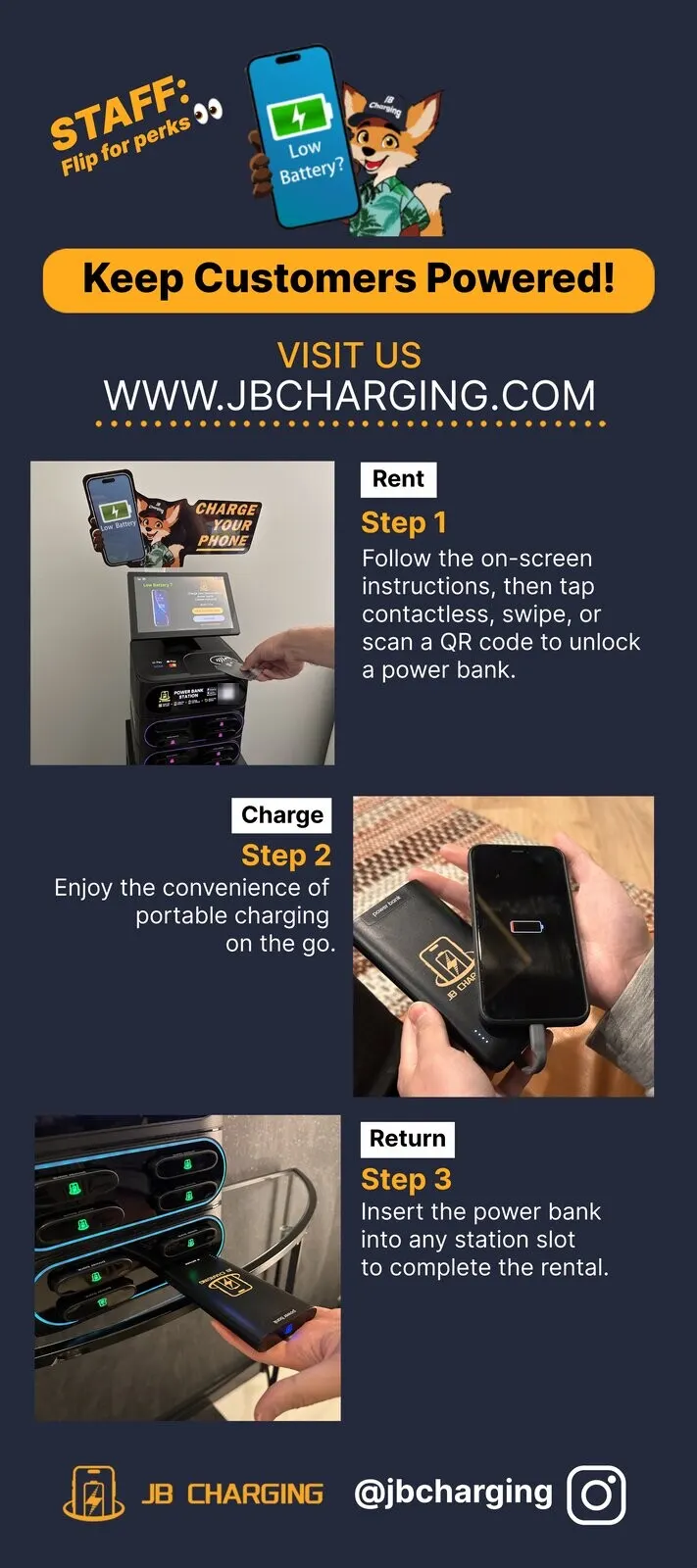
Don't say: "They'll never have to touch it." Name the one ask and keep to it.
6. "We already charge phones behind the bar." (Or: "We have outlets.")
To them, this is solved, and it's free. Ask how often someone wants a charge, where the phones sit, and what happens when two black phones get swapped, or one walks. A charging shelf makes the bartender a coat check for something worth more than the tab, and outlets pin guests to a wall. A rented bank goes back to the table.
Don't say: lawsuit stories. You aren't their lawyer, and fear reads as a sales tactic.
7. "Who fixes it at 1am on a Saturday?"
Not their staff. Renters reach JB Charging's support through the machine, the app or the receipt. Station problems are yours to spot: your portal's Overview flags a station that's offline, a card reader that's down, or a machine low on charged banks. Check it every morning and before a weekend rush. On install day, put your cell number in the manager's phone and agree when you'll check in.
Don't say: round-the-clock support, a response time, or "it never goes down." Promise what you'll do when it does.
Risk objections
8. "People will walk off with the batteries."
The banks belong to you, and the venue is never charged. By default, a renter who keeps a bank past 24 hours pays a $40 non-return fee and keeps it; you can change both per station. Staff who find a bank on a table slide it into any free slot, and the rental closes. JB Charging's standard venue agreement also says the venue isn't responsible for third-party theft or customer misuse.
Don't say: "Nobody ever keeps one." Some people will. It just costs the venue nothing.
9. "Lithium batteries in a packed room? Is it UL listed?"
Answer straight: JB Charging doesn't claim a UL listing. The power banks carry FCC, CE and RoHS marks. Then cover what you control: a wall outlet, never an extension cord, out of exit paths, and a tower backed to a wall with a plan for securing it. Don't promise bolts or a tether you don't have.
If an inspector or insurer has a specific requirement, get it in writing and send it to us. We'll tell you what documentation exists before you promise anything. Carry your own general liability policy, because venues ask for a certificate; see insurance and COIs for operators.
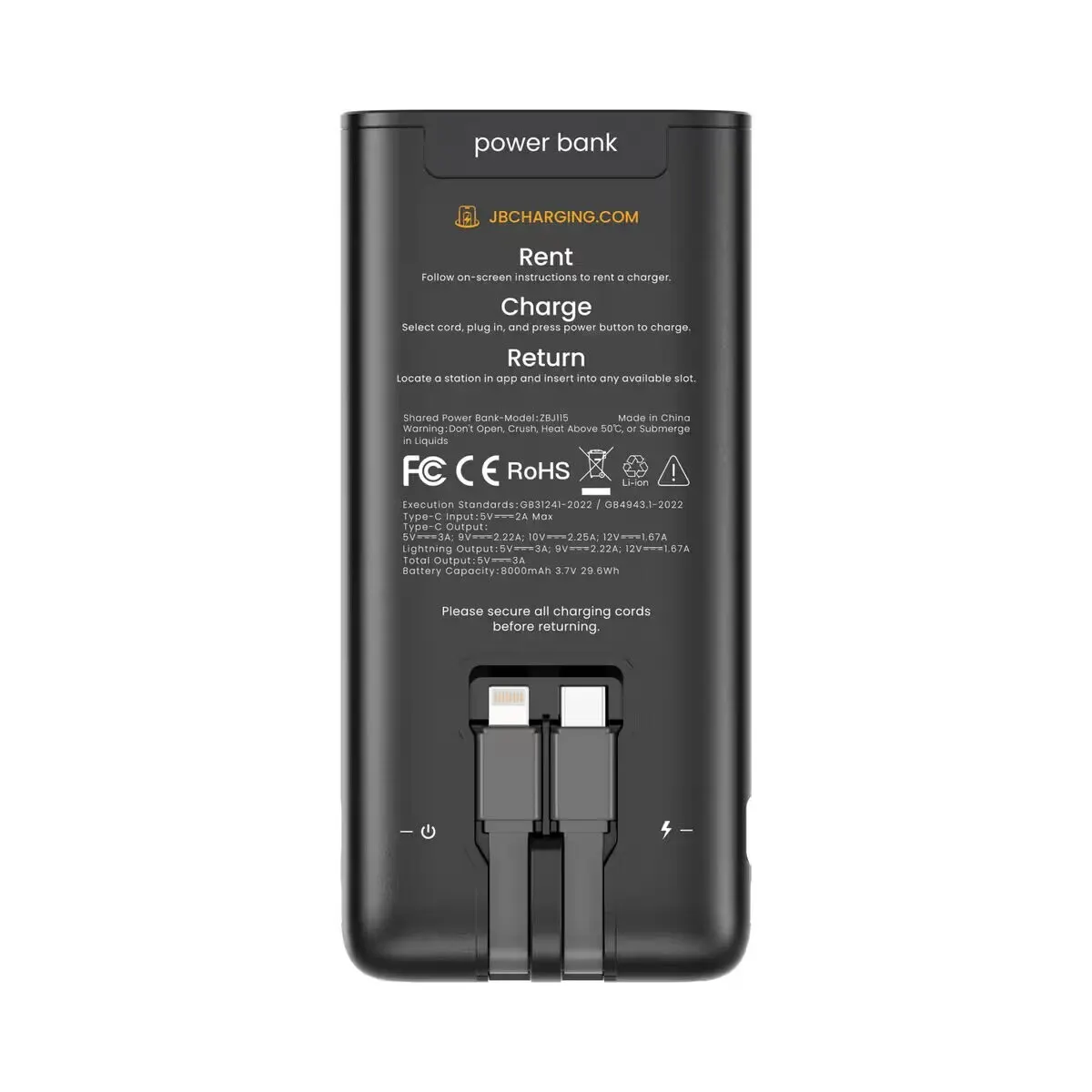
Don't say: any listing, test or rating the hardware doesn't have, or "it can't catch fire."
10. "Does it need our Wi-Fi? IT won't allow it."
It doesn't need their network. Every station JB Charging sells has a built-in 4G SIM at no charge and takes payment on its own card reader, never their register. Tap rentals need no app or account. Wi-Fi is only a backup, and theirs only if they agree, so check signal in basements and concrete rooms first.
Don't say: "It can't be hacked," or promise anything about guest data, and don't offer guest contact lists. Send IT's harder questions to us.
11. "We already have a charging vendor."
Don't sell against it. Ask when their agreement renews. JB Charging's standard venue agreement rules out a competing charger during the term, so assume theirs might too, and don't ask them to break it. Log the date, come back a month or two before, and ask to be the second quote. If theirs is often empty or offline, pitch your own routine at renewal, without a word about theirs.
Don't say: anything about the other company's hardware, terms or service. The manager picked them.
12. "Corporate has to approve it."
It's either true (a chain, a franchise, a managed property) or a polite no, and getting past "corporate has to approve" covers both. Ask who signs off on guest amenities and what they'll want to see; in a franchise, ask whether the owner decides locally. Then send the manager a note to forward. With JB Charging's standard venue agreement, it can read:
What it is: a self-service phone charging station I own, stock and maintain. Guests tap, take a power bank, and return it to any free slot.
What the venue provides: about 9 by 9 inches of counter (15 by 15 of floor on a stand), one standard outlet and the electricity.
Getting out: a 6-month term, then month-to-month with 30 days' notice. Removal costs the venue nothing.
Don't say: "Can't you just approve it yourself?" And don't go over the manager's head. They'll still be there after corporate says yes.
End every answer with a small ask
Make it physical: "Can I show you where it would go?" If it's still no, log the objection word for word and open your next visit with the answer. The full visit, from walk-in script to follow-up email, is in how to pitch a venue.
Next step
Hearing one that isn't on this list? Book a call and bring it, with the venues you're working on. To check footprints and screen sizes before a walk-in, see the stations.
Examples are illustrative only, not a forecast or a typical result. What a station earns depends on the venue, placement, pricing, local demand, and how actively you run it.
Frequently Asked Questions
What do venue owners ask before hosting a phone charging station?
Mostly four things: what it costs them, what happens if guests keep the batteries, whether staff have to do anything, and whether it's safe and insured. Money tends to come last. Answer each with something you can put in writing: the outlet and footprint, the non-return fee the renter pays, the one thing staff do, and the FCC, CE and RoHS marks plus your own insurance certificate.
What does it cost a venue to host a phone charging station?
Under JB Charging's standard venue agreement, nothing beyond a standard wall outlet and the electricity the station uses. The operator owns, stocks and maintains the station, and if the venue ends the agreement, the station is removed at no cost to it. Operators can use different terms, so the signed agreement is what counts.
What happens if a guest doesn't return the power bank?
By default, if a bank isn't back within 24 hours, the renter is charged a $40 non-return fee and keeps the bank. The operator can change the window and the fee per station. The venue is never charged.
Is the charging station UL listed?
The power banks carry FCC, CE and RoHS marks; JB Charging doesn't claim any other listing. The station plugs straight into a standard wall outlet, should never run on an extension cord, and belongs out of exit paths. If an inspector or insurer has a specific requirement, get it in writing and send it to JB Charging to check what documentation exists before promising anything.
How much commission should I give a venue for a charging station?
There's no standard. Many venues host a station free as a guest amenity. Others take a negotiated share of the rental revenue at that station, paid monthly by direct deposit with a statement, and it comes out of the operator's 80%. Write the percentage into the agreement and don't forecast what it will pay.
Do I need my own insurance to place charging stations?
Plan on it. Many venues, especially malls and property managers, ask for a certificate of insurance before install, so carry your own general liability policy and have the certificate ready before you pitch.

