How Much Revenue Share Should You Offer a Venue?
JB Charging Team

Open at 0%. Many venues host a charging station for free, because it keeps guests' phones alive and gets staff out of the phone-charging business. If one asks for a cut, it comes out of your 80% of rental revenue (JB Charging keeps 20% for payment processing, 4G and support), so treat a revenue share for a venue like rent: pay it only for a spot guests walk past, start near the 5% to 10% that one vending-industry guide calls standard, and write in a 90-day review.
The test: a 20% share breaks even if the spot it buys does about a third more rentals than the spot you'd get for free. That's a low bar for a hallway every guest walks past, and a high one for a shelf by the back door.
Start at 0%: many venues host for free
You don't owe a venue anything on top of our 20%. A share is a separate decision, made station by station. Plenty of venues say yes at 0% and host the station as a guest amenity.
A manager rarely starts with the check. They want to know whether a guest at 5% battery can still get a ride home, and whether staff can stop charging phones behind the bar. Bring up money only when the venue does, and treat any share as a bonus, never the reason to say yes.
What a revenue share for a venue costs you
A share is a percentage of the station's rental revenue, but every point comes out of your 80%, so it bites harder than it sounds. For every $100 in rentals:
| Venue share | Venue gets | You keep | Part of your 80% you give up | The paid spot must out-rent a free one by |
|---|---|---|---|---|
| 0% | $0 | $80 | none | n/a |
| 5% | $5 | $75 | 1/16 | about 7% |
| 10% | $10 | $70 | 1/8 | about 14% |
| 15% | $15 | $65 | nearly 1/5 | about 23% |
| 20% | $20 | $60 | 1/4 | about a third |
| 25% | $25 | $55 | nearly 1/3 | about 45% |
| 30% | $30 | $50 | 3/8 | 60% |
A 10% share hands the venue an eighth of your money, so the spot must out-rent a free one by about 14% just to break even. At 20%, it's a quarter of your money and a third more rentals. (The last column is 80 divided by what you keep, minus one; fixed costs are the same at either spot.) To follow a dollar from the renter's card to your bank, see where the money goes on a power bank rental.
When a share is worth paying: the spot
Say two venues on the same block will take a station. Picture the first at 11:40 on a Friday: the restroom line runs right past the hallway wall it's offering, for 20%. The second hosts for free, but only on a shelf by the back door.
Assume each rental brings in $5, and you spend $15 a month on replacement power banks and fuel. The station is a J8 Pro from the 5-pack, about $950 delivered at list price at the time of writing, on one of the bundle's two stands.
| Hypothetical | Rentals a month | Renters pay | Venue gets | You keep | After $15 costs | Months to cover $950 |
|---|---|---|---|---|---|---|
| Hallway (strong spot), 20% share | 40 | $200 | $40 | $120 | $105 | About 9 |
| Hallway (strong spot), 10% share | 40 | $200 | $20 | $140 | $125 | About 8 |
| Back-door shelf, no share | 10 | $50 | $0 | $40 | $25 | About 38 |
| Slow spot, 20% share | 10 | $50 | $10 | $30 | $15 | About 63 |
Examples are illustrative only, not a forecast or a typical result. What a station earns depends on the venue, placement, pricing, local demand, and how actively you run it.
Here, paying 20% instead of 10% at the hallway costs you $20 a month. Taking the free shelf to avoid a share costs you $80. Swap in your own rental counts: at any volume, the paid spot wins if it out-rents the free one by more than the figure in the first table.
The last row is the warning: the same 20% at a slow spot leaves you $15 after costs and over five years to cover the station. Save a generous share for a spot that has proven itself, or tie it to a review date.
Flat fees work differently. Say a property wants $100 a month per station instead. At $200 a month in rentals, you keep $160 before the fee and $60 after it. At $50, you keep $40 and still owe $100. A percentage shares a slow month with the venue; a flat fee leaves all of the risk with you. To compare the two, divide the fee by the percentage: $100 a month matches a 20% share only at $500 a month in rentals. Below that, the fee costs you more.
None of this counts your time, your own liability insurance if a venue asks for a certificate, or taxes. Add them before you decide what you can give away.
Market rates: what vending locations get
- One vending-machine seller's guide puts location commissions at about 5% to 15% of sales, with 10% to 15% for the busiest accounts and free placement as the baseline for smaller ones.
- Its revenue-split guide makes 0% the default offer, calls 5% to 10% the industry standard, and suggests a sliding scale, such as 0% on the first $300 of monthly sales and 10% above that.
Like a venue share, those commissions are figured on sales, and they aren't JB Charging terms. Read together: 0% is a normal ask, 5% to 10% is the common middle, and the low teens are for spots that have proven busy. For a sliding scale's effect, start low and raise the share once the station clears a monthly rental figure you both wrote down.
Decision table: what to offer, by venue situation
Pick your opening number and your ceiling for each venue before you walk in, and use our 10 placement rules to judge which spot is worth paying for.
| Venue situation | Open with | Raise it when | What the share buys |
|---|---|---|---|
| The owner wants the amenity: guests ask for chargers, staff are tired of minding phones | 0% | Only if they ask, and only for a better spot | Nothing. They've already said yes. |
| Busy late-night venue offering a spot everyone passes (restroom hallway, entrance, host stand) and asking for a cut | 5% to 10%, with your ceiling set before you walk in | By the 90-day review, rentals clear a monthly figure written into the agreement | The spot, named and photographed in the agreement |
| Wants a share but can only offer a back corner | 0% | They offer a spot guests can see | Nothing yet. Money doesn't fix a spot nobody sees. |
| The spot guests walk past has no counter | 0%, plus a stand | Only if they ask once it's proven busy | A $150 stand (list price at the time of writing) can buy the hallway instead of a share |
| New venue, odd hours or an untested type | 0% for the first 90 days | Rentals clear a level agreed in writing | Real numbers before you pay for a guess |
| Got a share from another company's station | Ask what it actually received, in dollars, over the last few months | Your spot beats where theirs sat | Dollars, not percentages. A high percentage of very little is very little. |
| Mall or large property that wants a placement fee | A percentage instead of rent | You've seen the space busy, and it fits a floor-standing station | A concourse spot, on terms that shrink when rentals do |
| Clinic, office or gym | 0%, or place the station elsewhere | Don't | In our experience, paid rentals there are weak, and a share won't change that |
| Asking for 30% or more | Your ceiling, plus a review date | Rarely | 3/8 of your 80%, double the top of the vending range. Be ready to walk. |
Malls bring their own paperwork and fees, so read getting into malls before you quote one.
Points aren't your only currency. You can offer a slot on your screen for the venue's own specials; agree how long it runs, because a slot you give away is one you can't sell. And since you price each station, a spot busy enough to earn a share may also carry a price above the $3 per 30 minutes default.
How the share gets paid
You set each station's share in your portal, and it comes out of your 80%. We pay the venue directly, monthly, by direct deposit with a statement once it completes payout setup. Your Billing tab shows gross rentals, the venue's share and your net, and you never write checks.
On install day, tell the manager a payout-setup invite is coming, and make sure they finish it. A venue that agreed to a share and never sees a deposit stops feeling like a partner.
A script for the share conversation
Lead with the guest.
"When a guest's phone dies here, the ride home goes with it. Guests tap a card or phone, take a power bank and bring it back, and your staff never have to hand one out. It needs one outlet and less than a square foot of counter."
When they ask what's in it for them.
"Lots of places host it free for their guests, and I can set it up that way today. If you'd like a share, I can do that for a spot people actually see, like the hallway to the restrooms: [your opening number] of this station's rental revenue, paid to you monthly by direct deposit with a statement."
If they push for more.
"I can't start higher before I've seen it run here. Let's write a 90-day review into the agreement: if this station clears [$X] a month in rentals by then, your share goes to [Y]%. If it's slow, we look for a better spot together."
Don't say what another venue earns, or what this one will make. Quote the percentage and show it on a modest round number: "If guests spend $100 here in a month, 10% is $10."
If they want a flat monthly fee.
"I'd rather share what the station brings in than pay rent on a guess. If it does well, you do well. If it doesn't, I'll move it, and it's cost you nothing but a little electricity."
Close.
"I'll send the agreement from my portal today. Once you've finished the payout setup, the deposits go out monthly."
For the full walk-in pitch, see how to pitch a venue.
Put five things in writing
Your portal sends a standard venue agreement. If any of these isn't in it, add it in a short addendum you both sign.
- The spot. Name it ("restroom hallway, left wall") and attach a photo. If the station gets moved somewhere worse, the share is open for review.
- The base. A percentage of this station's rental revenue. Check how your agreement defines it, so you can answer "a share of what?" on the spot, including whether refunds and non-return fees count. State that screen-ad revenue isn't included; you keep 100% of the ads you sell.
- The review date and the trigger. Set it 90 days out. Write down the monthly rental figure that raises the share, and the one that lowers it or ends with a move.
- Payment. Monthly, by direct deposit, with a statement, once the venue completes payout setup.
- Term and exclusivity. How long it runs, how either side exits (for example, 30 days' notice), and, if you're paying a share, that the venue won't host another charging station while yours is there.
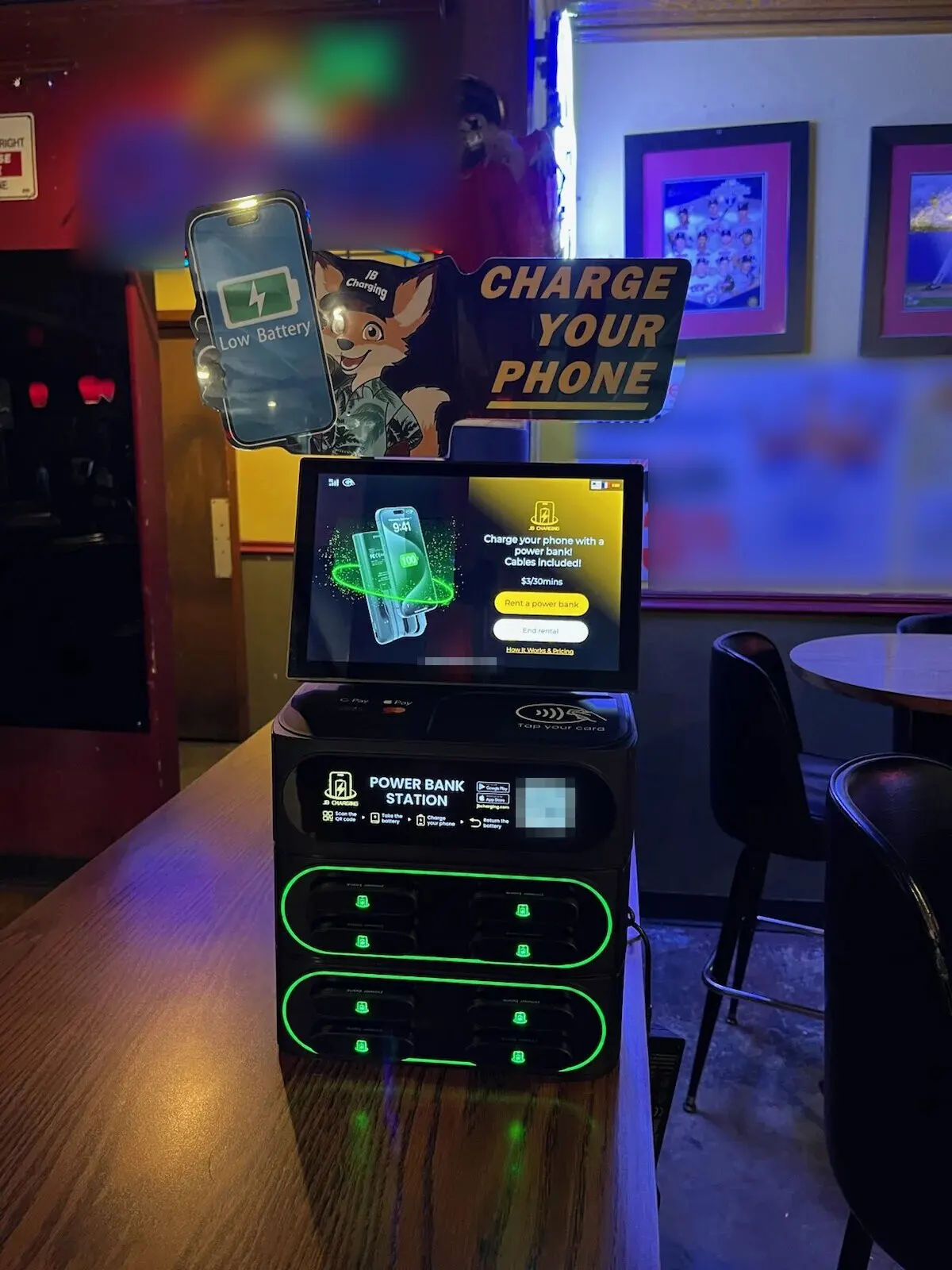
Next step
Before your next visit, write three numbers on that venue's line in your tracker: your opening share, your ceiling, and the monthly rental figure that moves you from one to the other. Our revenue calculator shows gross rentals, so keep 80% of that gross, then subtract the venue's percentage of the same gross (a 10% share leaves you 70%). Or book a call, and we'll work through a venue you're talking to.
Examples are illustrative only, not a forecast or a typical result. What a station earns depends on the venue, placement, pricing, local demand, and how actively you run it.
Frequently Asked Questions
How much revenue share should I give a venue for a charging station?
Start at 0%. Many venues host a station for free because it keeps guests' phones charged and gets staff out of charging phones behind the bar. If a venue wants a share, start near the 5% to 10% that one vending-industry guide calls standard for location commissions. Tie it to a spot guests actually walk past, and write in a 90-day review. That range is a market reference point, not a JB Charging term. You set the share for each station.
Do I have to give the venue a cut on top of JB Charging's 20%?
No. A venue share is optional, and you set it station by station. If you agree to one, it comes out of your 80%, not out of JB Charging's 20%, which covers payment processing, the built-in 4G connection, the software and renter support. So a 10% share is an eighth of your take, and a 20% share is a quarter of it. A 20% share only breaks even if the spot it buys does about a third more rentals than one you'd get for free.
What commission do vending machine locations usually get?
One vending-industry guide puts location commissions at about 5% to 15% of sales. Free placement is its baseline for smaller accounts, and it keeps 10% to 15% for the busiest. A venue share for a charging station works the same way, as a percentage of rental revenue, except that it comes straight out of your 80%. These are market reference points, not JB Charging terms.
Does the venue get a share of screen-ad revenue?
Not through the share you set. A venue share covers rental revenue. You keep 100% of the screen-ad revenue you sell, and JB Charging takes none of it. Say in the agreement that ad revenue isn't included, so nobody assumes otherwise.
How does the venue get paid its share?
You set the share for each station in your portal. JB Charging pays the venue directly, monthly, by direct deposit with a statement, once the venue completes its payout setup, so you never write checks. Your payout statements in the portal's Billing tab show gross rentals, the venue share and your net.
Should I pay a venue a flat monthly fee instead of a percentage?
Usually not, unless you've already seen the space busy and it's big enough for a floor-standing station, as in some malls. You owe a flat fee whether the station rents or not, so a slow month comes entirely out of your pocket. A percentage shrinks when rentals do, so the venue shares that risk with you. To compare the two, divide the fee by the percentage you'd otherwise pay. The result is the monthly rental figure at which they cost the same.

