How to Pitch a Venue on a Phone Charging Station
JB Charging Team

Walk in with a working machine, get the owner to name a problem they already have, and leave with a date on the calendar. That's how to pitch a venue on a phone charging station; email is for the follow-up. Below: when to go and who to ask for, a 60-second script, answers to what owners ask, a follow-up email and a tracker. Short on time? Jump to the script.
What one venue yes is worth: same station, different rooms
Say a J8 Pro from the 5-pack costs you about $950 delivered (list price at the time of writing, plus shipping shown at checkout). Assume each rental brings in $5 (an hour at the default $3 per 30 minutes is $6), the venue takes a hypothetical 10%, and banks and fuel cost $15 a month. Your 80% of a rental is $4; after the venue's 50 cents, you keep $3.50. Card fees come out of JB Charging's 20%.
| Same $950 station | Hypothetical rentals a month | Your net a month | Months to cover $950 |
|---|---|---|---|
| Still in your garage | 0 | $0 | Never |
| In a venue that rents about 1 a week | 4 | -$1 | Never |
| In a venue that rents about 2 a week | 8 | $13 | About 73 |
| In a venue that rents about 5 a week | 20 | $55 | About 17 |
| In a venue that rents about 1 a day | 30 | $90 | About 11 |
Same machine in every row; you choose which rooms to pitch. This leaves out your time, taxes, insurance and slow weeks. A station can earn less than its costs, and venues can say no.
Before you walk in
Scout at their busiest hour; pitch at their slowest. Start where people wait or stay late, far from their own charger: late-hour bars, hotel lobbies, the seats where parents wait at trampoline parks and bowling alleys.
Scout once as a customer on their fullest night, and note:
- Phones charging behind the bar or by the register: your opening line.
- Where people wait (host stand, restroom hallway, coat check, lobby seating): your spot. Never the bar top, an exit path, or an extension cord.
- An outlet there, and your phone's signal. Stations run on built-in 4G, with Wi-Fi as a backup.
- The owner's name and when they're in. Ask the bartender.
For bars, use this Friday-night scorecard.
Who decides, and when to catch them
| Venue | Ask for | When to go | Avoid |
|---|---|---|---|
| Independent bar | The owner, or the GM if the owner is never in | Tue to Thu, 2pm to 4pm, or the first hour after opening if they open late | Happy hour, weekend nights |
| Hotel | The general manager | Call to book 10 minutes, ideally weekday early afternoon | Checkout and check-in rushes |
| Trampoline park, bowling alley, arcade | The owner or GM | Weekday late morning | Weekends, birthday-party blocks |
| Franchise location | The franchisee, not the shift manager | The day the manager says the franchisee comes in | Pitching whoever is at the counter |
Whoever says yes has to be able to sign the venue agreement.
Pack the kit
- A tested demo station with its lit header (a J8 Pro is 11.5 lb). Run a full rental at home the night before and note how long it takes to come online once plugged in. Set a free first period (up to 60 minutes) so demo rentals cost you nothing; reset it before the station goes into a venue.
- A 20-second phone video of a rental, in case the room has no signal.
- Pitch cards ($25 for 50 at the time of writing), with the rental steps on the front and a staff guide on the back.
- A one-page sheet: your number, what the venue provides (one outlet, about 9 by 9 inches of space), what you handle, the guest price, the electricity cost and the terms.
- Your certificate of insurance, printed, and your portal (JB Hub) open on your phone, so the owner sees the demo rental appear under Active Rentals.
How to pitch a venue in 60 seconds: the walk-in script
About a minute out loud. The bold lines are what you do.
Walk in at the quiet hour and ask for the owner by name.
"Hi, I'm [name]. I'm placing phone charging stations around [town]. Can I show you something? It takes a minute."
Set the station on the counter, screen facing them, and plug it in.
"Quick question first. Do people ask your staff to charge their phones?"
Stop talking. Write down what they say. If it's "not really," ask: "So when a guest's phone dies here, what happens?"
"This takes that off your staff. A guest taps a card or their phone right here..."
Tap your own card. Hand them the power bank that slides out.
"...and takes a charged power bank with the cables built in. They keep their phone with them, and when they're done they drop the bank back in any open slot."
Let them slide it back into a slot themselves.
"Your staff never touch a phone. There's no cost to you beyond the power from one regular outlet. It has its own cell connection, so it usually won't need your Wi-Fi. I own it, I keep it stocked, and if anything's wrong, you call me.
"I'd put it by [the host stand / the restroom hallway], where people wait. Can I show you the spot?"
Walk to it together. Then ask for a day: "Can I bring it in Tuesday at 3 and set it up right here? I'll send the agreement today."
If they won't decide on the spot: "Fair enough. Can I come back Thursday at 3 with the agreement, so you can read it first?"
Why it's built this way:
- The question comes first. Their answer makes your case in their words. Say the owner answers, "Every weekend. Friday there were six phones behind the bar." That's the first line of your follow-up email, already written.
- You demo instead of describing. A bank sliding out, and back in, beats any spec sheet.
- Guests, then staff, then cost. Never money first. Many venues host a station free as a guest amenity. Opening with "you'll get a cut" turns a conversation about guests into a negotiation over money.
- It ends on a day and a time. "Let me think about it" is a polite no. "Tuesday at 3" goes on a calendar.
Swap the opening question to fit the room:
- Hotel: "How many chargers does the front desk lend out on a busy day?"
- Trampoline park or bowling alley: "Where do parents sit while the kids play, and for how long?"
- Late-night bar: "What happens at close when someone's phone is dead and they need a ride?"
Owner not in? Often they won't be. If the manager has a minute, run the demo anyway; owners hear about it from their managers. Don't ask for a yes they can't sign. Ask when the owner is usually in, write your name, number and that day on a pitch card, and hand it over. If they want something to forward, point them to the page for their type of venue under solutions for venues. Then put the day in your tracker.
First venue? Don't imply a route you don't have. If they ask where else you are, tell the truth; the demo carries the pitch.
Stations not here yet? Run the minute with your phone video, close on the spot and a verbal yes, and promise a call when they land. Don't name an install date you can't keep.
The four questions every owner asks, plus two
Answer in one breath, then show something. For "no room," "it'll look cheap" and the rest, see 12 venue objections and how to answer them.
| They ask | Say | Show |
|---|---|---|
| "What does it cost us?" | "Nothing but the power from one regular outlet. No fee, no construction, no monthly bill." | The electricity line on your one-pager |
| "What if people walk off with them?" | "The batteries are mine, and you're never charged. If a guest keeps one past 24 hours, their card is charged a $40 non-return fee." | Active Rentals in your portal: every bank that's out, and for how long |
| "Will my staff have to do anything?" | "No. Guests rent and return on their own, and renters with a problem get help from the machine, the app or the receipt. Anything the station needs, I handle." | The staff guide on a pitch card. Then the perk: staff who register with the station's staff code in the JB Charging app get a free rental each day, within a weekly limit |
| "Is it safe? Are you insured?" | "It plugs straight into a wall outlet, with no extension cords and nothing in an exit path. The banks carry FCC, CE and RoHS marks. And yes, I'm insured." | Your certificate of insurance |
| "What do my guests pay?" | "I set the price for this station. The default is $3 per half hour with a $20 daily max, and guests just tap a card or phone, no app." | The price on the station's screen |
| "What if it doesn't work out?" | "The agreement runs 6 months, then month-to-month. Give me 30 days' notice and I take it out at no cost to you." | The venue agreement in your portal |
Cost. Even at its adapter's full 60-watt rating around the clock, a J8 would use about 43 kWh a month. At the U.S. average commercial rate of about 14.5 cents per kWh (July 2026, preliminary, EIA), that's about $6, more in high-rate states.
Theft. The 24 hours and $40 are defaults you set per station, so quote yours. The standard venue agreement also says the venue isn't liable for third-party theft. If a bank doesn't come back, contact support and check the replacement coverage in your distributor agreement; replacement banks list at $200 for 10 at the time of writing.
Safety. "I'm insured" has to be true, so carry your own general liability policy before your first walk-in; see insurance and COIs for charging station operators. If a venue wants to be named additional insured, that's an endorsement from your own insurer. Claim only what's on the spec sheet: FCC, CE and RoHS for the banks. If they ask about UL or any other listing, don't stretch and don't guess. Write the question down word for word, tell them when you'll answer, and ask us.
Price and terms. If the owner hates charging guests at all, you can set a free first period of up to an hour; you give up short rentals to win the spot. The 6-month and 30-day terms come from JB Charging's standard venue agreement. Read the version you send, because you can change them.
What's in it for them? You've already said it: guests whose phones last, and staff who stop babysitting them. If they ask about a share, answer plainly: any share comes out of your 80% and is paid to the venue monthly by direct deposit with a statement. Decide your ceiling before you walk in; how much revenue share to offer a venue covers how.
On the fence? Offer a short trial
When you hear "maybe," you can offer to leave the station for a set period, say 30 days. That's your call, not a JB Charging program, and it needs a clear end:
- Agree in writing on the start and end dates, the spot, the guest price, no cost to the venue beyond power, and what happens on the end date. An email the owner replies "agreed" to is enough.
- Add the venue in your portal so the station shows on the app's map, and have the agreement ready, so keeping it takes one signature.
- Halfway through, drop in with their last 7 days from your portal's Venue Insights.
- On the end date, the question isn't "do you want one?" It's "should I take this one away?"
Only offer a trial where you'd want the station long term. A month in the wrong room is a month it isn't working in the right one.
Follow up: one email, one question, a specific day
Send it the same day or the next morning:
Subject: The charging station for [venue]
Hi [first name],
Thanks for the few minutes today. You mentioned [their words, e.g. "six phones behind the bar on Friday"].
[One line answering the one objection they raised, e.g. "On the batteries walking off: you're never charged. If a guest keeps one past 24 hours, their card is charged the non-return fee."]
It needs one regular outlet and nothing else from [venue]: no fee, no monthly bill.
Can I bring it in Thursday at 3 and set it up by [the spot you discussed]?
[Your name] [Phone]
If they gave you a cell number instead, the same lines work as a text.
The rules:
- Their words, not yours. Quote the problem as they said it.
- One objection, one answer. Don't resend the pitch.
- One question, with a day and a time. End on it, with no "let me know if you have any questions" after it.
- No reply by that day? Stop in at the same quiet hour instead of sending a second email.
- "Not now"? Ask which month is better and put it in your tracker. If they already have a charging vendor, log when that agreement ends, and never knock the other company.
- A clear no? Log their exact words and move on. The next venue on the street is a better use of the afternoon.
Track every venue in one list
A spreadsheet is enough:
| Column | What goes in it | Example (hypothetical) |
|---|---|---|
| Venue | Name and street | Neighborhood bar, Main St |
| Type | Bar, hotel, bowling alley, and so on | Bar |
| Decision-maker | Name, role, and when they're usually in | Owner, Tue to Thu afternoons |
| Scouting notes | What you saw at the busy hour, and the spot you'd propose | Phones behind the bar Friday; outlet in the restroom hallway |
| Last touch | Date, and whether it was a visit, email, call or text | Tue visit |
| Their objection | In their words | "Batteries will walk" |
| Stage | Listed, visited, met the decision-maker, verbal yes, trial, agreement sent, installed, live; or not now (with a date), or no | Met the decision-maker |
| Next step | One action | Theft-answer email, then drop in |
| Next-step date | A real date, never blank | Thu 3pm |
Sort by next-step date every morning; a venue with no date is a venue you've lost. Log objections word for word, because they write your next email. Pitch one venue type per afternoon; by the fourth bar, your answers are sharper than at the first.
After the yes: agreement, install day and staff codes
Add the venue and send the venue agreement from your portal the same day, with any share you agreed on in writing. On install day, put the station exactly where you said, run a test rental with the manager watching, and check that the station shows on the app's map. Before you leave, have each staff member register with the station's staff code in the JB Charging app.
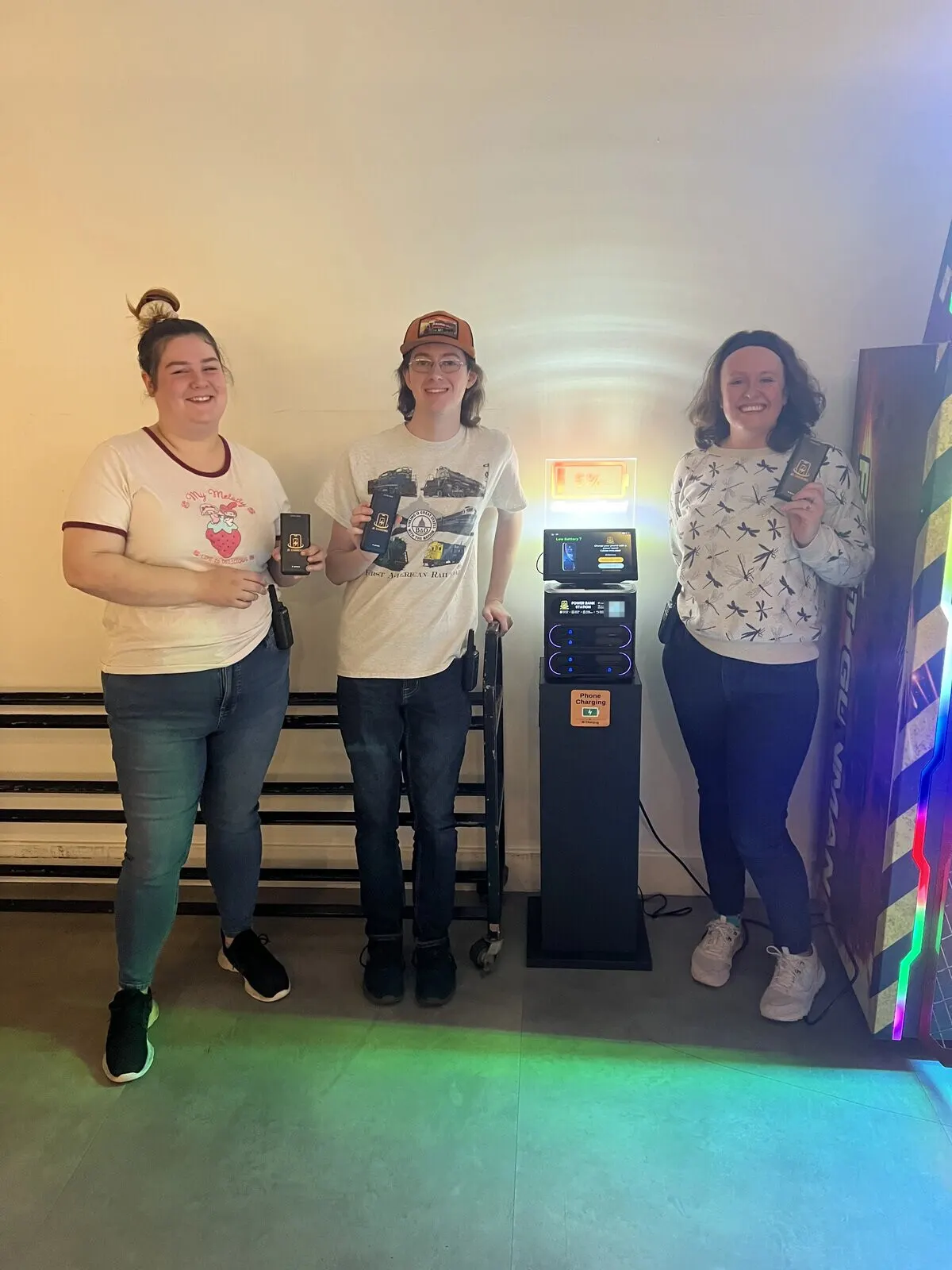
Then ask one more question: "Who else on this street should I talk to?"
Next step
Have stations waiting, or deciding whether this business fits you? Book a call and bring the venues you're considering; we'll talk through which to pitch first and how to answer what they ask. Pitch cards and stands for your demo kit are on the products page.
Examples are illustrative only, not a forecast or a typical result. What a station earns depends on the venue, placement, pricing, local demand, and how actively you run it.
Frequently Asked Questions
What do I say to a business owner about a phone charging station?
Open with a question, not a pitch: "Do people ask your staff to charge their phones?" Then demo it: tap a card, hand them the power bank that slides out, and let them return it. Cover guests first, then staff, then cost, which is nothing beyond the power from one regular outlet. End by walking to the spot together and asking for a specific install day and time.
What if the owner isn't there when I walk in?
Plan for it, because it happens often. If the manager has a minute, run the demo, since managers tell owners what they saw, but don't ask for a yes they can't sign. Ask when the owner is usually in, write your name, number and that day on a pitch card, and hand it over. Put the day in your tracker and come back then.
Should I email venues or walk in?
Walk in with a working station. When an owner taps a card and watches a power bank slide out, the demo answers questions an email can't. For hotels, call ahead and book 10 minutes with the general manager. Save email for the follow-up: send one the same day or the next morning that quotes the problem they described, answers the one objection they raised, and asks one question with a specific day and time.
How much commission should I give a venue for a charging station?
There's no standard rate. Many venues host a station free as an amenity for their guests, and others want a share of rentals that you negotiate. Any share comes out of your 80% of rental revenue and is paid to the venue monthly by direct deposit with a statement. Don't open with it. Decide the most you'd give before the meeting, and answer plainly if they ask.
Do I need a contract with the venue?
Yes. Send the venue agreement from your portal. JB Charging's standard template has no cost to the venue beyond electricity, runs 6 months and then month-to-month, ends with 30 days' notice, and has you remove the station at no cost to the venue. Read the version you send, since you can change the terms, and put any revenue share or trial terms in writing.
What should I bring to pitch a venue?
A charged, tested demo station with its lit header, pitch cards to leave behind, a one-page sheet with your terms and the guest price, a printed certificate of insurance, and your portal open on your phone so the owner can watch the demo rental appear. Keep a short video of a full rental on your phone in case the room has no signal.

