Hospital Phone Charging Programs: How Operators Can Make Free Charging Work
JB Charging Team

Paid rentals sell slowly in hospitals, which tend to ask for free charging instead. So a hospital phone charging program can work when someone else pays for the free time: the patient experience budget, the hospital's foundation or auxiliary, or a local sponsor named on the screen. Your job is to find that payer. Say a foundation pays you $250 a month for one ER waiting-room station. After about $40 a month in costs, about six months of fees cover a J8 Pro (about $1,235, list price at the time of writing plus shipping), and a 12-month agreement leaves you about $1,285 ahead before a single paid rental.
Work at a hospital? Our page for hospitals is written for you.
Why paid rentals stall in hospitals
Picture your station in an ER waiting room at 2:40am, six banks charged, the screen showing $3 per 30 minutes. A woman whose father came in at 11pm is at 9%, and she walks past it to ask the triage nurse for a cable. Nobody shops in a crisis, a price in that room can look like the hospital profiting from a bad night, and staff point families to a free outlet first. In our experience, paid rentals in clinics and medical buildings are some of the slowest placements we see. Where hospitals offer charging, it's often free to families, paid for by the hospital, a foundation or a donor.
Put the wait in your pitch. CMS data puts the national figure for median time in the ER at 162 minutes, arrival to departure, for patients sent home, and 287 for patients transferred elsewhere (October 2024 to September 2025). Whoever came with them often waits through much of it, far longer than a free hour, so the price after the hour matters.
Who pays for a hospital phone charging program
| Payer | Money comes from | What they want back | Ask for |
|---|---|---|---|
| The hospital | Patient experience or guest services budget | Fewer complaints, a visible comfort fix | Patient experience director |
| Foundation or auxiliary | Donations, events, gift-shop proceeds | A named gift families see every day | Foundation director; auxiliary president |
| Community sponsor | A local business's marketing budget | Its name in front of families | Credit unions, local banks, insurance agencies, pharmacies |
Read the foundation's annual report: its corporate donors already give to this hospital, so they're your warmest sponsor leads. Auxiliaries are worth a call even at small hospitals; many run the gift shop and fund comfort items. One reported in 2020 giving about $35,000 for emergency department waiting-room furniture, and it gives about $60,000 a year, raised through its gift shop and fundraisers. At $250 a month, free charging is a $3,000-a-year comfort gift of the same kind. Ask your champion to submit it as a funding request.
Expect the hospital to approve any sponsor and rule out categories such as competing health systems, personal-injury lawyers, alcohol and health claims. Get the off-limits list in writing before you sell. You find and sell the sponsor yourself. Sponsorships and screen-ad sales aren't guaranteed and take time and effort, and a hospital or foundation may simply say no.
Who signs off, and in what order
Start with the person who wants it, not procurement, and with independent or community hospitals, where the people who decide work in the building; health systems may need system-level sign-off. Once your champion and payer say yes, everyone else reviews something the hospital already wants, though facilities or infection prevention can still turn down a spot.
| Order | Who | First question | Bring or answer |
|---|---|---|---|
| 1 | Patient experience director | "Does it cost families anything?" | "Not for the first hour. After it, a low rate and daily cap, posted on screen." |
| 2 | Foundation, auxiliary or sponsor | "What does our name look like on it?" | A sample slide and the monthly fee |
| 3 | Facilities and infection prevention, on one walk | "Where does it plug in?" "What can we wipe it with?" | The spot and power draw; your cleaning plan and schedule (ask us about guidance; don't guess at products) |
| 4 | IT or privacy | "Does it touch our network or patient data?" | "No. It runs on built-in 4G and asks for no patient details." |
| 5 | Risk management and vendor credentialing | "Are you in our vendor system?" | Your insurance certificate, W-9 and credentialing profile |
| 6 | Marketing | "Who approves the content?" | Sample slides and the sponsor list |
Facilities. Obstructed exit routes are among the most common reasons hospitals get cited under the Joint Commission's means-of-egress standard, per the American Society for Health Care Engineering. Keep the station inside a room, back to a wall, plugged straight into an outlet. If facilities or clinical engineering inspect plug-in equipment, send us their checklist before you answer. The banks carry FCC, CE and RoHS markings; promise no other listing.
Risk and credentialing. Carry your own general liability policy; the hospital will want your certificate naming it as additional insured (insurance and COIs for operators). Vendor credentialing will likely apply, since you'll service equipment on site. One credentialing company's guide for vendor representatives lists common requirements for non-clinical areas, including an annual criminal background check, general liability insurance, a W-9, annual HIPAA training and a seasonal flu shot. Ask whether registration costs anything, and price it in.
What to say to patient experience, the foundation and sponsors
Open with a question: "Does your surgical team text families updates during procedures?" If yes, a dead phone means a missed update. That's your pitch.
To patient experience:
Hi [name], I run phone charging stations in [area]. Families in your ER and surgical waiting rooms are there for hours, and their phone is how they get updates and rides home. I'd like to run one station for 90 days: families tap a card and take a charged power bank to their seat. The first hour is free, then it's [price], capped at $[x] a day. It needs one wall outlet and no network connection, and your staff don't have to run it. Would your team fund it, or should I talk to the foundation?
To the foundation or auxiliary:
Free phone charging for every family in the ER waiting room, with "Provided by the [Name] Auxiliary" on the station's screen. It's $[fee] a month for 12 months, and I handle the station, the power banks and the service visits.
To a sponsor:
Families in [hospital]'s ER waiting room see this screen when their phone is dying: "Free charging for patients and families, courtesy of [your business]." The hospital approves the slide, and I'll send you a monthly photo of it running. It's $[fee] a month for 12 months. Can I show you where it sits?
How to structure the deal
Free time, and the price after it. You set pricing per station in the portal, including an opening free period of up to 60 minutes. After that the station's rate applies, and you keep 80% of it, before any venue share and your own costs. ER waits outlast the free hour, so keep the rate and daily max low. Say a family keeps a bank for three hours: at the default $3 per 30 minutes they pay $12 after the free hour; at $1 per 30 minutes with a $5 daily max, $4. Put both numbers in the agreement and on the screen. If the payer wants every rental free with no limit, talk to us first.
A flat fee. The payer pays a set amount monthly or yearly, agreed in writing. There's no JB Charging list price for it. How that fee is billed, and whether any of it is shared, depends on your distributor agreement, so confirm it with us before you quote.
Screen credit. The hospital will want to approve every slide. If a sponsor pays you for its name on the screen, that's screen advertising, and you keep 100% of the ad revenue you sell.
Non-return terms. By default, a bank that isn't back within 24 hours puts a $40 non-return fee on the renter's card; the hospital is never charged. Families get admitted or sent home in a hurry, so agree a gentler window and fee (both set per station) and post them on the screen.
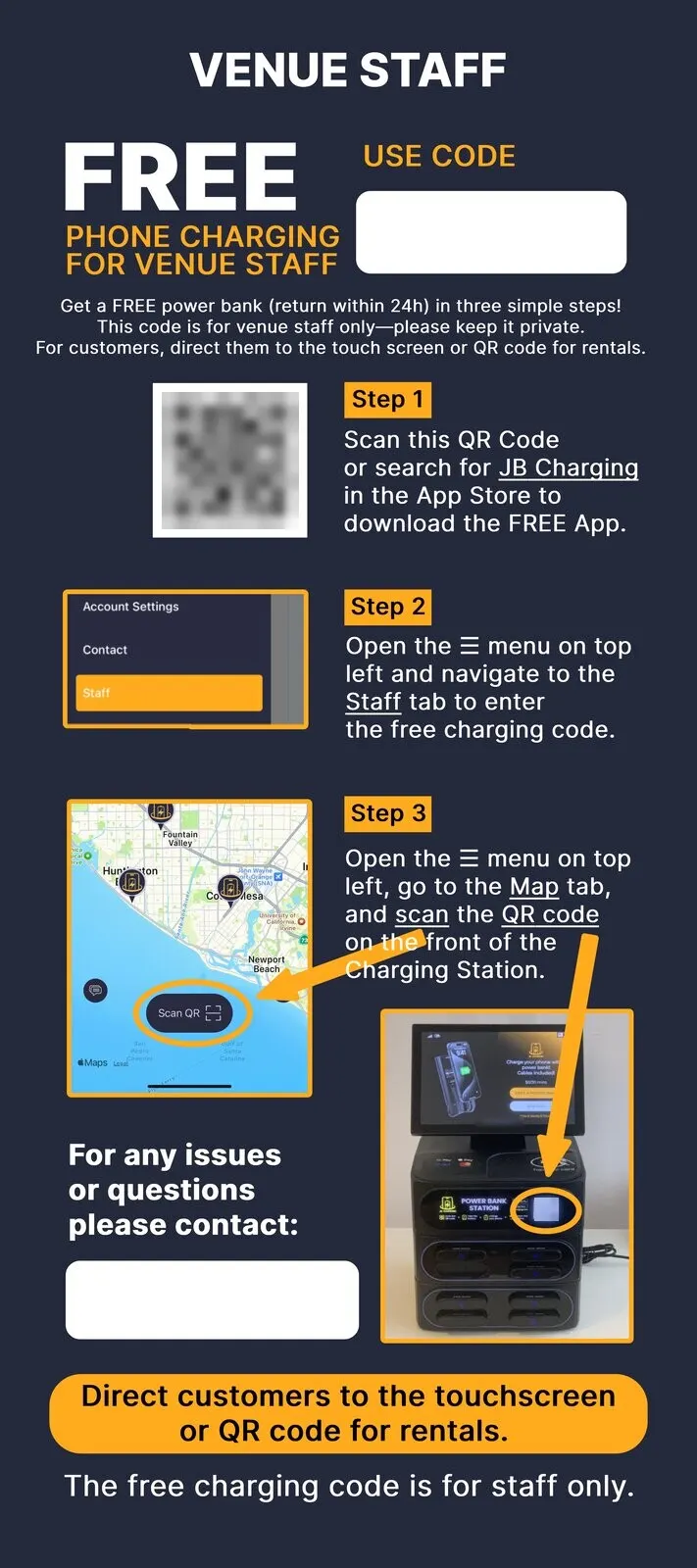
Staff, too. Up to 20 staff per station can register with the staff code for a free rental each day, within a weekly limit. Sign up registration clerks and security officers first: families ask them where to charge.
Put the deal on one page:
- term: a 90-day pilot, then 12 months
- the fee, and when billing starts
- free period, rate and daily max after it, non-return terms
- slide approval; off-limits sponsor categories
- who cleans what, how often; whether banks may leave waiting areas
- insurance wording, reporting, and how either side exits
The standard venue agreement runs 6 months, then month to month on 30 days' notice, so write the 90-day exit into it too.
The fee math: what a monthly payer covers (hypothetical)
None of these fees is guaranteed: a payer can decline, offer less or not renew. Assume monthly costs of $40 per J8 Pro and $60 per J24 Pro for service visits, cleaning supplies and replacement banks (banks list at $200 for 10). Insurance, credentialing and your time come on top. The table treats the whole fee as yours; check your agreement.
| If the payer pays | Station cost | Left after monthly costs | Months to cover the station | After 12 months |
|---|---|---|---|---|
| $100 a month, one J8 Pro | about $1,235 | $100 − $40 = $60 | about 21 | $515 short |
| $100 auxiliary + $100 screen sponsor, one J8 Pro | about $1,235 | $200 − $40 = $160 | about 8 | $685 ahead |
| $250 a month, one J8 Pro | about $1,235 | $250 − $40 = $210 | about 6 | $1,285 ahead |
| $400 a month, one J24 Pro, main lobby | about $3,550 | $400 − $60 = $340 | about 11 | $530 ahead |
Station costs are list prices at the time of writing, plus shipping as shown at checkout.
The first row is the lesson: at $100 a month, one year doesn't cover the station. Add a second payer (row two), a two-year term or a higher fee.
Set your floor before you quote: station cost ÷ months in the agreement + monthly costs. For one J8 Pro over 12 months, $1,235 ÷ 12 + $40 ≈ $143, so quote at least $150; over 24 months, about $91. If any of the fee is shared, raise the floor to match. To the payer, $250 a month is about $8 a day. How to price power bank rentals covers the rate after the free hour.
Start with one waiting room
Pick the ER waiting room or the surgical family waiting area: long waits, and a desk that can point families to the station. Run a test rental at the exact spot first, since thick walls can weaken cell signal.
Pilot terms: 90 days, billed from day one. A reduced fee is fine, but a free pilot teaches the payer the program is worth $0. Report weekly for a month, then monthly: whether the station stayed online, banks still out, complaints, and a photo of the sponsor slide running. Write the renewal trigger now: if the station stays online and patient experience logs no complaints, the pilot rolls into the 12-month term unless either side gives notice by day 75. If it ends at day 90, the station is still yours to place elsewhere.
Then add a station in the main lobby or cafeteria, where families pass on the way out. Banks go back to any free slot at any JB Charging station, so a bank that went upstairs can come back that way. A lobby can take a J24 Pro tower.
Hospital objections and how to answer them
"Why pay every month when we could buy a cable station once?" Cables tie families to one chair, and they walk off. A bank goes back to the seat, you restock and service the station, and the sponsor's name is on screen daily. A bank kept past the non-return window is billed to its renter, never the hospital. Send them charging lockers vs power bank rental to compare.
"We already have a charging vendor." Ask when that agreement renews and whether it covers every building. Offer a room or campus it doesn't cover, ask to be the second quote at renewal, and don't criticize the incumbent.
Next step
Have a hospital in mind? Book a call and bring its name, who you know there, and three questions: fully free rentals, our cleaning guidance and the usage report you'll send the payer. To compare the J8 Pro and the towers, see the stations.
Examples are illustrative only, not a forecast or a typical result. What a station earns depends on the venue, placement, pricing, local demand, and how actively you run it.
Frequently Asked Questions
Can phone charging in a hospital be free for patients and families?
Yes, within limits you set. Pricing is set per station, and you can add an opening free period of up to 60 minutes to every rental, so a family pays nothing if the bank is back within that time. After that, the station's rate and daily maximum apply, so keep both low in a hospital. Families still tap a card or phone to start, which is what lets the non-return fee work. The hospital, its foundation or a sponsor can pay you a flat fee for running it, agreed in writing. If a hospital wants every rental free with no time limit, check with JB Charging before you promise it.
Who pays for free phone charging in a hospital?
Look to three budgets: the hospital's patient experience or guest services budget, its foundation or auxiliary (funded by donations and, often, gift-shop proceeds), or a local sponsor such as a credit union whose name appears on the station screen. The payer pays a set amount monthly or yearly, agreed in writing, and there's no JB Charging list price for it. How that fee is billed, and whether any of it is shared, depends on your distributor agreement, so confirm it with JB Charging before you quote. None of these payers is guaranteed to say yes.
How much should an operator charge a hospital for free phone charging?
There's no JB Charging list price; you and the payer agree it in writing. Work up from a floor: the station's cost divided by the months in the agreement, plus your monthly costs for service visits, cleaning supplies and replacement banks. If any of the fee is shared under your distributor agreement, raise the floor to match. Bill from the first month of the pilot, and treat renewals and paid time past the free hour as upside.
What happens if a family takes a power bank home or up to a patient's room?
Banks can be returned to any free slot at any JB Charging station, so a second station in the main lobby or cafeteria, where families pass on the way out, makes returns easier. By default, if a bank isn't back within 24 hours, the renter's card is charged a $40 non-return fee, and the hospital is never charged. The window and the fee are set per station. In a hospital, agree gentler terms with the patient experience team, decide whether banks may leave the waiting areas, and post both on the screen.
What paperwork do hospitals ask charging station operators for?
Expect a certificate of insurance naming the hospital, so carry your own general liability policy. Many hospitals also require vendors who come on site to register in a vendor credentialing system, which commonly asks for a background check, a W-9, HIPAA training and a seasonal flu shot for non-clinical areas. Infection prevention will ask how and how often the station and banks are cleaned, and facilities will check that the station sits out of corridors and exits.
Do hospitals provide phone chargers?
Some offer wall outlets or a charging station in their waiting areas; in others, families end up asking staff for a cable. For an operator, that gap is the opening. On your first visit, see what the ER and surgical waiting rooms have now and ask the desk how often families ask to charge. Where free charging already exists, ask who paid for it: that budget may fund yours.

