How to Set a Power Bank Rental Price for Each Venue
JB Charging Team

Start every new station at the default power bank rental price, $3 per 30 minutes with a $20 daily maximum, then adjust it to the room. Charge more where the need is urgent and late, price by the hour where people wait for hours, and give a free hour only when someone else pays for it. Price it well and the same box brings in more: if a busy bar station keeps 4 of every 5 renters after a move from $3 to $5 per 30 minutes, your 80% share grows by a third.
Renting a bank rather than running a station? The price is on the screen before you tap; see how it works.
The settings you control on every station
You set pricing per station in the Stations section of your portal, and the screen shows the price before anyone taps.
| Setting | Default | What it does | When to move it |
|---|---|---|---|
| Rate | $3 per 30 minutes | Price per 30 minutes, per hour or per day. The portal accepts cents, like $3.50. | Per hour for long waits, per day where nobody wants to watch a clock, cents for small test steps. |
| Daily maximum | $20 | The most a renter pays in a day. | Raise it with the rate. Lower it where people keep banks all day. |
| Free first period | None | 0 to 60 free minutes at the start of every rental. | Two or three minutes for mistaken taps. A full hour only when a venue or sponsor pays for it. |
| Non-return | $40 after 24 hours | The renter is charged the fee and keeps the bank. The venue is never charged. | Rarely. See below. |
| Staff code | One free rental a day | For staff who register with the station's code: up to 3 in any 7 days, up to 20 staff per station. | Sign staff up at install and tell them the limit, so they can answer "how much is it?" |
Why start at the default power bank rental price
You don't know a venue until a station has been in it for a few weeks, and the default is a clean baseline: a price guests take in at a glance, $6 for an hour, and a $20 ceiling on a bank kept all day. Change it sooner and you'll never know whether the change helped.
After that, move. Some operators charge well above the default where demand is high, such as $10 per 30 minutes, and in our experience busy late-night bars are where it happens most. There, a dead phone can mean no ride home, and a couple of dollars matters less than getting one. Once you have a baseline, read the station:
- Test a step up when the portal flags it low on or out of banks on busy nights, banks stay out for hours, and staff hear no complaints.
- Hold when rentals are steady, banks come back and the manager is happy.
- Leave the price alone when a station barely rents at the default. That's usually the venue, the spot or a station that's offline, and no price fixes it. See when to move a charging station.
- Add free minutes or switch to hourly when guests wait for hours, or when a venue or sponsor will pay for free time.
Too cheap costs more than you'd think
Underpricing costs you three ways.
It can look untrustworthy. On an unfamiliar machine, a too-low price can read as a gimmick. One competing network's public operator training describes an arena whose stations sat in poor spots, without signs, at a very low price. The fix moved them to the entrances, added signs, promoted them on the arena's screens and raised its prices. The network reports that revenue went up, and its lesson was that too-cheap pricing looks low quality. Four things changed at once, though, so nobody knows how much came from price, which is why the test at the end changes one thing at a time.
It empties the station. When a whole evening costs next to nothing, renters keep banks long after their phones are full, and the guest who needs one at 1am finds the station empty. Per-30-minute pricing gives people a reason to bring banks back.
It costs the same to serve. A $1 rental wears a bank just like a $5 one. You keep 80% of what the renter pays. Any venue share comes out of that, and so do your own costs: banks, travel, upkeep and taxes.
Overpricing has a cost too. Guests complain to the bartender, not to you, and a manager who hears "that charger is a rip-off" every weekend can ask you to take it out.
How many rentals a price rise can cost
The rule: if renters keep banks just as long, a price rise pays as long as the share of renters you keep is higher than the old price divided by the new one.
| Move, per 30 minutes | Each rental brings in | You're ahead if you keep more than | So you can lose up to |
|---|---|---|---|
| $3 to $3.50 | 17% more | 86% of rentals | about 1 in 7 |
| $3 to $4 | 33% more | 75% | 1 in 4 |
| $3 to $5 | 67% more | 60% | 2 in 5 |
| $3 to $6 | twice as much | 50% | half |
A percentage venue share shrinks both sides equally, so it doesn't change this table. A higher rate can also shorten rentals, so the test below judges total revenue.
Your daily maximum does change the math. At $3 the $20 cap doesn't bite until 3 hours; at $5 a renter pays the same $20 for 2 hours or all day. Raise the cap with the rate, and keep the ladder in order: one block costs less than the daily max, which costs less than the non-return fee, so returning the bank is always the cheaper choice.
Picture a busy late-night bar. Say 10 renters each pay for two half-hour blocks. At the default they pay $60 and your 80% is $48, before any venue share and your own costs. Move to $5 per 30 minutes and say 8 of the 10 still rent: they pay $80 and your 80% is $64, a third more from fewer rentals. Plenty of stations rent far less often than a busy bar, but the percentages hold at any volume. The bad case: if only 5 of the 10 still rent, you keep $40, $8 behind the default. A month of data shows it, and you set the price back.
Card processing, 4G data and the software come out of JB Charging's 20%, so you keep 80% whatever the price. Your own costs, such as fuel, your time and banks that walk off ($200 per 10 at list price at the time of writing), don't change with the price, and slow weeks hit both prices alike, so revenue decides the test. For what a station nets after costs, use the worksheet in how much a phone charging kiosk can make.
Pricing by venue type: a decision table
These are starting approaches, not predicted results. Treat each one as a test.
| Venue | Start here | Free minutes | Watch for |
|---|---|---|---|
| Late-night or tourist-district bar | Default for a baseline, then test a step up | None, or two or three for mistaken taps | An empty station before close. Banks out for hours can mean the price is too low. |
| Nightclub or lounge | A price the GM has agreed to; step up once it runs out of banks on busy nights | On a separate VIP-room station, if the house pays | Complaints landing on door staff. Banks leaving at close. |
| Hotel lobby | Default, or per hour | Up to 60 minutes, if the hotel pays for it as an amenity | Banks going up to rooms overnight. Keep the non-return window at 24 hours or longer. |
| Mall or food hall | Default | Only if the center pays | A monthly placement fee, if the mall charges one. Count the rentals it takes to cover it before you sign. |
| Family entertainment or youth sports | Per hour, so a 3-hour wait isn't 6 blocks | A first hour paid by the venue or a sponsor | Parents doing the math on a long session. |
| Hospital or urgent care | Plan on the facility or a sponsor paying | First hour free, paid by the facility or a sponsor | A paid-only station nobody uses. |
| Dealership lounge, salon or laundromat | Default, or per hour for long services | A first hour, if the business pays you a monthly fee | Long services that run renters into the daily max. |
| College library or student union | Plan on a sponsor paying, with a low daily max for overnight keeps | A sponsor-paid first hour | A paid-only station whose banks never leave. |
| Event or festival | Short events: default. All-day: a per-day price or a lower daily max | A sponsored first hour | Banks leaving with attendees. Run a test rental on your own card before gates open. |
Free minutes and sponsored charging
Free minutes have two good uses.
A grace period. With two or three free minutes, a guest who taps by mistake and puts the bank straight back pays nothing, and nobody has to ask for a refund.
A free hour someone else pays for. In hospitals, family centers, VIP rooms and sponsored events, a free first hour can get you in the door. Price it from what the paid version would bring in: rentals a month × $6 × 80%. Say a family entertainment center wants the first hour free, and you'd expect 20 one-hour rentals a month at the default. Renters would have paid $120, and $96 of it would have been yours. Free charging gets used more, and every rental wears a bank, so quote the venue or a sponsor a monthly fee well above the $96 you'd give up, on your own invoice and in writing. There's no JB Charging list price for it. Rentals that run past the free hour bill at your normal rate. The family entertainment center playbook works through a full deal.
Put the sponsor's name on the screen. Sponsors don't come with the station: you find and sell them yourself, it takes time, and some rooms won't support one at all. Free all day, with no clock at all, isn't a standard setting, so ask us before you promise it.
Non-return settings
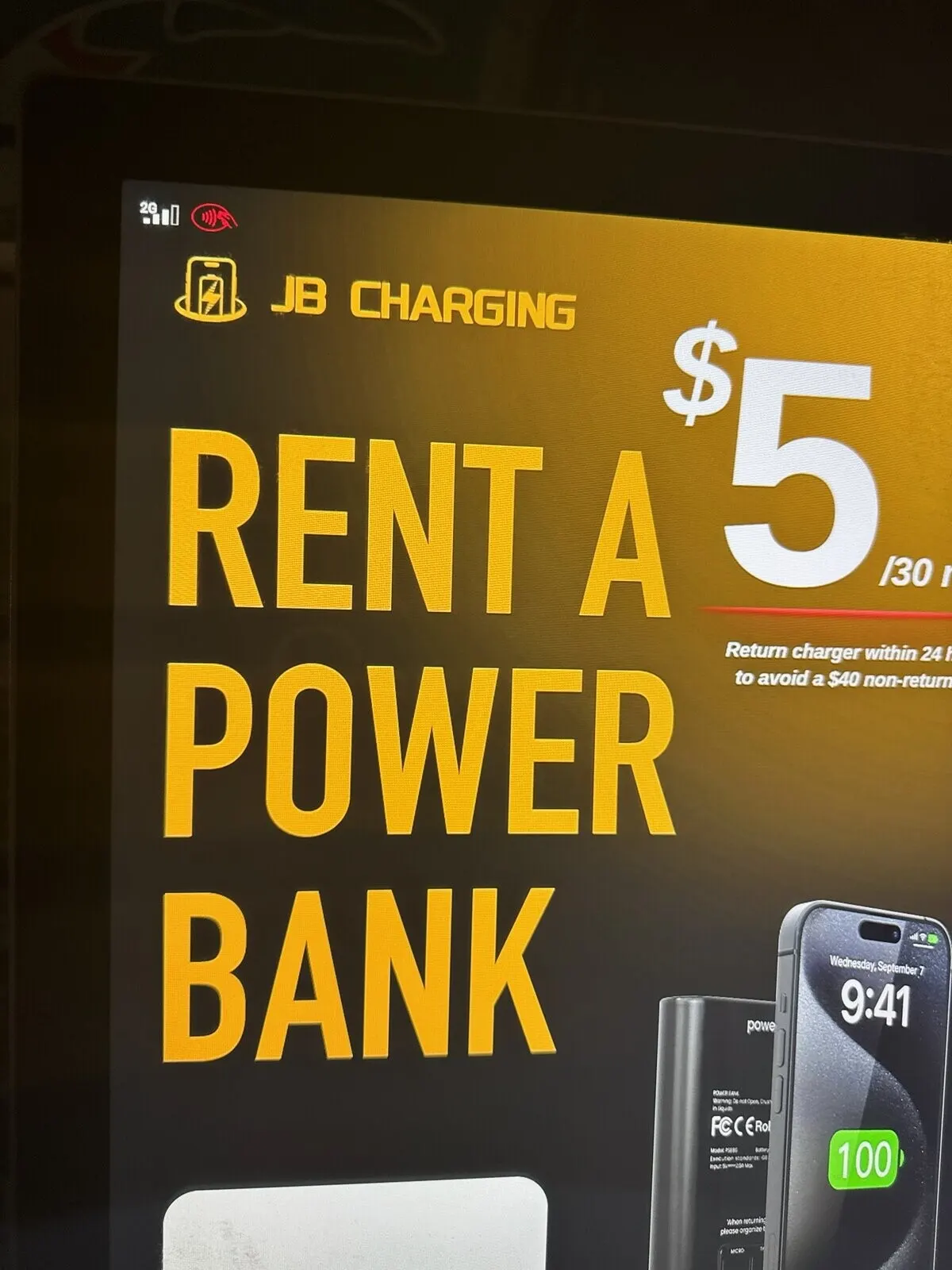
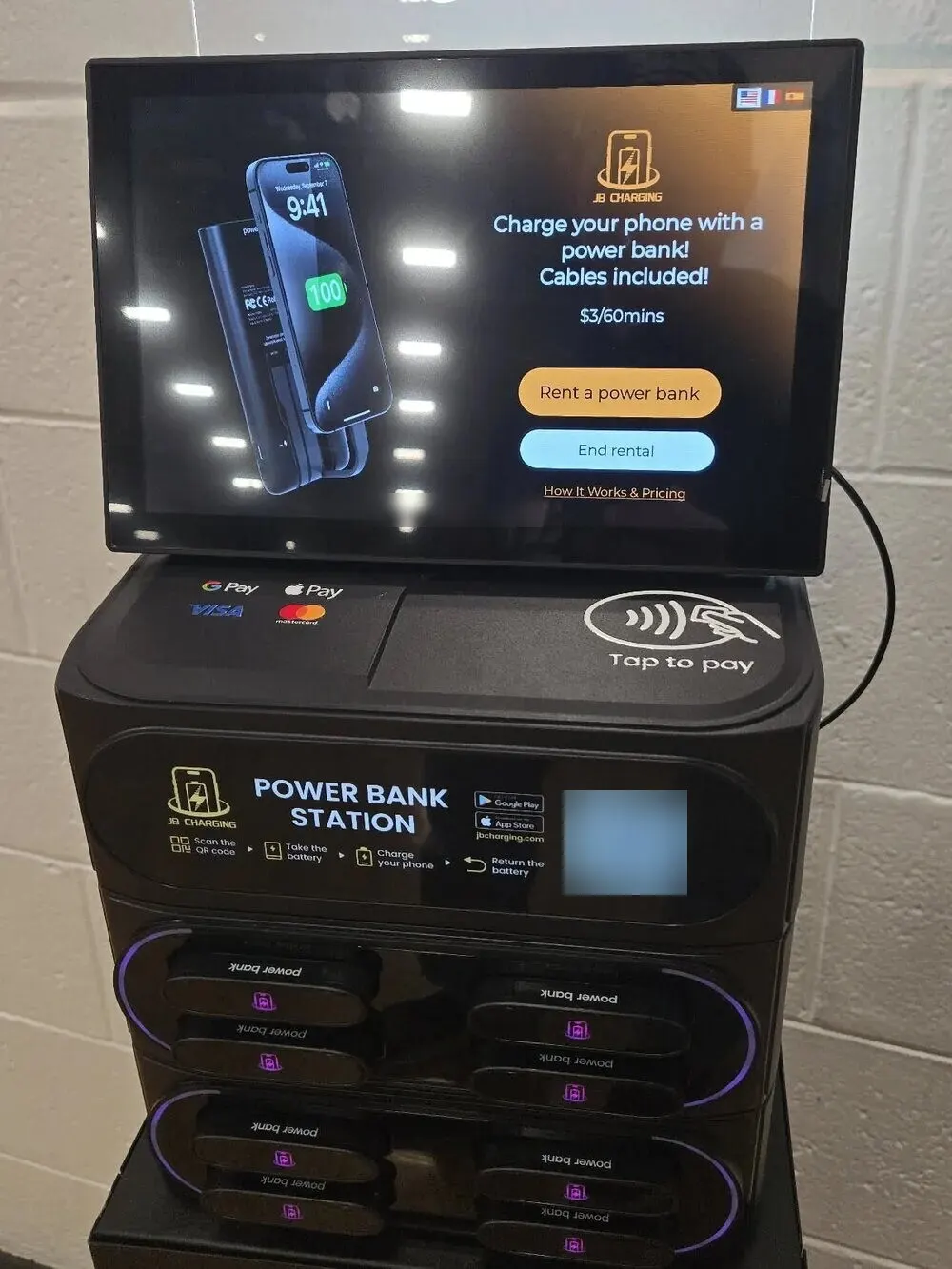
By default, a renter who hasn't returned a bank within 24 hours is charged a $40 non-return fee and keeps the bank, and the venue is never charged. You can change the window and the fee per station. If you do, keep the fee above your replacement cost (about $20 a bank at list price at the time of writing) and above your daily max, and never so low that keeping your bank beats buying one at a drugstore. Consider adding the fee to your screen artwork, as the station pictured above does, and update any price in your artwork whenever you change it in the portal. More in lost power banks and what non-returns really cost.
How to test a price change
- Get a baseline. Run the current price for a full month, or two full weeks at a station that rents several times a night. At a few rentals a week, a swing of 3 or 4 either way is noise, so treat a small difference as no difference.
- Change one setting: the rate, the max or the free minutes. Never two at once, and never while you're also moving the station.
- Tell the venue manager and staff before the new price shows, then run a test rental on your own card to confirm the screen and the charge match what you set.
- Hold the new price as long as the baseline ran, and don't compare a holiday weekend with a normal one.
- Check the portal. Venue Insights shows each venue's 7- and 30-day revenue and trend. Active Rentals flags staff rentals, which are free, so leave them out of your counts.
- Decide on revenue, not rental count. Use the break-even column to read it early: moving $3 to $5, you need to keep more than 6 of every 10 renters. If revenue is down, put the price back and try a different lever.
- Log it in one line: date · station · old → new setting · rentals and revenue, before and after · decision.
Next step
Pick one station, note its price and its last 30 days of revenue, and choose one change to test. To try prices and rental counts across your route, or before you buy, use the revenue calculator. It shows what renters pay, before our 20%, any venue share and your costs. To talk through pricing for a specific room, book a call with our team.
Examples are illustrative only, not a forecast or a typical result. What a station earns depends on the venue, placement, pricing, local demand, and how actively you run it.
Frequently Asked Questions
How much does it cost to rent a power bank?
At a JB Charging station, the operator who runs it sets the price, and it shows on the screen before you tap. The common default is $3 per 30 minutes with a $20 daily maximum. Prices vary by station: some charge more where demand is high, and some give the first minutes free.
What should I charge for power bank rentals?
Start at the default, $3 per 30 minutes with a $20 daily maximum, and run it for a full month (two weeks at a busy station) to get a baseline. Then change one setting at a time to fit the venue, and judge each change on revenue, not rental count.
How much of the rental price does the operator keep?
80% of what renters pay. JB Charging keeps 20%, which covers card processing, 4G data, the software and support, and there are no monthly fees. Any share you agree to pay the venue comes out of your 80%, and so do your own costs, such as equipment, travel, upkeep and taxes.
Can I make phone charging free at a venue?
Partly. An operator can set each of their stations to start every rental with a free period of up to 60 minutes; normal pricing applies after that. Someone, such as the venue or a sponsor, should pay for that free time under a fee you agree in writing. Fully free charging all day isn't a standard setting, so ask JB Charging before you promise it.
What happens if a renter doesn't return the power bank?
By default, if a bank isn't back within 24 hours, the renter is charged a $40 non-return fee and keeps the bank. The venue is never charged. Operators can change both the window and the fee on each station. Keep the fee above what a replacement bank costs you.
Do venue staff have to pay to use the station?
Staff who register with the station's staff code get one free rental a day, up to 3 in any 7 days, for up to 20 staff per station.

