
Phone Charging Stations for Hospitals and Waiting Rooms
Families rent a charged power bank with a tap, and under our standard terms a local operator installs and services the station at no cost beyond electricity.
Updates reach a charged phone
Families keep charging in the waiting-room chair or the cafeteria line. The phone that takes the surgeon's call and arranges the ride home lasts through the wait.
No cables to lend or chase
Families tap a card or phone, take a bank with Lightning and USB-C built in, and return it themselves. Staff stop holding phones at the desk and lending cables.
Fund a free hour for families
Your hospital, its foundation or a sponsor named on the screen pays the operator an amount agreed in writing, and every rental starts with up to an hour free.
A phone charging station for hospitals keeps families' phones alive through long waits, without your staff's help. Families tap to rent a charged power bank and drop it in any slot on the way out. They pay per rental, or the hospital, its foundation or a sponsor funds a free first hour.
Why families run out of battery at the hospital
Nobody packs a charger for an emergency. Picture 9:40am in the surgical family lounge. A man's wife went back at 7:30, and the surgeon will call his cell when she's out. It has relayed updates all morning. It's at 11%, and the outlet by his chair is taken.
- Long waits. From October 2024 through September 2025, the national median time in the ED was 162 minutes for patients sent home and 287 minutes for patients transferred to another facility (CMS data). Many visits run far longer.
- The phone is the update line. It takes the surgeon's call and, on a maternity floor, every video call home. A charging locker holds the phone away just when the surgeon might call, and a cable station keeps families by the wall; a power bank charges it in their hand.
- Bedside outlets belong to equipment. A visitor hunting for a socket can unplug a pump or monitor.
- The nurses' station becomes a charging desk. Staff end up holding phones on borrowed cables.
How a family rents a power bank
- Tap a card or phone (Apple Pay, Google Pay or contactless), or scan the QR code. No app or account.
- Take a charged bank with Lightning and USB-C cables built in.
- Keep it with you in the waiting-room chair or the cafeteria line.
- Return it to any free slot at any JB Charging station.
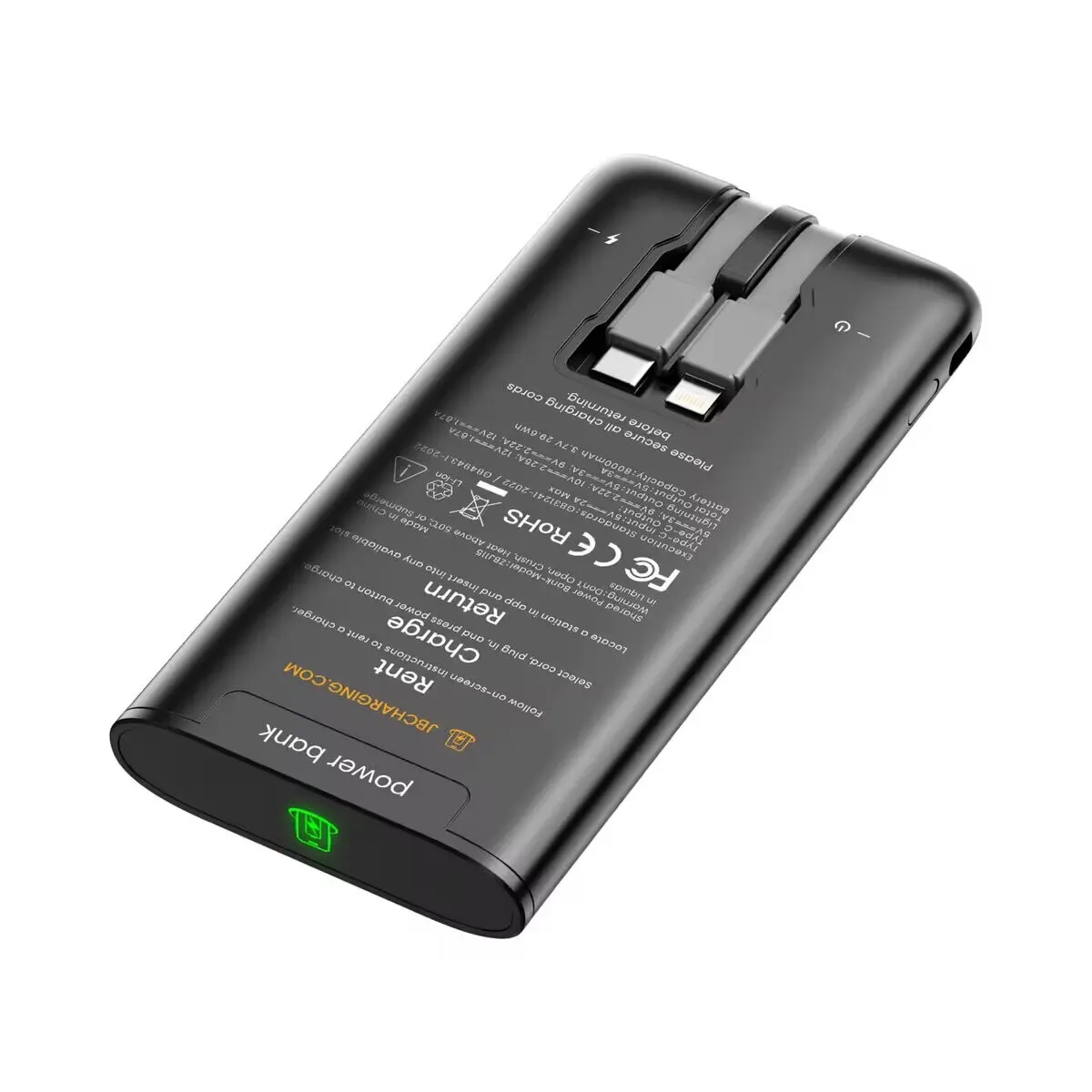
Operators set each station's price. At the default of $3 per 30 minutes with a $20 daily maximum, a bank kept through a three-hour wait costs $18. That's a lot to ask at 2am, hence the funded free hour (below).
Where to put a phone charging station in a hospital
Put it where families wait, in public space and in sight of a desk, never in corridors (exits and stretchers need them), treatment bays or patient rooms.
| Spot | Who's there, and when | Placement notes |
|---|---|---|
| ED waiting room | Patients and families, all hours | On a wall in view of registration, clear of triage and doors |
| Surgical family lounge | Families awaiting the surgeon's call | Beside the volunteer or information desk |
| Maternity family lounge | Partners and grandparents, overnight | In the lounge, or the nearest waiting area outside a locked unit, never the corridor |
| Main lobby | Visitors; discharged patients awaiting rides | By the information desk and seating, out of the entrance flow |
| Cafeteria | Families on a break | By the seating, away from the tray line |
Leave room for a wheelchair at the screen and reader. Skip short-visit clinics, garages and elevator lobbies; an upstairs station belongs in a family lounge near the inpatient elevators.
Which station fits your hospital
| Hospital | Start with | Add a station when |
|---|---|---|
| Critical access or small community | One J8 in the ED waiting room | Families elsewhere ask staff where to charge |
| Community hospital with surgery and maternity | One J8 in the ED or surgical lounge | It runs short of charged banks most evenings: add the other lounge, then a lobby J24 |
| Large medical center | A J24 in the ED waiting room | It earns its spot: add J8s in the surgical and maternity lounges, then a lobby J24 |
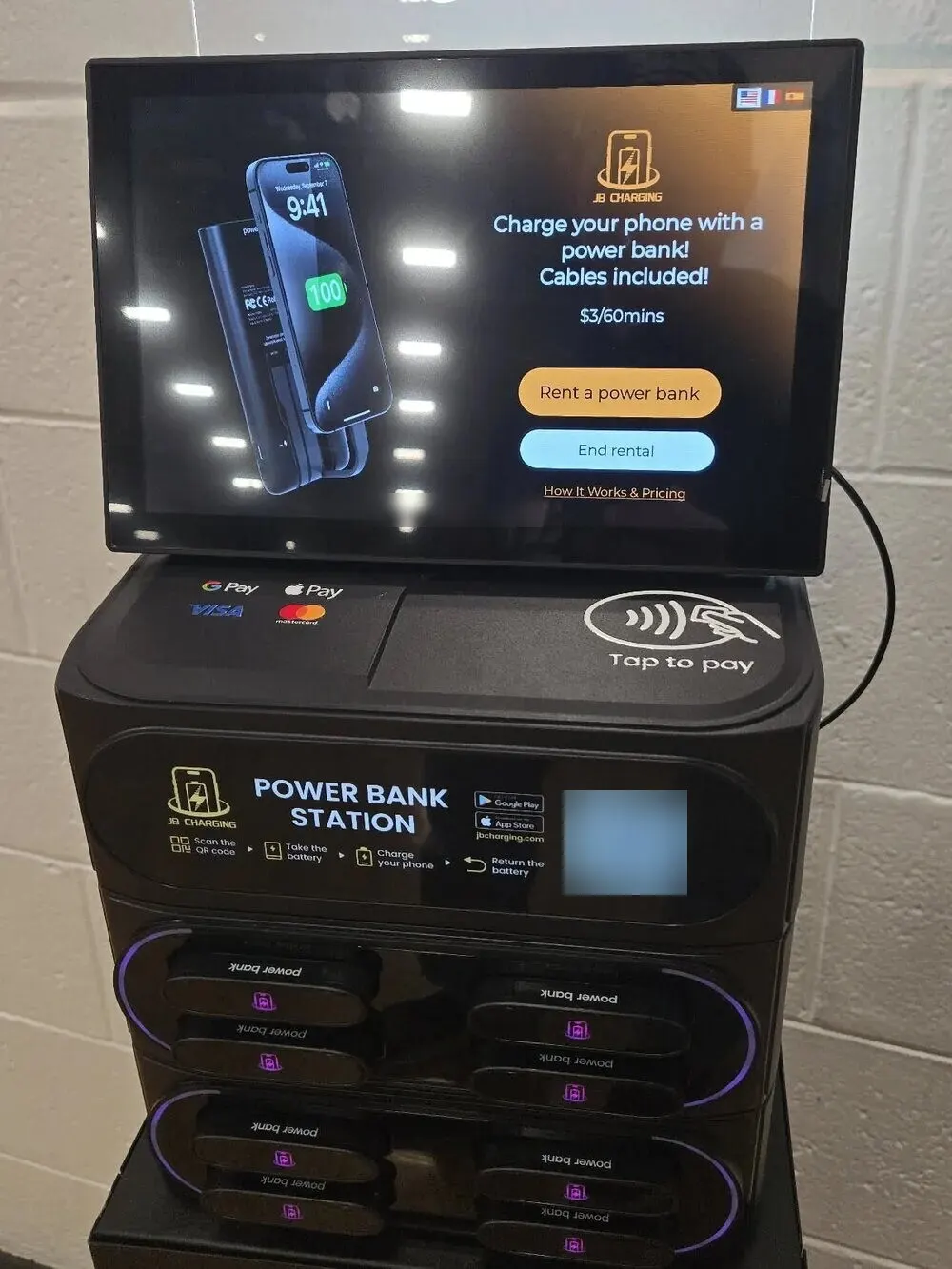
- J8 Pro: 8 banks, about 9 x 9 inches and 16 inches tall, 10-inch touchscreen; counter, stand or wall mount.
- J24 Pro: 24 banks in a 71-inch tower on a 14 x 18-inch footprint, 24-inch screen.
- J48 Pro: 48 banks, built to order.
What your staff, facilities and IT teams do (and don't)
- Clinical and desk staff: no rentals to run. Families get help from JB Charging, not your desk, and a bank left behind goes in any free slot. One line at registration covers it: "Phone low? Tap a card at the station by the windows and take a bank." Staff can use the station's staff code for a free rental a day, within a weekly limit.
- Facilities: one standard outlet (not a red emergency-power outlet), no extension cord, clear of exits. If you require a UL or ETL listing, raise it on the first call, before committee review.
- IT and privacy: nothing to connect; stations run on built-in 4G. A rental asks for no patient details, and the phone plugs into a battery, not a computer (is it safe?).
- Infection prevention: ask us about cleaning before install and check it against your approved disinfectants. Banks pass between families and aren't wiped between rentals unless someone does it, so agree in writing who wipes the screen, reader and banks, and how often. Decide where banks may go, and keep them out of isolation rooms and behavioral health units.
What it costs, and the agreement
Under our standard terms, hosting costs only electricity; any revenue share and the exit are agreed in writing before install.
| Option | Families pay | Who pays the operator | Hospital's cost |
|---|---|---|---|
| Hosted, paid rentals | The posted rate | Renters, plus any screen ads the operator sells | Electricity |
| Hosted, funded free hour | Nothing for the first hour of each rental, then the posted rate | Renters after the hour, plus the hospital, foundation or sponsor (amount agreed in writing) | Electricity, plus that amount if the hospital pays it |
| Hospital-owned | What you set, including up to an hour free | No operator: you service them, replace lost banks and keep 80% of rental revenue before costs (JB keeps 20%) | About $1,200 per J8 Pro or $3,300 per J24 Pro at list price at the time of writing, plus shipping; no monthly fees (stations and list prices) |
- Funding the free hour. There's no JB Charging list price. Ask your operator for a flat monthly amount, so the cost doesn't rise with use, and ask us first about longer free time or no charge at all.
- Who does the work. Where one serves your area, a local, independent operator on the JB Charging network supplies, installs and services the station; if none does yet, we'll tell you. You sign with that operator, who goes through your vendor onboarding. Write in how often they visit and who staff call if it's empty or down.
- Term and exit. Our standard template runs 6 months, then month to month on 30 days' notice, and removal costs nothing. The hospital isn't liable for visitor theft or misuse and hosts no competing charger during the term, so list any lockers you already have as excluded. Operators may propose other terms; what you sign governs. See our agreement checklist.
- The screen. Beyond the price and rent button, the operator controls it. Agree what may run (cafeteria hours, the sponsor's credit), what may not (injury lawyers, other health systems), and that marketing approves every slide.
Start with one waiting room. Request a station or ask for specs, photos and our standard agreement for your committees first. We'll reply with whether an operator serves your area, and the terms. Nothing is installed until you sign.
Run charging stations yourself? Read our hospital playbook for operators.
Frequently Asked Questions
How much does a phone charging station cost a hospital?
Under our standard hosting terms, it costs nothing beyond electricity, where an operator serves your area. The operator is paid from rentals and any screen ads it sells. A J8 runs on a 60-watt adapter, so even drawing that much around the clock it would use about 43 kWh a month, which is under $10 at 20 cents per kWh. A J24, rated at 160 watts, would use about 115 kWh, roughly $23 a month on the same assumption. To fund free charging time for families, the hospital, its foundation or a sponsor pays an amount agreed in writing with the operator. To own stations instead, list prices at the time of writing are about $1,200 for a J8 Pro and about $3,300 for a J24 Pro tower, plus shipping, with no monthly fees.
Can phone charging be free for patients and families?
Yes, for a set free period, if someone funds it. That can be the hospital's own budget, its foundation, auxiliary or volunteer guild, or a local sponsor credited on the station's screen. The operator can set a free first period of up to 60 minutes on every rental. After that the station's normal pricing applies, or a lower rate if you agree one. Families still tap a card or phone to take a bank, so a bank that isn't returned is charged to them, never to the hospital. JB Charging has no list price for the funding. If you want longer free time or no charge at all, ask us what's possible in your area before you plan on it. The amount, what it covers and the non-return terms are agreed in writing before install.
Does the station connect to our network or collect patient information?
It doesn't need your network. Stations run on built-in 4G, and Wi-Fi is only an optional backup for weak-signal rooms. A tap rental needs no app or account, so it asks for no name, room number or anything about the patient. The phone plugs into the power bank's built-in cable, which connects it to a battery, not to a computer or any hospital system.
How is the station cleaned, and what will infection prevention need?
Ask us about cleaning before install, so your infection-prevention team can check it against the disinfectants you already use. Then agree in writing who wipes the screen, card reader and banks, and how often: the operator on service visits, your environmental services team on its rounds, or both. Banks pass from family to family, so decide whether they may leave the waiting areas. If they may go to patient floors, keep them out of isolation rooms and behavioral health units, where cords are removed. Stations belong in public waiting areas, not in treatment bays or patient rooms.
What if a family takes a power bank up to the room, or home?
Families can return a bank to any free slot at any JB Charging station, including another one in your hospital if you have more than one. Your infection-prevention team decides where banks may go inside the building. A bank that isn't returned is charged to the renter, never to the hospital. By default the renter pays a $40 non-return fee after 24 hours and keeps the bank. The operator sets the window and the fee per station, so a maternity unit with longer stays can ask for a longer window.
Is JB Charging insured, and can our hospital be named on the certificate?
JB Charging carries general liability insurance of $2 million per occurrence. On request, your hospital or health system can be named as an additional insured on JB's policy. Your operator is an independent local business that owns and services the station, so ask them for their own certificate too, as you would with any vendor on site. Send us the exact entity names your risk team needs.
What about lithium batteries and fire codes?
The power banks carry FCC, CE and RoHS markings and charge in their own slots in the station. The station plugs straight into a standard wall outlet with no extension cord, and it stays out of corridors, exits and doorways. If your facilities team, insurer or fire marshal requires a UL or ETL listing or another safety document, raise it on the first call, before your committees start their review.
Who usually needs to approve a charging station at a hospital?
Often several people: patient experience or guest services, facilities, infection prevention, and risk or insurance, plus the foundation if it's funding free time. Larger systems may also put the operator through vendor onboarding. Tell us who signs off and we'll send specs, photos and our standard venue agreement for their review.