What to Check Before Signing a Phone Charging Station Agreement
JB Charging Team

A fair phone charging station agreement costs your venue an outlet and a few square feet, lets you leave cleanly, and leaves the risk with whoever owns the station. Three things should stop you cold: a long lock-in, any fee to the venue, and vague terms for removing the station.
On our network, three parties are usually involved: you; a local, independent operator who owns, stocks and services the station; and us, running guest payments, renter support, payouts and the insurance you can be named on. The operator often sends our standard venue template from their portal, and that template is the example below. Operators can change it, so check the paper in front of you, not the pitch you heard. And skip the handshake deal: the share, the exit and the insurance only exist in writing.
The phone charging station agreement checklist
| # | Clause | Fair looks like | Red flag |
|---|---|---|---|
| 1 | Cost | Nothing beyond electricity; the guest price is on the screen, and you hear before it changes | Any fee to you: install, service, "connectivity," removal or lost banks |
| 2 | Term and exit | 6 months, then month to month on 30 days' notice; free removal by a date you agree on | A multi-year term, auto-renewal into a new full term, an exit fee, removal "within a reasonable time" |
| 3 | Ownership and service | The operator owns, stocks and fixes it and is named with a phone number; the venue isn't liable for guest theft or misuse | No named person, or your staff are expected to fix or restock it |
| 4 | Insurance | A certificate with your venue as additional insured, plus the operator's own certificate | "We're covered," with nothing on paper |
| 5 | Revenue share | Any share written as a number with its base, paid monthly by direct deposit with a statement | A verbal promise, a percentage with no base, cash "when I come by," no statement |
| 6 | Placement | The spot is named, plugged straight into a wall outlet, out of exit paths, moved on request | "Wherever it fits," extension cords, drilling your landlord hasn't approved |
| 7 | Staff | None; the station runs without staff | Staff handle refunds, resets or missing banks |
| 8 | Exclusivity and screen | Rival rental stations only, during the term, at this address; you know what the screen runs | It outlasts the agreement, covers your own outlets or binds all your locations |
Where the fair column goes beyond our template, such as a removal date, it's an ask worth making of any operator, ours included.
1. Cost: yours and your guests'
Our standard template: no cost to the venue except electricity, from a standard 110V outlet. The station runs on its own built-in 4G, with Wi-Fi only as a backup, so there's usually no IT ticket.
Electricity has a hard ceiling. The table assumes full rated power every hour of a 30-day month, at July 2026 commercial rates: 14.53 cents per kWh for the U.S. average and 24.18 cents for New York (EIA Table 5.6.A; it updates monthly). Swap in the rate from your bill.
| Station | Rated power | kWh a month at full draw | At 14.53¢ (U.S.) | At 24.18¢ (New York) |
|---|---|---|---|---|
| J8 Pro (countertop) | 60 W | 43 | $6–8 | $10–12 |
| J24 Pro (tower) | 160 W | 115 | about $17 | about $28 |
| J48 Pro (tower) | 290 W | 209 | about $30 | about $50 |
The J8's rating is its power adapter's output, so its range allows for adapter losses.
The operator sets your guests' price per station. The common default is $3 per 30 minutes with a $20 daily maximum, shown on the screen. Ask what guests will pay, and ask to hear about changes before they happen. A lower price, or a free first period of up to an hour, is also a per-station setting.
2. Term and exit
Our template runs 6 months, then month to month. After that, 30 days' notice ends it, and the equipment is removed at no cost to you.
Say you sign in March and want that wall back in October for a renovation. Under our template, you give notice on October 1, the agreement ends 30 days later, and removal costs you nothing. Now run the same month under a 3-year agreement that renewed itself because nobody caught the 30-day objection window, with a $500 early-exit fee and removal "within a reasonable time." You pay $500, and your contractor works around a 73-pound tower until the operator gets to it.
"Within a reasonable time" isn't a date. Our template says removal costs you nothing; ask the operator to add the date: out by the last day of the notice period. A J48 weighs about 130 pounds, so moving one isn't a job for your staff.
In the first 6 months, ask what leaving early would cost, if anything. Worth asking for: a line that lets you end early if the station sits offline or empty for 2 weeks after you've told the operator.
3. Who owns it and who services it
You're hosting equipment, not buying it. The operator owns the station and its power banks, keeps them stocked and handles repairs.
The agreement should give the operator's legal business name, a contact person, a phone number and an email. Ask what triggers a service visit. A good answer names who comes and when, such as their dashboard showing the station offline or low on charged banks; "we'll swing by regularly" isn't one. And ask what happens if the operator sells the station or stops servicing it: the new operator should sign with you, or you should be free to end the agreement on notice.
Our template says the venue isn't liable for third-party theft or customer misuse. In plain terms, a guest who walks off with a bank or cracks the screen isn't your bill. A renter who keeps a bank past the return window pays a non-return fee (by default, $40 after 24 hours; both are set per station) and keeps the bank. On our platform the venue is never charged, so strike any line that says otherwise.
Rather own a station? Then there's no hosting agreement at all; see hosting, buying and renting compared.
4. Insurance
JB Charging carries $2 million per occurrence in general liability and can name your venue as an additional insured on request. Ask the operator for their own certificate too.
When you ask, send your exact legal entity name as it appears on your lease, any other names your lease requires (your landlord or management company, say), and any insurance requirements sheet from your landlord or corporate office. Ask for the certificate and the additional-insured endorsement page back. The certificate alone isn't coverage: the standard ACORD 25 form says it confers no rights on the holder, and that an additional insured needs the policy endorsed (sample form).
Requirement sheets often go beyond general liability: workers' comp, an umbrella policy, a waiver of subrogation, 30 days' notice of cancellation. Not every certificate carries every line, so get a written yes on each one before you sign.
5. The revenue share, and how it's paid
Many venues host for free as a guest amenity; others negotiate a share of rental revenue. Don't let a share talk you into a longer term or a fee to leave. It's a bonus, not the reason to host. Get whatever you agree in writing as a number, even if that number is zero.
On our platform, any share is paid monthly by direct deposit with a statement once you've completed payout setup. Do the setup the day you sign.
Then ask what the percentage is a percentage of. Say, for round numbers, guests pay $100 at your station over some stretch, $5 of it is later refunded, and $10 is non-return fees. A share of gross is figured on the full $100; a share of rentals after refunds, not counting non-return fees, on $85. Same percentage, smaller base. Get both the percentage and the base in writing, along with whether it's figured per station or across every station at your address. Ask for a sample statement before you sign.
6. Placement and safety
Write the spot into the agreement, or attach a photo. A countertop J8 Pro sits on about 9 by 9 inches and stands about 16 inches tall before the lit header on top. A J24 tower takes about 14 by 18 inches of floor and stands nearly 6 feet; the J48 needs about 23 by 16 inches and stands close to 7 feet.
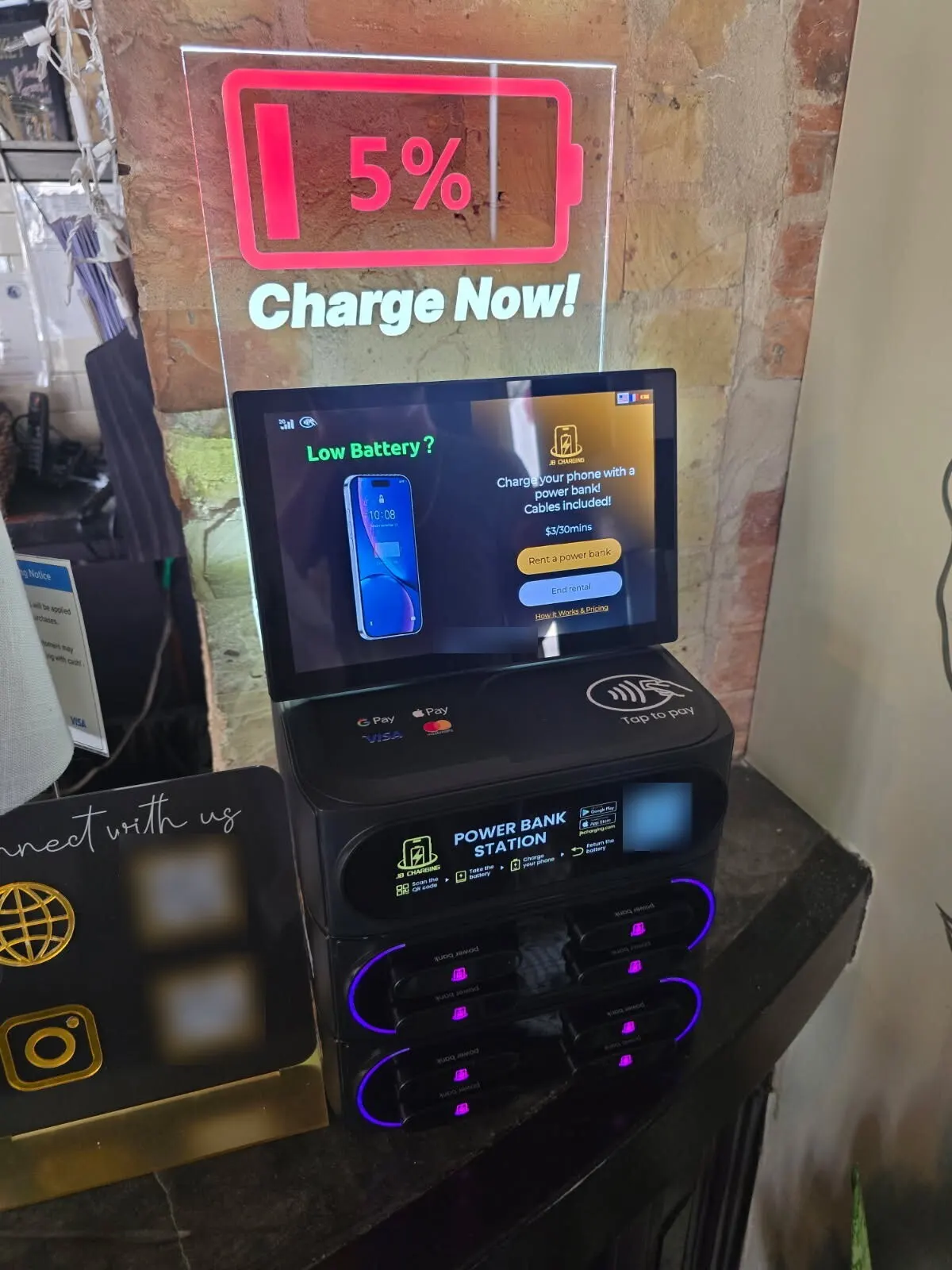
Plug it straight into a wall outlet and keep it out of every exit path. Skip extension cords: New York's fire code, for one, says they "shall not be a substitute for permanent wiring" (state fire-prevention bulletin). Set a tower with its back to a wall, which makes it harder to tip. The power banks carry FCC, CE and RoHS marks; if your insurer, landlord or fire inspector needs a specific listing or document, ask the operator whether the equipment has it before you sign.
Ask how it will be secured: on the counter, a floor stand or a wall mount. Drilling may need your landlord's OK, and the operator should patch any holes at removal. Add a line that the operator will move it within your venue on request if you rearrange.
7. What your staff do
Our template says the station runs without staff. Guests tap a card or phone, take a charged bank with the cables built in, and return it to any free slot. Staff who register with the station's staff code get a free rental each day, within a weekly limit.
Any staff duty in the agreement should be small and specific. Your team should never issue refunds, open the machine or chase missing banks. They need three answers: where the station is, that billing help is on the screen, in the app or on the receipt, and who to text when the station goes dark. Send them how power bank rental works before install day.
8. Exclusivity, and the screen
Our template asks the venue not to host a competing charger during the term. That's fair: a second rental station 20 feet away splits the same guests. Ask the operator to confirm in writing that this means a rival rental station, not your own USB outlets at the bar rail, cables at the front desk, or a phone locker you already have.
Exclusivity should also end with the agreement and, if you have several locations, bind only the address on it. Already host another charging vendor? Read that contract's exclusivity clause before you sign a second.
Beyond the price and the rent button, the screen is display space the operator controls and may sell to local advertisers. If you don't want a competitor's promo in your lobby, put that in writing, and ask whether your own promos can run there.
Questions to send before you sign
Paste this into an email to the operator:
Subject: Charging station agreement: 8 things to confirm before we sign
Before we sign, please confirm these in the agreement:
- Our only cost is electricity: no install, service, removal or lost-bank fees. What guests will pay, and that you'll tell us before it changes.
- The term and notice period; removal by the last day of notice at no cost to us; and our right to end early if the station is offline or out of charged banks for 2 weeks after we tell you.
- Your legal business name, a contact name, phone and email, what triggers a service visit, and what happens to this agreement if you sell the station or stop servicing it.
- Your certificate of insurance, and the network's if you run on one, each naming [our legal entity] as additional insured, with the endorsement pages. [Our insurance requirements sheet is attached.]
- Any revenue share as a percentage, what it's a percentage of, when it's paid, and a sample statement.
- The exact spot, how it's secured, that it plugs straight into a wall outlet, that you'll patch any mounting holes at removal, and that you'll move it within our venue if we rearrange.
- That our staff have no duties beyond pointing guests to the station.
- What the exclusivity covers, that it ends with the agreement, and what can run on the screen.
A fair operator can answer all eight in one reply. If one comes back vague, ask for a rewrite before you sign.
Next step
See how hosting works for venues like yours in phone charging by venue type, or ask for a copy of our standard venue template when you request a station below.
Examples are illustrative only, not a forecast or a typical result. What a station earns depends on the venue, placement, pricing, local demand, and how actively you run it.
Frequently Asked Questions
Does a phone charging station cost my venue anything?
Under our standard venue template, nothing except electricity from a standard outlet. Even drawing its full rated power around the clock, a countertop J8 Pro would use roughly $6 to $8 of electricity a month at the July 2026 U.S. commercial average rate. Operators can propose different terms, so check the agreement for install, service, removal or lost-bank fees.
How long does a charging station agreement last, and how do we get out?
Our standard template runs 6 months, then month to month. After that, 30 days' notice ends it, and removal costs the venue nothing; ask the operator to write in a removal date. Watch for multi-year terms, automatic renewal into a new full term, early-termination fees, and removal promised only "within a reasonable time."
What happens if guests walk off with the power banks?
On our platform, the venue isn't charged. A renter who keeps a bank past the return window pays a non-return fee (by default, $40 after 24 hours; both are set per station) and keeps the bank. Our standard template also says the venue isn't liable for third-party theft or customer misuse.
Can our venue be named as an additional insured?
On request, yes. JB Charging carries $2 million per occurrence in general liability and can name your venue as an additional insured; each request is handled individually. Send your exact legal entity name and any landlord requirements, and ask for the endorsement page along with the certificate. Ask the operator for their own certificate as well.
Can guests charge for free or at a lower price?
The operator sets the price per station. The common default is $3 per 30 minutes with a $20 daily maximum. You can ask for a lower price or a free first period of up to an hour. Both are per-station settings, so put what you agree in the agreement.
What should we check about safety before signing?
Where it plugs in and where it stands: straight into a wall outlet with no extension cord, out of every exit path, and a tower with its back to a wall. The power banks carry FCC, CE and RoHS marks. If your insurer, landlord or fire inspector needs a specific listing or document, ask the operator whether the equipment has it, and send your insurance requirements sheet, before you sign.