Trade Shows and Conferences: Sell the Charging Sponsorship, Not Just the Station
JB Charging Team

Conference sponsorship menus already sell the charging station sponsorship, at $425 to $6,000 in listings we checked in October 2026. The organizer sells the logo, then needs someone to bring and stock the stations and run the sponsor's creative. That can be you: if a show pays you $1,500 to supply two towers that cost about $7,500, five shows cover them. Below: who decides, how to price the deal, the convention-center costs that can sink it, and the lines to send.
Organizing the show? Our page for convention centers and show organizers is written for you.
What shows charge for a charging station sponsorship
- A water utility association's fall 2026 conference sold the logo on its one exhibit-hall charging station for $425.
- A plastics trade association lists its 2026 conference charging station sponsor at $5,000.
- A state music educators' convention lists branding on four charging stations at $6,000.
- A statewide solar and storage summit offered an exclusive charging sponsorship on two 48-slot stations with 43-inch screens and two 24-slot stations with 24-inch screens, free for attendees.
That last listing names the hardware. A J48 Pro (48 slots, 43-inch screen) and a J24 Pro (24 slots, 23.8-inch screen) can meet a spec like that. It also promises charging free for attendees, so check with us before you match that part.
Three ways to get paid, and the math
The $7,500: two J24 Pros at $3,299 list (at the time of writing) plus about $250 freight each, 10 spare power banks ($200) and a hand truck.
- Supplier. The show sells the sponsorship and pays you to deliver it: stations, sponsor creative, setup, stocking and teardown.
- Sponsorship seller. With the show's written OK, you sell it yourself; put any cut the show wants, and the power order, in writing. You keep 100% of the screen-ad revenue you sell; JB takes no share. But you have to find and close the sponsor yourself, and nothing guarantees one buys.
- Booth station. An exhibitor pays a smaller fee for a station that pulls people into its booth.
Quoting your fee. Cover your costs and the rentals the free hour gives away, so the trip pays even if nobody rents. Then check the show's own price. One selling the sponsorship at $5,000 can pay you $1,500 and keep $3,500; one selling it at $425 can't, so offer one J8 Pro or the seller deal.
Costs push five shows toward seven. Say it's a three-day hotel show 90 minutes away, and you bring two J24s and spend $400: $100 for gas and parking, $200 for a load-in and teardown helper, $40 for two replacement banks and a $60 sign. The show orders the power. Rentals are your 80%, before costs, insurance and taxes.
| Deal (assume $400 your costs) | Paid to you | Your 80% of rentals | Net per show, before insurance, taxes and your time | Shows to cover $7,500 |
|---|---|---|---|---|
| Supplier: $1,500 fee, first hour free courtesy of the sponsor; say $125 of rentals run past the hour | $1,500 | $100 | $1,200 | 7 |
| You sell the sponsorship for $2,500, the show takes 20%, same free hour | $2,000 | $100 | $1,700 | 5 |
| The show pays $750, no sponsor, and 100 people rent at $5 | $750 | $400 | $750 | 10 |
| Free spot, no fee, no sponsor, and 100 people rent at $5 | $0 | $400 | $0 | Never |
| The supplier deal, if you paid 24-hour power for two outlets and freight handling (about $1,400 before electrician labor and tax) | $1,500 | $100 | About −$200 | Never |
The fee carries the show; the free hour gives away most short top-ups. The last row, built from real 2026 show forms (below), is why power and freight go on the show's account in writing, or into your fee.
With J8s instead. Four J8 Pros from a 5-pack (about $950 each) plus two extra $150 stands run about $4,100. If a show pays you $1,000 and your costs are $250 (no helper, hand-carried where allowed), about six shows cover them, before insurance and taxes.
Between shows, park the kit at a venue that agrees in writing to let you pull it for show weeks. Or skip move-in: stations that live in a hotel's pre-function area meet every show booked there, each a new sponsor to sell.
Who decides at a trade show
Prospectuses are public. Search "charging station sponsor" with your state and next year's date, and check event calendars at your nearest convention center, big hotels and state trade associations. Favor annual shows within driving distance: the same manager buys again next year.
| Who | What they control | What to ask them |
|---|---|---|
| Sponsorship or exhibit sales manager | The prospectus, sponsor rights, pricing | "Who supplies the stations behind your charging sponsorship?" |
| Meeting planner or events director | Floor plan, common areas, show hours, vendors | A spot at registration and in the lounge, with power ordered on the show's account |
| General contractor (the "decorator") | The exhibitor kit, freight, material handling, labor | The kit link, dock and cart rules, contractor paperwork |
| Convention center or hotel event manager | In-house exclusives (electrical, internet, catering), building rules | Whether any exclusive covers phone charging, and where power can reach |
At a small association, one person may wear the first two hats. Sales close early (the solar summit wanted its charging sponsor secured by October 1), so ask when next year's menu is set, and pitch then.
What the sponsor gets: listing copy the show can paste
Charging Station Sponsor (exclusive, 1 available): $[price] [Two] phone charging stations at registration and the attendee lounge, all show hours. Your creative on every station screen. The first hour of every rental free, credited to [Sponsor] on screen and signage. Logo on station signage, plus a listing in the event app, floor map and pre-show email. Post-show photo report.
- The screen. Beside the price and rent button, it's ad space you fill from your portal: 10.1 inches on a J8 Pro, 23.8 on a J24 Pro, 43 on a J48 Pro. Add the sponsor's booth number and a QR code.
- The free hour. You can open every rental with up to 60 free minutes. Free all day? Ask us before you promise it.
- The photo report. Shoot the creative running at each station. For rental counts, ask us what your portal can show for the show dates.
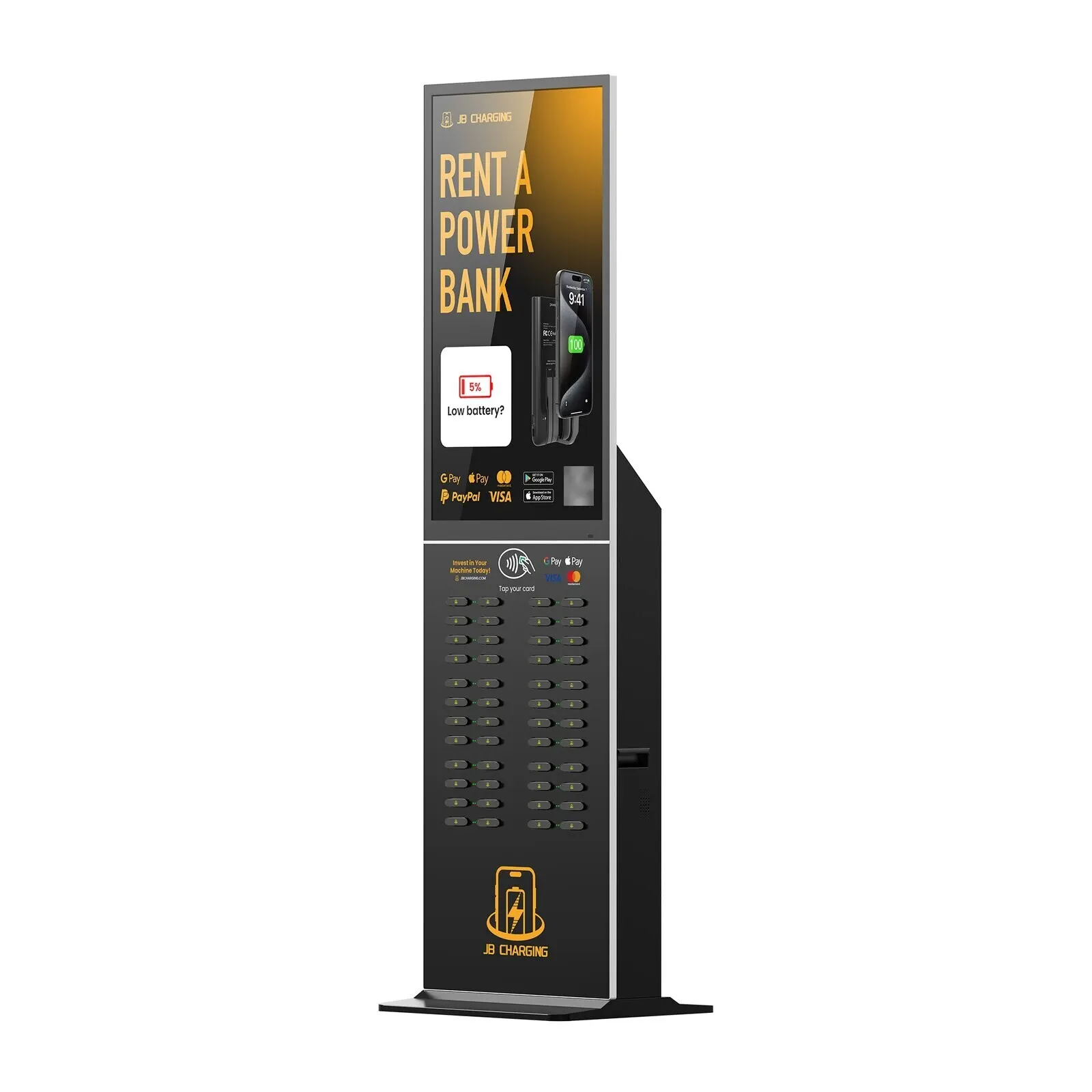
Get creative two weeks out, have the show approve it, follow the portal's file spec, and test it on a station before you pack. More: how to sell local ads on your station screens.
Convention center logistics: power, freight and labor
Power. At convention centers and many hotel conferences, an exclusive contractor supplies power through the exhibitor kit. One 2026 electrical order form for a hotel conference bars exhibitors from the building's wall outlets unless they order power through the contractor. On that form:
- The smallest outlet, 500 watts, covers a J8 Pro (60-watt adapter), J24 Pro (rated at 160 watts) or J48 Pro (290).
- It cost $99 by the advance deadline and $147 after, plus a 26% service charge, sales tax and a 3% card fee.
- That price covers delivery to the back of an inline booth. A common area adds electrician labor at $116 an hour, with minimums.
- Power runs show hours only, so banks returned at closing don't recharge. 24-hour power costs double, about $250 per outlet at the advance rate before tax. The alternative: restock each morning with banks charged overnight in another of your stations.
Return window and last day. By default, a bank kept past 24 hours puts a $40 non-return fee on the renter's card. Rent at 9am, return at 10am the next day, and the complaint reaches the show under your sponsor's name, so set each station's window to cover the whole show. On the last day, put a return-by time on every screen and sign, keep the stations up until then, and check your portal's Active Rentals view before you pack.
Freight and labor. One union-facility convention center's rules for a 2024 show limited hand-carry to what one person could carry in one trip, with no carts, dollies or hand trucks. Only the exhibitor's full-time employees could unload from a personal vehicle, cartload service included. You aren't one, so plan on the contractor moving your station, billed by weight. One 2026 exhibitor kit listed $460.20 per 100 pounds with a 200-pound minimum, so even one boxed tower costs about $920.
Hotel conferences often use the same contractors and forms; both cost examples above come from hotel shows. In some cities, union rules also decide who may move freight, run power or hang a sign, so ask the general contractor what applies to an outside supplier before you bring a cart.
| Station | Weight | Best spot | Getting it in |
|---|---|---|---|
| J8 Pro (8 banks) | 11.5 lb | Lounges, registration counters | One hand-carry; its 29.8-lb stand is a second trip, where the rules allow |
| J24 Pro (24 banks) | 72.8 lb | Registration, hall entrances | Needs a hand truck, which may mean show labor |
| J48 Pro (48 banks) | 130.1 lb | The largest halls; built to order | Arrives on a pallet; plan on show labor |
Insurance and signal. Expect a certificate of insurance request; see insurance and COIs for operators. Big halls can have weak 4G spots, so test-rent at the exact spot during load-in.
Book shows only with stations already online and test-rented, never on a pending shipment.
Put it in the deal
- Your fee, and when it's paid (ask for part on signing)
- Who orders and pays for power, including overnight
- Who pays material handling and hangs your sign, and whether you may hand-carry
- Who sells the sponsorship, off-limits categories, and the creative due date
- Mentions in the event app, floor map and pre-show email
- Who must be named as additional insured on your certificate (show management, the building, the general contractor), in time to give your broker a month
- In a booth: the exhibitor's electrical order and the exhibitor-appointed contractor (EAC) form, due weeks before the show
Pitch lines for the sponsorship manager, exhibitors and sponsors
To the sponsorship manager:
Hi [name], I saw the charging station sponsorship in your [year] prospectus. I run phone charging stations in [area] and can supply them for [show]: [two towers / four countertop stations] at registration and the lounge, your sponsor's creative on every screen, and every rental's first hour free, courtesy of the sponsor. Attendees take a power bank into sessions and return it to any station; I handle delivery, setup, stocking and teardown. Who coordinates sponsor deliverables?
No charging line in their prospectus? Send the listing above: "Plenty of shows sell one. Here's copy you could add, and I'll supply it."
To an exhibitor (the list is on the show's site):
If the station in your booth is the only one on the floor, every renter visits you twice: to take a bank and to bring it back. Your creative runs on its screen all show.
To a sponsor, once the show agrees in writing:
Everyone who needs a charge stands at your screen while they tap, all three days. Put your booth number and a QR code in the creative, and every rental's first hour is free, "courtesy of [sponsor], visit booth [#]." You'll get photos of it running at each station.
Trade show objections and how to answer them
"We already rent charging kiosks from an event company." You're local: no inbound freight, and back on site the same day if needed. Ask when they book next year's show, and quote the same package.
"The building has an exclusive." Ask whether it covers phone charging or only power and internet. If charging, ask whether a sponsor's own booth is exempt, or move on to hotel conferences.
"Our sponsor wants leads, not a logo." Offer their creative at every rental and a QR code on the screen pointing to their offer. Don't promise attendee contact data.
"Lithium batteries on the show floor?" Banks charge in the station's slots; the station plugs into the show's outlet, back to a wall, clear of aisles and exits. The banks carry FCC, CE and RoHS markings. Before you sign, check the kit's fire-safety rules for listed-equipment or fire-marshal requirements, and send them to us to ask what documents are available.
"Who handles problems during the show?" You do, in person. Be there at open and close, stay close by in between, give the show's operations lead your cell, and watch each station's ready count in your portal. Anything physical, like an empty or jammed station, is yours to fix.
Fairs and festivals work differently; see running a charging station business at events.
Next step
Pick one annual show within driving distance that already lists a charging sponsorship. Book a call with its prospectus and exhibitor kit, and we'll go over which stations fit, the free-hour and return-window settings, and which costs belong on the show's account. Or compare the stations first.
Examples are illustrative only, not a forecast or a typical result. What a station earns depends on the venue, placement, pricing, local demand, and how actively you run it.
Frequently Asked Questions
How much does a charging station sponsorship cost at a conference?
Organizers set their own prices. Listings we checked in October 2026, linked in this post, ran from $425 for one station in an exhibit hall to $6,000 for branding on four stations. That is the organizer's price to its sponsor. What a show pays you to supply the stations is a separate deal. Cover your travel, help at load-in and teardown, replacement banks, and power and freight if the show won't order them. Then check your fee against the show's own sponsor price.
Who pays for electricity at a trade show or convention center?
Whoever orders the outlet pays for it. At convention centers and many hotel conferences, power comes from an exclusive electrical contractor through the exhibitor kit, and it costs less before the advance deadline. For common-area stations, ask show management to order the power on its account. One 500-watt outlet covers a J8 Pro, J24 Pro or J48 Pro. Show power may run only during show hours. On multi-day shows, order 24-hour power or restock each morning with banks charged overnight in another of your stations.
Do I need union labor to bring a charging station into a convention center?
It depends on the building and the city's labor rules. At some union convention centers, union crews run all material handling equipment. Hand-carry is limited to what one person can carry in one trip without a cart or dolly, and only the exhibitor's own full-time employees may unload from a personal vehicle. Everything else goes through the general contractor, billed by weight. As an outside supplier, ask the general contractor which rules cover you before move-in. A J8 Pro (11.5 lb) is the easiest station to bring in. A J24 Pro (72.8 lb) likely means show labor.
Does JB Charging take a share of the sponsorship money?
JB takes no share of the screen-ad revenue you sell. JB's 20% applies to rentals that run through the station, and the rental figures in this post's table are already your 80%.
Can I work a trade show with the J8 Pros I already own?
Yes, for lounges and registration counters. Four J8 Pros on stands put a sponsor on four 10.1-inch screens, and each station is light enough to hand-carry where the rules allow. At a main entrance, a J24 Pro's 23.8-inch screen gives the sponsor more. Book only stations that are already online and test-rented.
What happens to power banks attendees don't return?
The show is never charged. By default, if a bank isn't back within 24 hours, the renter's card is charged a $40 non-return fee. You set the window and the fee for each station. On a multi-day show, set the window to cover the whole show, and on the last day put a return-by time on the screens.

