How to Sell Local Ads on Your Charging Station Screens
JB Charging Team

Every station we sell has a screen that shows the rental price and a rent button. The rest of the screen is yours to sell, and JB takes no cut of advertising on charging station screens: you keep 100% of the ad revenue you sell. Say three shops on one street each pay $150 a month for a spot on your five screens. That's $450 a month, before your time and costs.
The catch: you find the advertisers and upload their ads yourself from the portal. Below: who buys, a sample rate card, creative and upload basics, proof that keeps advertisers renewing, and a pitch email to send this week.
What you're actually selling
You're not selling impressions. You can't hand an advertiser a verified view count, so don't invent one. You're selling a spot in front of people on a specific block, at a moment when they're standing still.
- People stand at it. Picture 11:40 on a Friday. A renter taps her card, spends about 30 seconds waiting for a bank to slide out, and faces your screen running the taco shop's "Open till 2am. 3-minute walk." Every return puts someone back in front of it.
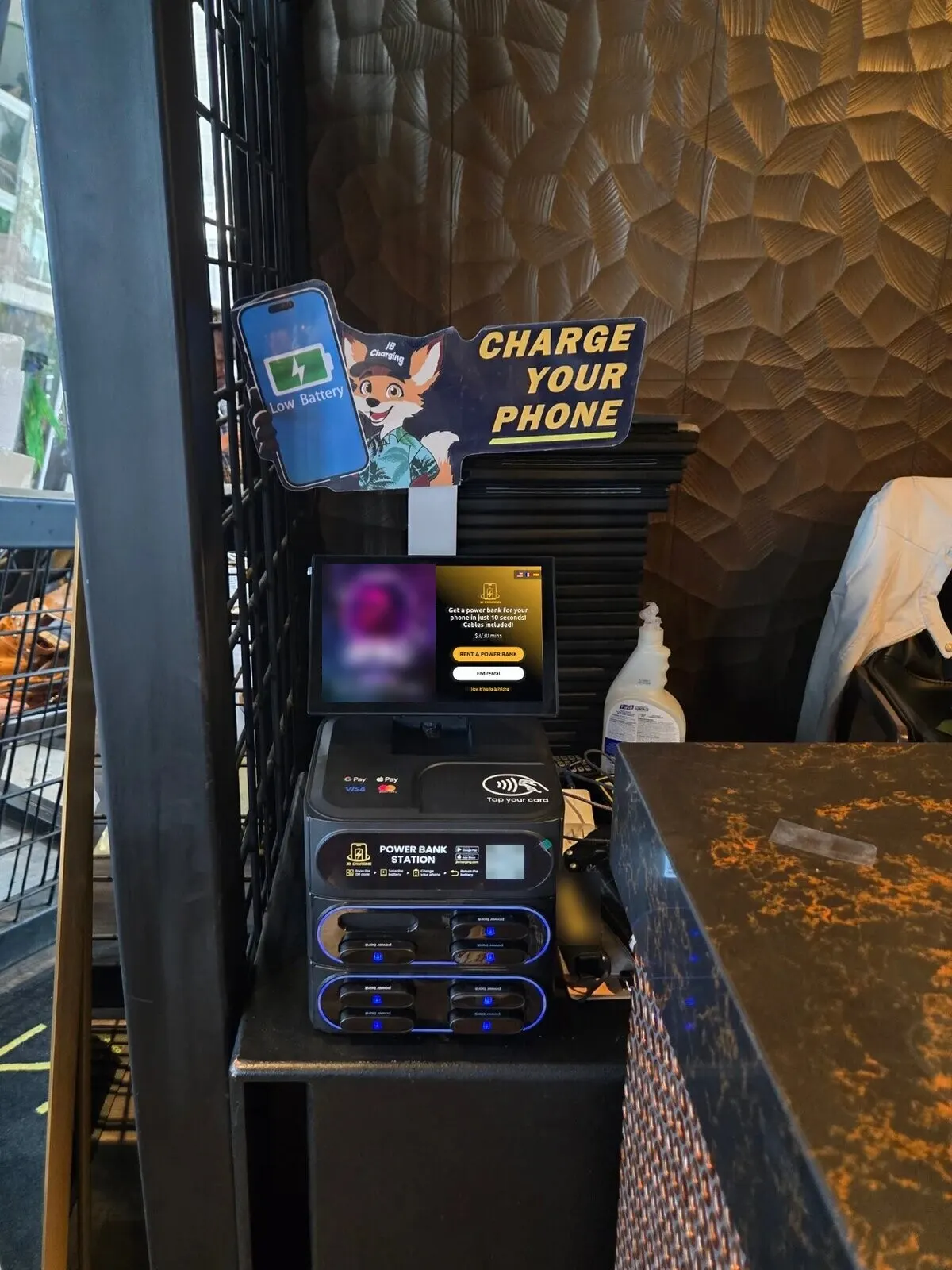
- It's built to be seen. A J8 has a 10.1" screen under a lit "Charge Your Phone" header that shows across a dark room. The J24 and J48 towers carry 23.8" and 43" portrait screens.
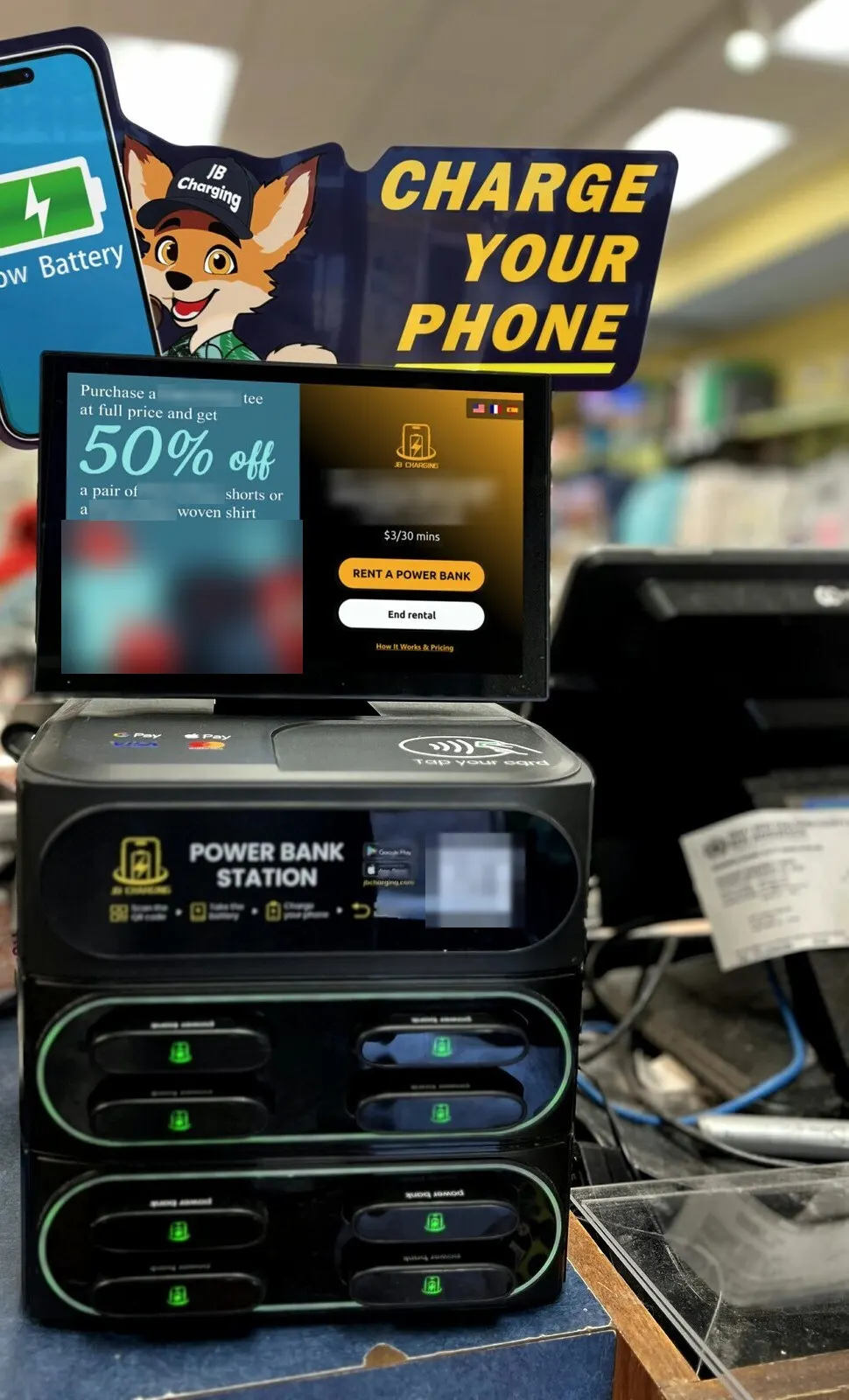
Sell by the route, not the screen. One 10-inch screen in one bar is a hard sell. Five screens in five venues on the same strip is a small local media buy. Group your stations into routes by neighborhood before you price anything.
A sample rate card for advertising on charging station screens
These prices are placeholders that show the structure, not market rates. Ask five or six local businesses what they spend now on mailers, local print, sponsorships or boosted posts, then price below the option they complain about most.
| Product | What the advertiser gets | Hypothetical price |
|---|---|---|
| Single screen | One slot on one J8 screen | $50 a month |
| Tower screen | One slot on one J24 tower screen | $120 a month |
| Route package | One slot on every screen on a route (say, 5 venues) | $150 a month |
| Category exclusive | Route package, with no competitor in their category | $250 a month |
| Event run | Two weeks on the screens nearest the event | $60 per run |
| Design | A static ad from their logo and one offer | $75 once, waived on a 3-month term |
| Prepay | 3 or 6 months up front | 10% or 15% off |
| Host venue | One slot for its own specials | Included |
- Cap the rotation. A slot is one spot in a station's slideshow. Sell four paid slots per screen, plus the venue's slot and your house ad. Each extra ad makes the others come around less often.
- Push prepay. Three months up front covers your design time and keeps the ad up long enough for its scan count to mean something.
Hypothetical math: what one five-screen route could bring in
Say you've placed a J8 five-pack in bars and late-night spots along one commercial strip, and you sell from the card above. The five-pack lists at $4,499.95, or about $4,745 with the $245 shipping shown at checkout (list price at the time of writing).
| Say you sell (hypothetical) | Per month | First 12 months |
|---|---|---|
| Nothing yet | $0 | $0 |
| One single-screen slot at $50 | $50 | $600 |
| Two route packages at $150, signed in months 3 and 5 | $300 once both run | $2,700 |
| Three route packages at $150, all year | $450 | $5,400 |
| Three route packages plus one category exclusive at $250, all year | $700 | $8,400 |
If those three packages stayed sold all year, $450 a month of ad sales would add up to the five-pack's price in about 11 months ($4,745 ÷ $450 is about 10.5), or about 7 at $700. That's before your time, discounts, empty months, payment fees and any venue cut. The last row fills every paid slot on the route; to carry more, you'd need higher prices or more screens.
Two of those costs are easy to miss: empty months while you replace an advertiser who cancels, and credits you owe for days a venue is closed or a screen is offline, one more reason to keep your stations online.
Rentals are a separate line: you keep 80% and JB keeps 20%, and any venue share and your own costs come out of your 80% (here's where every rental dollar goes).
Until someone signs, the ad line in your plan is $0. Nobody can promise you advertisers, and selling ads takes time and effort on top of running the stations. Pick venues for rentals, and treat the screens as a second line you build on the route you already have.
Who buys local screen ads
Your easiest yes is a business already paying for local ads. Walk two blocks around each venue and list every business with a sandwich board, window poster or yard sign. Note who sponsors the venue's trivia night, and ask the owner where the regulars eat and get their hair cut. You aren't selling them on advertising, just on a spot a few doors from their own. Match each one to the room:
| Advertiser | Best-fit rooms | An ad that fits |
|---|---|---|
| Late-night food | Bars and clubs after 10pm | "Open till 2am. 3-minute walk. Scan for the menu." |
| Real estate agents | Cafes, salons, mall concourses | Their face and neighborhood, "Scan for your home's value" |
| Orthodontists, pediatric dentists, tutors | Trampoline parks, bowling, youth sports | "Free consult. 5 minutes from here." |
| Gyms and studios | Malls, cafes, salons | "First week free. Two blocks east." |
| Car dealers and auto shops | Laundromats, salons, waiting rooms | This month's service special and the address |
| Lawyers | Malls and waiting areas; bars if the owner agrees | Practice area and phone number |
| Event promoters | Bars and clubs | The flyer, two weeks before the date |
| The host venue | Every room | Trivia night, happy hour, private-event booking |
Event sponsorships are a bigger version of the same sale; see how operators sell charging at events.
Settle the screen with the venue first
Settle three things before the first paid ad goes up.
- Tell them the screen carries local ads. Raise it while you pitch the station, not after an ad surprises the manager. Our venue pitch guide covers the rest of that conversation.
- Give them a slot. Offer the venue one free place in the rotation for its own specials. It makes the station part of the house, and their promo fills the loop while you sell.
- Agree on a veto list. No direct competitors (no other bar's happy hour on a bar's screen) and nothing the owner wouldn't hang on their own wall. Ask about DUI attorneys, vape shops and sportsbooks by name. Those categories, along with alcohol and cannabis, have their own state ad rules, so have the advertiser confirm its ad complies.
Whether the venue sees any ad money is your call. Offer a share as a bargaining chip or keep it all, but put it in writing.
Creative that works on a small screen
- Design tall, at the size the portal's upload box recommends. The price and rent button take part of every screen, even a tower's 1080 x 1920 one, so don't design to the full display or start from a wide banner. Off-spec files can display badly, so check the first upload on the real screen before you invoice.
- Not a designer? Ask the advertiser for the file behind its last flyer, and rework it in a free design tool at the portal's size.
- Say one thing. A headline of about six words, the logo, one offer, one QR code. If it can't be read in the time it takes to tap a card, cut words.
- Use high contrast. Bars are dark: bold type, bright text on a dark background, no thin fonts or text over photos.
- Don't imitate the rental side. Nothing that looks like the rent button or the price.
- Give every advertiser its own QR link, so they can count scans themselves. For a shop that won't check web stats, add a screen-only code ("Say CHARGE for 10% off") and let them count it at the register. It's theirs to measure, not yours to claim.
- Keep a default image. Always keep one image you own in each slideshow, such as a house ad ("Advertise on this screen. Text [your number]"). The slot never sits empty when an advertiser leaves, and the house ad sells the next one.
Upload, check, and prove it ran
Ads go up remotely. In the Distributor Portal, open Stations, pick the station, and upload the file in its Screen and Advertising section, where it joins that station's slideshow. Uploads are per station, so a five-screen package means five uploads.
Keep a sheet: advertiser, screens, start date, end date, file name, last proof photo. Put each end date in your calendar the day you upload; an expired ad that keeps running is a free ad.
Advertisers will ask how often their ad comes around. Count the items in the slideshow and time one full loop on the real screen.
On day one, send a photo of the ad live on every screen, with enough of the room in frame to show where it is. Take fresh photos on each visit, and send this monthly:
Subject: [Business] on 5 screens: [Month] photos
Hi [Name], photos of your ad on all five screens are attached, taken [date]. [If a screen was down:] The [Venue 3] screen was offline [dates], so this month's invoice is $[x] lower. Your scan link is [link] if you want this month's count. Your term renews [date]; send a new offer by the 25th and I'll swap it in for [next month].
[Your name]
Never share a venue's rental activity with an advertiser.
The pitch email
Bring a mockup: a photo of one of your screens with their logo and offer dropped into the ad panel.
Subject: Your logo on 5 screens on [Street]
Hi [Name],
I run the phone-charging stations at [Venue 1], [Venue 2] and three other spots on [Street], all a few minutes' walk from you. Each has a screen people stand at while they rent or return a power bank, and I sell a few monthly spots on them to nearby businesses.
I'd like to put [Business] on all five screens for $[price] a month: your logo, one offer, and a QR code to [your menu or booking page] so you can count the scans yourself. On a three-month term I'll design the ad at no charge, and you'll get a photo of it on every screen when it goes up and each month after.
I keep it to four advertisers per screen. If you'd rather be the only [category] on these screens, that's $[x] more a month. Could I stop by Thursday afternoon with a mockup?
[Your name] · [Phone]
When they ask how many people will see it, say: "I can't give you a verified count. What I can show you is the venues and their hours, how often your ad plays in the loop, a photo of it on every screen each month, and your own scan count."
What goes in a one-page ad agreement
- Screens: each venue's name and address, and the start date.
- Price and term: billed monthly in advance by card on file or autopay, month-to-month with 30 days' notice or prepaid for 3 or 6 months.
- Creative: supplied to your spec or designed by you, one change a month included, and you can refuse anything that breaks the content rules.
- Content rules: nothing illegal, adult or competing with the host venue, and the venue can have any ad taken down.
- What isn't promised: no view or traffic numbers. If a venue closes, the station moves, a screen goes offline or the venue asks for the ad to come down, you credit the affected days.
- Proof: a photo at launch and each month.
- Responsibility: the advertiser owns the rights to its logo and images and stands behind its own claims.
Clause 7 matters more if you write the ad. The FTC's advertising guide for small business says advertisers need proof before an ad runs, and that an ad agency can also be held responsible for misleading claims. Design the ad and you're doing the agency's job, so only put claims on screen the advertiser can support. Have a local attorney review your version once, and ask your accountant whether ad sales are taxable in your state.
Next step
Already running stations? Put a house ad on every screen this week. Still deciding? Book a call and we'll walk you through the screens, the portal and which venues could form a route, or see the stations to compare a 10.1-inch countertop screen with a 23.8- or 43-inch tower.
Want your own business on a station near you? Ask the venue who runs its charging station; that operator sells the space.
Examples are illustrative only, not a forecast or a typical result. What a station earns depends on the venue, placement, pricing, local demand, and how actively you run it.
Frequently Asked Questions
Do I have to share ad revenue with JB Charging?
No. You keep 100% of the screen-ad revenue you sell, and JB takes no share. Rentals work differently: you keep 80% and JB keeps 20%, and any venue share and your own costs come out of your 80%. Ad deals are between you and the advertiser, so you set the price and invoice them yourself.
Does JB find advertisers for me?
No. You find, sign and invoice your own advertisers, and you upload their ads yourself from the Distributor Portal, one station at a time. Ad sales aren't guaranteed and take time, so start by putting a house ad on every screen so each one advertises its own space.
What format should a charging station screen ad be?
Use a tall image at the size printed in the portal's upload box, which also lists the file types it accepts. The rental price and rent button take up part of every screen, so don't design for a tower's full 1080 x 1920 screen or shrink a wide banner. Check the first upload on the real screen.
How much should I charge local businesses for a screen ad?
There's no standard price. Find out what nearby businesses already spend on mailers, local print, sponsorships or boosted posts, and price a monthly package below that. Bundle all the screens on one route together, because one small screen on its own is a hard sell.
Do I have to tell the venue about ads, or share the ad money?
Tell the venue the screen carries local ads before you install. Whether it gets any of the ad money is your call and part of the negotiation. Put three things in writing: any share, whether it gets a free slot for its own specials, and which ad categories it can veto.
How much can I make selling ads on charging station screens?
We can't tell you, because it depends entirely on what you sell. Nobody can promise you advertisers, and selling ads takes time and effort on top of running the stations. The rate card and math in this post are hypothetical illustrations, not a forecast.

