College Campus Phone Charging: Why Sponsors Pay and Students Rarely Do
JB Charging Team

On a college campus, the student is your user but rarely your customer. That's the trick to college campus phone charging: students use it when it's free and mostly pass it by when they have to pay. So you sell the free hour and the screen to whoever already pays for student life: the union, the library, student government, athletics or a local business.
Say the union buys a $150-a-month screen package to keep the first hour free, and a credit union near campus pays $200 a month for an ad slot on the same screen. That's $3,150 over a nine-month school year. After about $500 in yearly costs, it would take about a school year and a half to cover a roughly $4,000 tower.
Students won't pay. Their school will.
Students carry chargers. What they lack is an outlet where they are: a lecture hall with outlets on one wall, the bus after a late lab. A power bank fixes that, but at $3 it competes with free: the outlet by the library window, a roommate's cable. Commuters have it worst, with no dorm room to go back to between classes.
The money already exists. One university lends power banks free from kiosks around campus (its help page). In 2025–26, a public university's student senate took up a bill to spend about $1,700 of one-time funds on two branded charging tables for its union, as a test of student interest (the bill). At another school, a local telecom sponsored a charging station in the union. The school, student government, a sponsor: that's who you pitch.
So set up a campus station like this:
- First hour free. Set an opening free period of up to 60 minutes, about one class.
- Someone else pays for it. A department or a local sponsor buys the screen and the line "First hour free, courtesy of [name]." That's ad revenue, and you keep 100% of it.
- Free still starts with a tap, so a bank that never comes back is charged to the renter, not the school.
- Say it on the screen. Put "First hour free" in your ad and on a sign, so nobody sees only your per-30-minute rate and walks past.
- Keep the daily max low. After the free hour you keep 80% of rentals, before any venue share and your costs. Banks go back to dorms overnight, so a $10 max instead of the default $20 spares the union complaints about $20 charges.
If a campus wants charging free all day, or wants to pay you for anything besides the screen, ask us first.
The sponsor math, as a hypothetical
The $4,000 is the J24 Pro's $3,299 list price at the time of writing, about $250 in freight as shown at checkout, and 10 spare banks ($200 at list), rounded up. Assume $500 a year for replacement banks, gas and parking. The table leaves out your time and rentals past the free hour.
| If the money comes from | Per school year (9 months) | After $500 in costs | School years to cover about $4,000 |
|---|---|---|---|
| Students only: say 2 paid rentals a day at $3, 200 days on campus, your 80% | $960 | $460 | About 9 |
| One screen sponsor at $200 a month | $1,800 | $1,300 | About 3 |
| The union's $150 screen package, plus one sponsor at $200 | $3,150 | $2,650 | About 1.5 |
| The union, plus two sponsors at $200 sharing the screen | $4,950 | $4,450 | Under 1 |
Run your own: (screen packages and sponsors $___ a month × 9) + (paid rentals a day ___ × days on campus ___ × price $___ × 80%) − yearly costs $___ = $___ a school year. Divide your all-in station cost by that.
Look at the top row before you plan around student rentals. Sponsor rows happen only if you sell them, and some sponsors will say no. There's no standard rate: ask what each one pays for a welcome-week table or a student-paper ad, and price a semester of screen time against that. If the host department wants a rental share, it comes out of your 80%, so offer screen time for its events instead.
Summer isn't in the table. If little runs in the building then (ask about summer session, orientation and camps), the tower can work an indoor or covered event or a busy summer bar (see running stations at events), as long as your campus agreement sets removal and reinstall dates. A J24 Pro weighs about 73 pounds, so bring a helper and a hand truck.
Who pays for college campus phone charging
| Who | Their money | What they want | Your offer | When they decide |
|---|---|---|---|---|
| Union or auxiliary services director | Auxiliary budget (dining, bookstore, union) | Students staying in the building; no staff work | A tower, first hour free, union events on the screen | Spring budget; a pilot anytime |
| Library dean or circulation head | Operating budget, sometimes a friends-of-the-library fund | Longer study sessions; no more lending cables | A J8 Pro at the desk, library hours on the screen | Spring, or a discretionary line |
| Student government | Student activity fees | A win students notice this semester | "First hour free, courtesy of your student government" | Requests during the year; next year's money in spring |
| Athletics | Sponsorship inventory | Something new for fans and sponsors | A concourse tower with a sponsor's name on it | Before the season |
| Banks and credit unions | Marketing budget | New student accounts | The screen plus the free-hour credit line | Anytime |
| Phone stores, student apartments, late-night food | Marketing budget | Students' attention when they need help | A screen slot, alone or rotating | Anytime. They sign with you, but the campus approves the ad |
Start with the union. Auxiliary units like dining, the bookstore and the union run largely on their own revenue, so a director there may fund an amenity without touching the academic budget. Under the standard venue agreement, hosting costs the union nothing beyond electricity; the screen package is the optional part that keeps the first hour free.
Before you sell to a bank, find the campus bank. Most schools that take federal student aid and have a contract with a bank to market accounts to their students must post that contract on their website (34 CFR 668.164). Search the school's site for "T2 arrangement." Pitch that bank first, and don't sell the screen to its competitor without the school's OK.
Get the campus advertising policy in writing, and ask about other exclusive categories, such as beverages or wireless. Ask whether the dining or vending contract covers kiosks; if it does, you may need that contractor's OK. For athletics, ask who holds the multimedia rights: at many schools an outside company, not the athletic department, sells the sponsorships. To price the screen, see selling local ads on your station screens.
Timing: pitch in spring, install in August
- January to April: pitch. Departments and student governments often set next year's money in spring, and many public colleges budget July to June, so ask when yours starts. In the first meeting, ask what environmental health and safety requires for plug-in equipment with lithium batteries, and send us that list. The banks carry FCC, CE and RoHS markings; get anything beyond that confirmed by us in writing before you promise it.
- May: sign before finals scatter everyone, fall sponsors included.
- August: install or reinstall before move-in, test-rent on your own card at the exact spot, and go live for welcome week.
Plan for the first yes to take a semester. Meanwhile, work the edge of campus: bars and coffee shops just off campus need no university approval, and each one becomes a return point for your campus station.
Where stations go, in order
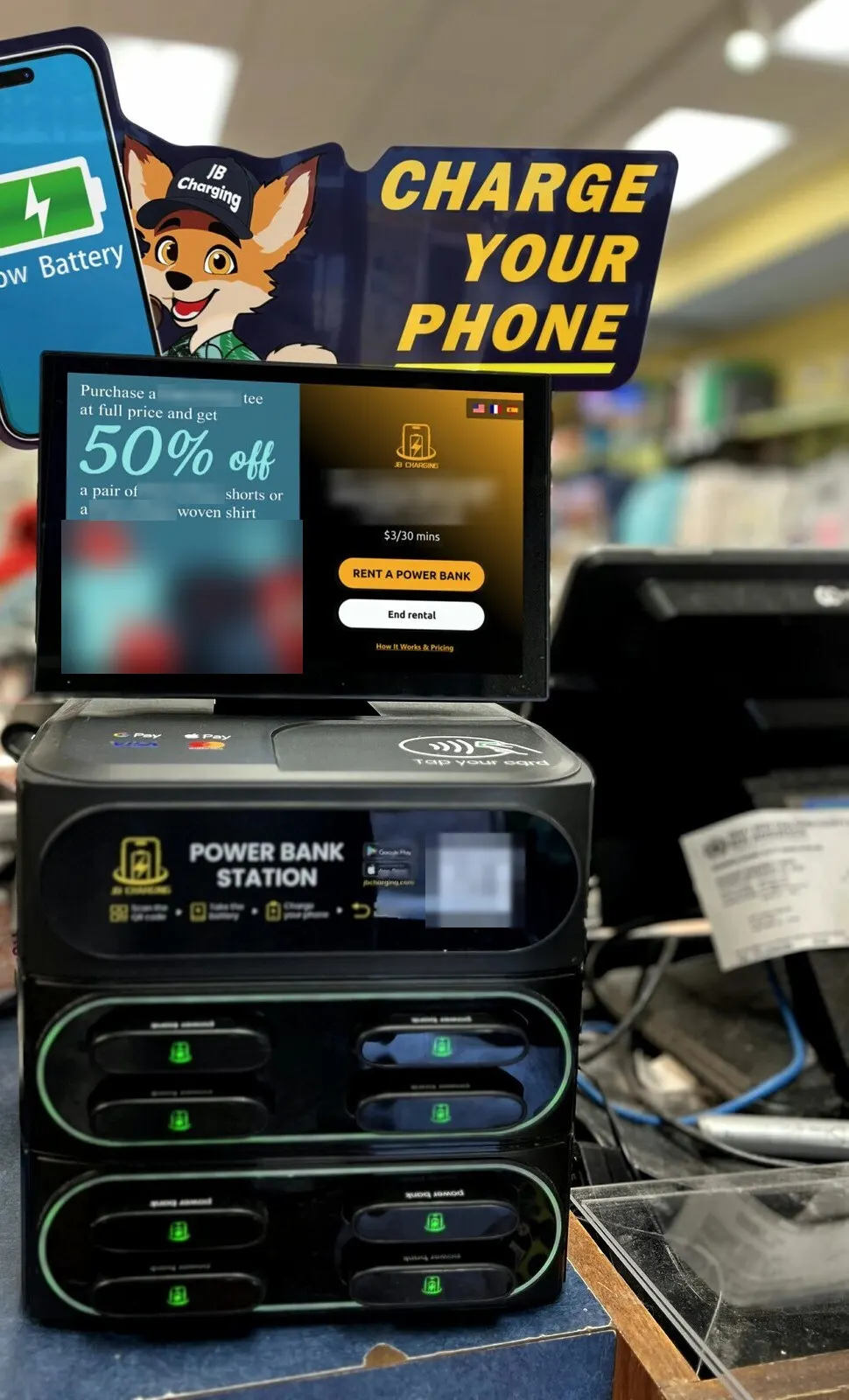
Put stations where students stop and wait. Two buildings on the same daily path beat two stations in one lobby, because a bank can go back to any free slot at any JB Charging station.
| Order | Building and spot | Station | Why this order |
|---|---|---|---|
| 1 | Union, edge of the food-court seating | J24 Pro | The auxiliary director can say yes, and the 23.8-inch screen faces the lunch line a sponsor pays for |
| 2 | Library, by circulation or the entrance; a late-night study floor only if staff agree | J8 Pro on the desk, or a J24 Pro in the lobby | A return point for the union, and the desk stops lending cables |
| 3 | Dining hall, along the wall where the line waits | J8 Pro on a $150 stand | A third return point on the meal path |
| When athletics says yes | Arena concourse near concessions, back to a wall | J24 Pro, or a J48 Pro (built to order) for the largest rooms | Busy on game days; needs whoever sells athletics sponsorships |
| Skip for now | Rec center (unless a sponsor pays), residence halls, outdoor quads | None | Gyms rent poorly in our experience, a bank taken back to a residence hall can sit in a room overnight, and stations are indoor equipment |
Everywhere: a standard wall outlet, no extension cord, out of exit routes, back to a wall. Check the 4G signal in basements and concrete stacks (Wi-Fi is the backup), and leave a couple of slots empty for returns.
Run a one-building pilot
Ask for one building for one semester, not five.
- Pick the building students stay in longest, the union or the library. With one building, the free hour works only for students who come back, so an off-campus station a block away gives them a second return point.
- Put it on one page. Write a one-page schedule that both sides sign alongside the standard venue agreement: semester dates, spot and outlet, posted price, who buys the screen package, what runs on the screen and who approves it, what you'll report, summer removal and reinstall dates, and removal at no cost if they don't renew. If the school uses its own contract, check removal, insurance limits and indemnity before you sign.
- Install before move-in, and register desk staff with the station's staff code, which gives each of them a free rental each day.
- Report monthly: photos of the screen running, plus whatever usage your portal shows. Ask us what it reports for free-hour rentals before you promise numbers.
- At semester's end, renew, add a second building, or remove the station.
Expect procurement to register you as a vendor and want a certificate of insurance naming the university, so get your own general liability policy first. Ask, too, whether a department would pay for a screen package by purchase order. See insurance and COIs for operators.
Pitch lines for the union, sponsors and student government
To the union or auxiliary services director:
Hi [name], I run phone charging stations around [city], including one at [the coffee shop on Main]. I'd like to put a tower by [the food court] for one semester as a test. Students tap a card or phone, take a charged power bank to class, and drop it back here or at [the coffee shop]. Hosting costs the union nothing beyond electricity: one outlet, a spot against a wall, no staff time. To make the first hour free, the union can take the screen package, your events plus "First hour free, courtesy of the union," for $[amount] a month, or I find a sponsor and you approve the ad. Who else should be in that conversation?
To a sponsor:
The union screen faces the lunch line, and the screen students tap to rent carries your ad and "First hour free, courtesy of [you]." For $[amount] a month, September through May, the slot is yours once the union approves the ad, and I'll send photos of it running each month. Can I send you a mock-up of your ad on the screen?
To student government:
Commuters, and students here from an 8am lab to a 9pm meeting, run out of battery with nowhere to plug in. For a one-time $[amount], student government can make the first hour free at the union station for a semester, with your name on the screen. It's a test: at the end I'll send photos, and you decide whether to fund it next year. I can draft the funding request. Who handles requests this term?
Write the request the way they write bills: a one-time amount, a test of student interest, their name on it, and a short report at the end.
Campus objections, answered
"Why should we pay? Let students rent it." They can, after the first hour. But on campus, use tends to stay thin when students pay, and an idle station does nothing for the union. The free hour is what students notice, and the screen package puts your name on it.
"Students can use the outlets." An outlet ties a student to one seat. A bank goes with them.
"We already lend chargers" or "We have charging lockers." Then you've already decided charging should be free. A locker holds the phone in place; a bank goes to class, and the cable drawer leaves your desk.
"We don't allow outside advertising." Then the union's own screen package still works, with campus content only and the free-hour line approved in writing.
"What if students walk off with them?" The school is never charged. By default, if a bank isn't back within 24 hours, the renter's card is charged a $40 non-return fee. You set the window and the fee per station.
"Lithium batteries? Safety will ask." The banks carry FCC, CE and RoHS markings. For any other document the safety office wants, check with us first.
"Do students need an account, or does it need our network?" No account or app; students tap a card or phone. The station runs on its own 4G, with Wi-Fi only as a backup where the signal is weak. Bring any data questions from IT or the privacy office to us before you answer them.
"Who do students call if something goes wrong?" Renters get help through the machine, the app or their receipt, not your desk staff. Problems with the station itself come to me.
For the department's side of the story, send them our page on phone charging for colleges and universities.
Next step
Got a campus in mind? Book a call and bring the school, the buildings you'd start with and any sponsors you know. We'll go over station choice, free-hour settings and your pilot page. Or compare the stations first.
Examples are illustrative only, not a forecast or a typical result. What a station earns depends on the venue, placement, pricing, local demand, and how actively you run it.
Frequently Asked Questions
How much does a phone charging station for a college campus cost?
At the time of writing, a J8 Pro countertop station lists at $1,199.99 and a J24 Pro floor tower at $3,299. Add shipping as shown at checkout, plus $150 for a stand if a J8 needs one. When an operator places a station under the standard venue agreement, the school pays nothing beyond electricity unless it chooses to buy a screen package that keeps the first hour free. The operator buys and owns the station. Its revenue comes from rentals and from any screen sponsors the operator sells.
Can I make phone charging free for students?
Each station can start every rental with a free period of up to 60 minutes. After that, your posted price applies, up to a daily maximum you set. Have a department or a sponsor buy the screen and the "first hour free" credit line. That's ad revenue, and you keep all of it. Students still tap a card or phone to start a free rental, because that's how a non-return gets charged. If a campus wants charging free all day, or wants to pay you for anything other than the screen, ask us first.
Who approves a phone charging station on a college campus?
It depends on the building. In the student union, start with the union or auxiliary services director. In the library, go to the dean or whoever runs the circulation desk. For the arena, talk to athletics, and first ask who holds their multimedia rights, since that company often sells the sponsorships. Student government can fund a free first hour from student activity fees. Sponsors such as a credit union or an apartment complex sign with you, not the university, but the campus still approves what runs on the screen.
Do I need insurance to place a charging station on campus?
Expect it. Procurement will usually register you as a vendor under your business and ask for a certificate of insurance naming the university. Carry your own general liability policy, and ask your agent how quickly they can issue a certificate before you promise an install date.
What happens if a student doesn't return a power bank?
The school is never charged. By default, if a bank isn't back within 24 hours, the renter's card is charged a $40 non-return fee, and you can set the window and the fee per station. Replacing the bank may be on you, so check the replacement coverage in your distributor agreement (power banks list at $200 for 10). Stations in two buildings make returns easier, since a bank can go back to any free slot at any JB Charging station.
What happens to campus charging stations over the summer?
Campus thins out over summer and winter break, so price sponsorships for the school year, September through May. Ask what still runs in the building over the summer, such as summer session, orientation or camps. If little does and your campus agreement allows it, move the station to an indoor or covered event or a busy bar, then reinstall it before move-in.

