Placing Charging Stations in Nightclubs: An Operator's Playbook
JB Charging Team

A nightclub phone charging station is an easy sell to guests and a slow one to the GM. Tickets, tabs and the ride home run on one battery, but the GM won't sign until you've answered the fire marshal, the insurer and "what if they walk off with them." The station rents power banks: guests tap a card or phone, take a charged bank with built-in cables, and return it to any free slot. You buy it, place it and keep 80% of rental revenue; JB Charging keeps 20% for payments, 4G and renter support.
Answer the GM on one page and a club can carry a J24 tower. Say it rents 4 banks a night at $10 a rental, three nights a week: your 80% covers the tower in about nine months, before your other costs.
The math: how many rentals cover a club tower
Say you put a J24 Pro tower in a club's main room: $3,299 at list price at the time of writing, about $3,550 with freight as shown at checkout. Say the GM agrees to $5 per 30 minutes with a $30 daily maximum (you set prices per station; the default is $3 and $20). A guest who keeps a bank an hour pays $10, and your 80% is $8. About 445 of those rentals cover the tower.
At 4 rentals a night, three nights a week, that's $96 a week to you before costs, and the tower is covered in about 37 weeks. A J8 Pro at coat check moves faster: about $1,235 with shipping as shown at checkout, at list price at the time of writing (about $950 a station in the 5-pack). At 2 rentals a night on the same three nights, $48 a week to you, a single J8 is covered in about 26 weeks.
Same tower, $10 a rental, three open nights a week:
| Rentals a night | Rentals a week | Gross a week | Your 80% | Weeks to cover the tower |
|---|---|---|---|---|
| 1 | 3 | $30 | $24 | About 148 (nearly three years) |
| 2 | 6 | $60 | $48 | About 74 |
| 4 | 12 | $120 | $96 | About 37 |
| 6 | 18 | $180 | $144 | About 25 |
Treat the 4- and 6-a-night rows as what a busy, well-placed room has to do, not as a plan. At the default price, your 80% of an hour is $4.80, and every row takes about two-thirds longer.
Any share you give the club comes out of your 80%. Say you pass the club $12 of that $120 week: your $96 drops to $84, and the 4-a-night row takes about 42 weeks. Then subtract replacement banks ($20 each at list price at the time of writing), your own insurance, gas, late-night visits, taxes and slow months. Which club, which spot, the price and staying online are partly in your hands. The room's own demand isn't.
Pricing for late nights
Where demand is high, as it often is in a busy club, some operators charge more than the default, such as $10 per 30 minutes. Start at a price the GM has agreed to, because complaints land on the club first, and raise it once the station regularly runs out of banks on busy nights. A free first period (up to 60 minutes) on the VIP station only is a perk for table guests, but it's revenue you give up.
Score the club before you pitch it
A busy late-night bar can out-rent a true nightclub, and the reason is arithmetic. Say it's the same tower and the same $10 rental: a bar that rents 2 banks a night, seven nights a week, does 14 rentals. A club that rents 4 a night on its three nights does 12. Nights open, how long guests stay and the district matter more than the word "club".
| Check | Good sign | Warning sign |
|---|---|---|
| Nights open | Four or more | Saturday or event nights only, or a summer-only room |
| Close | 2am or later; guests order rides at the door | Early close; the crowd drives home |
| Stay | Guests arrive early and stay through the headliner | In and out |
| District | A bar-hopping block, ideally with your other stations (a bank can go back to any JB station) | Nothing else open late nearby |
| Paperwork | The GM knows on the first visit what their insurer, landlord or fire marshal will want | A required listing or document JB Charging hasn't confirmed |
Bars get their own scorecard: which bars are worth a station.
Who decides in a club
Map the room before you pitch:
| Role | What they decide | What they worry about | Your line |
|---|---|---|---|
| Owner or managing partner | Signs the venue agreement | Liability, reputation, the look of the room | "It costs the house nothing but the electricity." |
| General manager | Says yes to a free amenity | Staff time, complaints, a Saturday breakdown | "Your bartenders stop charging phones." |
| Operations manager | The spot, the outlet, install day | Floor space, exits, cords | "One wall outlet, no extension cord, out of every exit path." |
| Head of security or crowd manager | Signs off on placement | Crowding, walk-offs, exits | "It sits where a short line blocks nobody." |
| VIP director or lead host | VIP placement | Table guests leaving early | "A station at the host stand for your tables." |
Promoters don't sign or pick the spot, so don't pitch them the station. Once you're installed, pitch them screen ads: you keep 100% of ad revenue you sell, though finding buyers is on you and nothing is guaranteed. Agree with the GM what may run.
Walk in on a midweek afternoon, when managers are in and the room is quiet, and ask for a daytime site walk. If you own a J8, bring it and run a test rental in front of the GM. A club inside a hotel or casino adds the property's risk and facilities people: slower, not impossible.
The pitch: the ride home and phones off the bar
"At close, the last thing your guests do is order a ride home, and that only works if the phone made it to 2am. We put a phone charging station at your coat check or on the restroom hallway. Guests tap a card or phone, take a charged battery, and drop it in a free slot on the way out. No app. Your bartenders stop charging phones, your staff don't touch it, and it costs the house nothing but the electricity. Can I walk the room with your ops manager one afternoon this week?"
Text the same day: "Hi [name], it's [your name] with the phone charging station. I can walk the room Wednesday or Thursday afternoon to pick the spot and check the outlet. Which works?"
If they ask what's in it for the club: a free amenity, a free rental each day for registered staff (within a weekly limit), and maybe a share paid monthly by direct deposit. Lead without a share; any share comes out of your 80% (how much to offer). Then send the GM our nightclub page, written for the club's side.
Where a nightclub phone charging station goes
Walk each candidate spot with the ops manager and check: a wall outlet the station reaches with no cord; your phone's signal (clubs are often basements, and Wi-Fi backs up the built-in 4G); the clear width left beside it; whether a guest at the door can see it; and where the coat line forms at close. Never the dance floor, the bar top, a stairway or an exit path.
| Spot | Station | Why |
|---|---|---|
| Coat check | J8 Pro (8 banks, about 9 by 9 inches on a counter) | Guests pass it arriving and leaving, the counter is staffed, and the lit header reads across a dark room |
| Restroom hallway | J24 Pro (about 14 by 18 inches of floor) or a J8 on a stand | The line gives guests a minute to rent. Only where it stays clear and isn't an exit route; if it splits, pick the side with the longer line |
| Entrance lobby | J24 Pro, off to one side | Seen on the way in and at close, without narrowing the doorway |
| By the ATM | J8 Pro on a stand | Guests already stop there; keep the line clear |
| VIP host stand | J8 Pro | Table guests rent without leaving the section |
| Main room of a big club | J24 Pro, or a J48 Pro (built to order) for the largest rooms | A busy night needs more banks than a J8 holds |
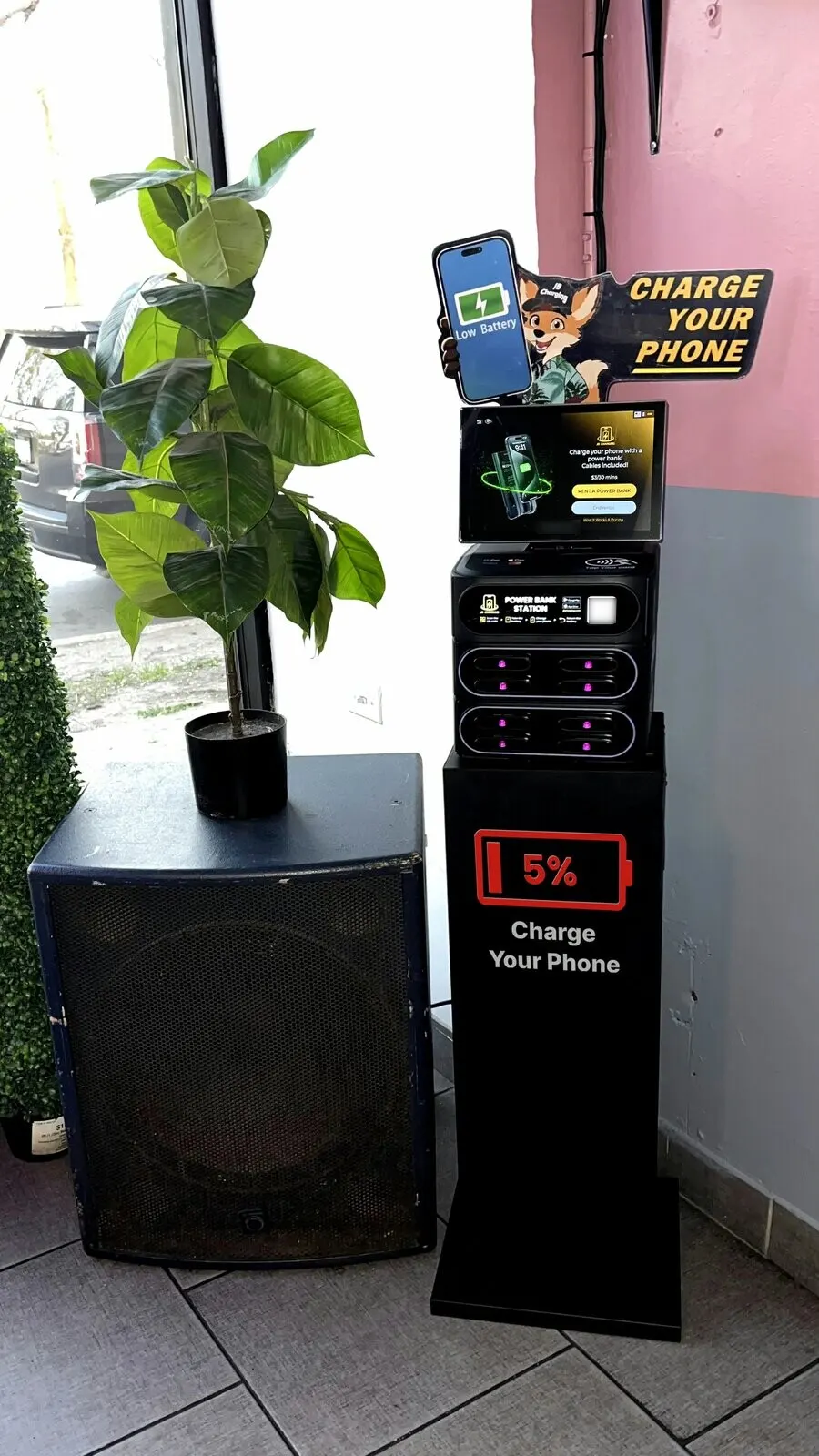
Rough rule: up to about 300 guests, start with a J8 at coat check or the host stand. From about 300 to 1,500, put a J24 at the main room's edge plus a J8 at coat check or VIP. Eight banks can be gone before midnight in a big room, and an empty station looks broken.
The packet that answers the fire marshal and the insurer
Clubs answer to fire inspectors on exits and cords, and NFPA's model codes require trained crowd managers in assembly occupancies such as nightclubs (NIST). Answer their questions on one page before anyone asks:
- Specs and power. J8 Pro: 9.4 by 8.7 by 16.1 inches, 11.5 lb, on a 60-watt adapter. J24 Pro: 14.0 by 17.7 by 70.9 inches, 72.8 lb, rated at 160 watts. Both plug into a standard wall outlet, with no construction.
- A sketch of the spot, initialed by the ops manager: the outlet, the nearest exit and its distance, the clear width, the signal, and how a tower is secured to the wall behind it.
- No cords. No extension cord or power strip. If the outlet is too far, pick another spot.
- The power banks. Say: "The banks carry FCC, CE and RoHS markings. If your inspector needs a specific listing or test report, tell me which one and I'll get you an answer in writing." Then ask us. Add no other listing or safety claim.
- Insurance. JB Charging carries general liability insurance and, on request, can look at adding the club as additional insured; ask us before you promise it. That's our policy, not yours, so bring a certificate from your own general liability policy too. Get the club's insurance requirements and exact legal names (club and landlord) at the site walk. See insurance and COIs for operators.
- The agreement. JB's standard venue agreement runs six months, then month to month on 30 days' notice. The station comes out at no cost to the club, and the club isn't liable if a guest steals or misuses it. Put whatever you agree in writing before install. If the club closes or changes hands, the station is still yours.
Local codes differ, and the fire marshal's reading is the one that counts. If they want the station moved, move it.
Nightclub objections and how to answer them
"Lithium batteries in a packed room? The fire marshal will kill it." Each bank charges in its own slot in the station, not on loose chargers behind the bar, and the station plugs into a wall outlet out of every exit path. Walk the spot with whoever deals with the fire marshal, hand over the packet, and bring any request for a listing to us before you answer.
"Guests will walk off with the batteries." The club is never charged. By default, a bank that isn't back within 24 hours puts a $40 non-return fee on the renter's card; you can change both per station. Replacing the bank may be on you, so check the replacement coverage in your distributor agreement.
"Our dance floor is phone-free." Then it goes at coat check or in the entrance lobby, clear of the exit path. It's for the ride home, not the floor.
"Our guests won't pay for charging." Nobody has to. It's for the guest at 4% at 1:45am with a ride to order, and the price shows before anyone taps.
"Who fixes it at 1am on a Saturday?" Not their staff. Renters contact JB Charging through the machine, the app or the receipt, and the station itself is yours to look after. Your portal flags a station that's offline, a card reader that's down or banks running low. Check it before doors on busy nights, give the GM your cell number, and don't promise a response time.
"We already have a charging vendor." Ask when that agreement ends and whether it bars a second charger; JB's standard venue agreement has the same clause, which protects you once you're in. Calendar the date, offer to be the second look, and don't knock the other company.
Install day and the first weekend
- Install on a weekday afternoon. A J24 weighs 72.8 lb, so bring a second person and a hand truck.
- Run a test rental at the exact spot. If 4G is weak, connect the club's Wi-Fi.
- Brief coat check, the door and the bar. Leave pitch cards (the back is a rental guide for staff), and give the bar manager the staff code.
- Running two stations? Returns tend to bunch up at close at the one nearest the door, and a full station can't take a bank back, so start that one a few banks short.
- On Monday, check Active Rentals for banks still out, then text the GM: "Weekend at [club]: [X] rentals, [every bank back]. Want your next event flyer on the screen?"
Next step
Have a club in mind? Book a call and bring your scorecard; we'll talk through which station fits the room and what goes in the packet. Or compare the stations and run your own numbers; the calculator shows gross rentals, before the 20% and any venue share.
Examples are illustrative only, not a forecast or a typical result. What a station earns depends on the venue, placement, pricing, local demand, and how actively you run it.
Frequently Asked Questions
Is a nightclub a good place for a phone charging station?
It can be, but the word "club" matters less than the room. Look for four or more nights open, a 2am-or-later close, guests who stay for hours, and a late-night district. A busy late-night bar open seven nights can out-rent a club that opens three, so score both before you pitch.
Which charging station fits a nightclub?
Match the station to the spot. A J8 Pro (8 banks, about 9 by 9 inches on a counter) suits coat check, a VIP host stand or a lounge of up to about 300 guests. A J24 Pro tower (24 banks, about 14 by 18 inches of floor) suits the main room of a club of about 300 to 1,500. The J48 Pro is built to order for the largest rooms. A big club often needs two stations, such as a tower in the main room and a J8 at coat check, and guests can return a bank to either.
How much should guests pay to rent a power bank at a nightclub?
You set the price for each station. The default is $3 per 30 minutes with a $20 daily maximum. Where demand is high, as it often is in a busy club, some operators charge more, such as $10 per 30 minutes. Start at a price the GM has agreed to, and raise it once the station regularly runs out of banks on busy nights.
What will a fire marshal ask about a power bank station in a club?
Expect questions about placement and power. Keep the station out of exit paths and stairways, and plug it straight into a standard wall outlet, with no extension cord or power strip. The J8 Pro runs on a 60-watt adapter, the J24 Pro is rated at 160 watts, and the power banks carry FCC, CE and RoHS markings. If the inspector asks for a specific listing or test report, write down which one and ask JB Charging before you answer. Local codes differ, and the inspector's call is the one that counts.
Do I need my own insurance to place charging stations in nightclubs?
Yes. Carry your own general liability policy, because clubs and their landlords often ask vendors for a certificate of insurance. JB Charging carries general liability insurance and, on request, can look at adding the club as additional insured, but that is JB's policy, not yours. Ask JB before you promise it, and get the exact legal names of the club and landlord right the first time.
Should I offer a nightclub a revenue share?
You don't have to. Many venues host a station free as a guest amenity; others take a share you negotiate. Any share comes out of your 80% and is paid to the club monthly by direct deposit. Lead with the ride home and phones off the bar, and offer a share only if it's what gets the yes.

