
Phone Charging Stations for Nightclubs and Lounges
Guests rent a charged power bank on the way in and drop it back on the way out; under our standard terms, where a local operator serves your area, the club pays only for the electricity.
The phone stays with the guest
Guests rent on the way in and top up in a pocket on the floor, so the phone holding their ticket, their tab and their ride home has a better chance of lasting until close.
Nothing charging behind the bar
Guests tap, take a bank with Lightning and USB-C built in, and return it themselves. Bartenders stop holding phones, and renters get support from JB Charging instead of your staff.
Walk-offs aren't your bill
A bank that doesn't come back is charged to the renter's card, never to the club, and our standard agreement says the venue isn't liable for guest theft or misuse.
A phone charging station for nightclubs earns its spot at 2am, when the phone that got a guest in and paid for the last round has to call the ride home. Guests tap to rent a charged power bank, keep the phone in their pocket on the floor, and drop the bank back on the way out, so the station goes where they pass twice: entrance, coat check, restroom hallway. Under our standard terms it costs the club nothing beyond electricity, and staff don't run it.
Why club guests run out of battery
In a club, the phone is the ticket, the wallet, the ride home and the way back to their friends. Picture a Saturday:
- 10:45pm, the door. A mobile ticket, on a phone at 30% after pregame photos.
- 12:30am, the floor. Friends split up in the dark; the way back is a text or a shared location.
- 1:15am, the bar. The round goes on a phone wallet, and at 9% the group talks about leaving early to save battery.
- 2:05am, the curb. The ride home: a phone that died at 1:40 means a guest asking your door team for a cab, or walking off alone, unreachable.
Without a station, those phones end up on a cable behind your bar, in your bartenders' care. Why that's a bad trade.
How a guest rents a power bank
- Tap a card, Apple Pay or Google Pay, or scan the QR code. No app or account.
- Take a charged power bank with Lightning and USB-C cables built in.
- Return it to any free slot at any JB Charging station.
Unlike a locker or a cable on the wall, the phone never leaves the guest. Renting takes about 30 seconds, and the operator's price shows on screen first: at a common $3 per 30 minutes with a $20 daily maximum, 11:30 to 1:30 costs the guest $12. Ask what yours will charge and put it in the agreement.
Where the station goes in a club
| Spot | Why it works | Station and placement |
|---|---|---|
| Inside the entrance | Seen arriving and at close | J8 on a stand, or a J24 in a big lobby; back to a wall, clear of the doors |
| Coat check | Arrival, and the coat line at close | J8 on the guest side of the counter; first choice if your floor is phone-free |
| Restroom hallway | A wait, all night | J8 on a stand or wall mount where the line forms, never where it narrows toward a fire exit |
| VIP host stand | Tables stay for hours | J8 on the guest side, so hosts don't hand banks out |
| Main room edge | All night, in rooms over 300 | J24, back to a wall, off the dance floor and clear of the bar |
Beside the ATM works too: guests there already have a card out. Skip the dance floor, the bar top (spills, and your bartenders become the help desk), stairwells, fire doors and the smoking patio (stations stay indoors).
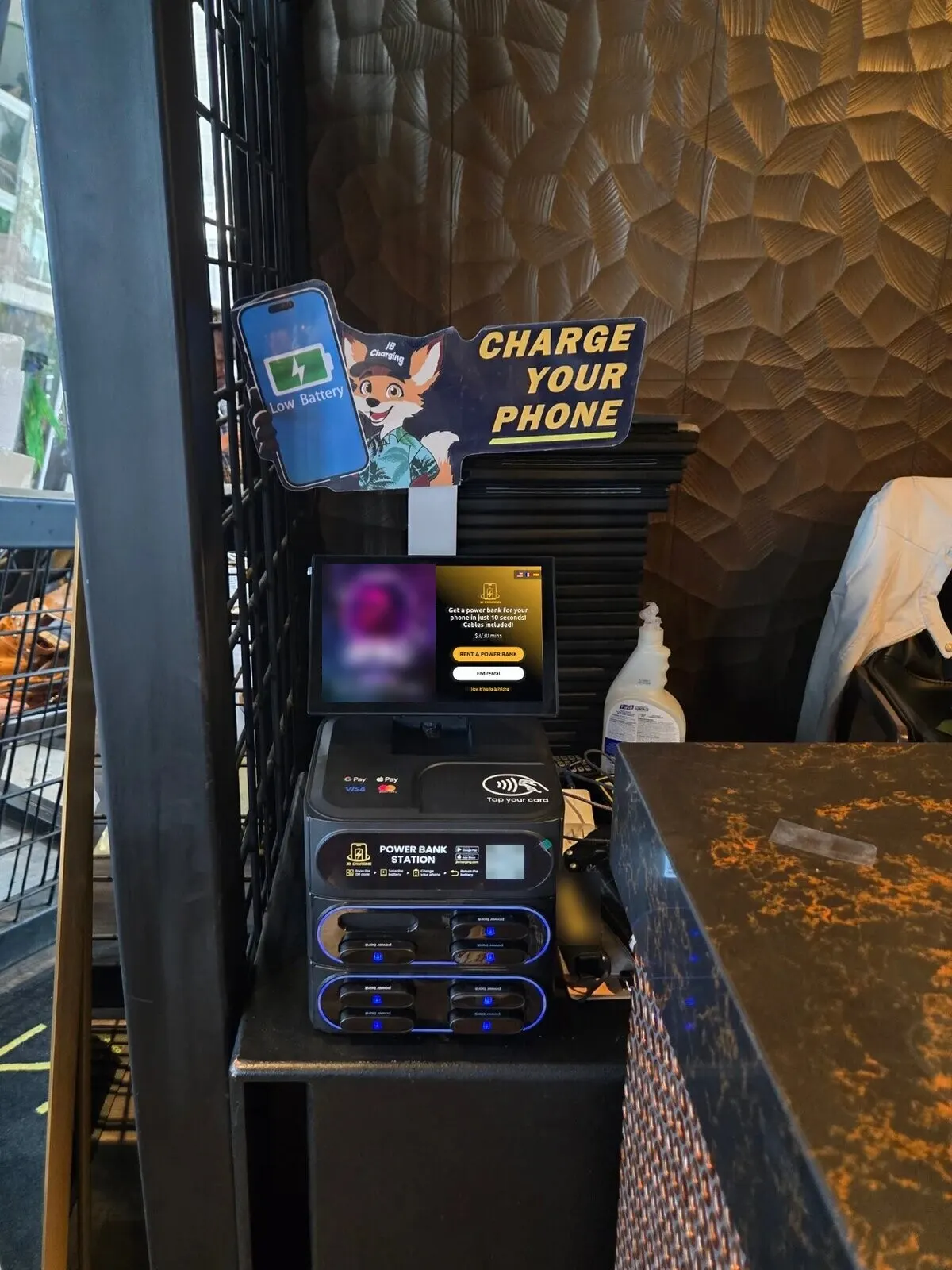
Choosing a phone charging station for nightclubs and lounges
| Your venue | Ask your operator for | Add a station when |
|---|---|---|
| Lounge or club up to about 300 capacity | One J8 at the host stand or coat check | It runs low before close |
| Club of about 300 to 1,500 capacity | A J24 at the main room's edge, plus a J8 at coat check | You open a VIP section or a second bar |
| Multi-room club | A J24 in each main room, J8s at coat check and VIP | One room keeps running short at close |
It's a rule of thumb, since your operator buys the machines: a J8 Pro is a countertop unit with 8 banks, a J24 Pro is a floor tower with 24, and a J48 Pro tower with 48 is built to order. Size for Saturday, not Tuesday.
What the fire marshal and your insurer will ask
- "Where is it, and what's it plugged into?" Back to a wall, clear of exits and fire doors, on one standard outlet with no extension cord or power strip. New York's fire code (§F605.5, based on the International Fire Code) says extension cords "shall not be a substitute for permanent wiring" (New York State fire safety bulletin); check your local code.
- "What batteries, and where do they charge?" Each bank charges in its own slot in the station, not on loose chargers. The banks carry FCC, CE and RoHS markings; if your inspector or insurer needs a specific listing or document, ask before install.
- "Can we get insurance certificates?" JB Charging carries $2 million per occurrence in general liability and can name your venue as an additional insured on request. Your operator is an independent business that owns the station, so ask for their certificate too.
Before install, ask your operator for one page: the specs, plus a sketch of the spot with the outlet and exits marked. Hand that to your fire marshal.
What your staff do (and don't)
The club provides a spot and an outlet; the station runs on built-in 4G, with Wi-Fi only as a backup, so it usually doesn't need your network. Staff don't hand out banks, take payments or chase returns; a renter with a problem contacts JB Charging through the machine, the app or the receipt, not your bar. The operator's dashboard flags a station that's offline or low; agree in writing how often they'll restock and how to reach them.
Give your door team one line for the way in:
"Phone under half? Grab a bank at coat check. Tap your card, keep it in your pocket, drop it back when you get your coat."
The timing matters: a phone at 0% can't tap to pay, so a guest whose phone has died needs a physical card.
What it costs the club, and the agreement
Everything, including any share and the exit, is agreed in writing before install.
- Who does the work. Where one serves your area, a local, independent JB Charging operator supplies, installs and services the station, signs the agreement with you, and is paid from rentals and screen ads. If none does yet, we'll tell you.
- What it costs. Under our standard terms, nothing beyond electricity. Many venues host it as a guest amenity; others agree a rental share, paid monthly by direct deposit.
- Term and exit. Our standard agreement runs 6 months, then month to month on 30 days' notice, with free removal, and the club hosts no competing charger meanwhile. Operators may propose other terms, and what you sign is what counts: check it with our agreement checklist.
- The screen. Beyond the price and rent button, the operator controls it; get in writing whether your event nights can run there, and that another club's won't.
- Or own your stations. Buy them and you're the operator: you set the price, restock, and keep 80% of rental revenue before your own costs (JB keeps 20% for processing, 4G and support). That revenue isn't guaranteed; it depends on placement, pricing and how actively you run it. Stations and list prices.
To start, request a station with your venue name, city, nights open, capacity and any insurer or landlord requirements. We'll reply with whether an operator serves your area, and the terms. Nothing is installed until you sign.
Run charging stations yourself? Read our nightclub playbook for operators.
Frequently Asked Questions
How much does a phone charging station cost a nightclub?
Under our standard hosting terms, it costs nothing beyond the electricity it uses, where an operator serves your area. A local, independent operator on the JB Charging network supplies, installs, stocks and services the station, and is paid from guest rentals and any screen ads it sells. The electricity is modest. A J8 runs on a 60-watt adapter and a J24 tower is rated at 160 watts. Even at full rated power around the clock, that's about 43 kWh and 115 kWh a month, which is under $10 and under $25 at 20 cents per kWh. If you'd rather own stations, list prices at the time of writing are about $1,200 for a J8 Pro and about $3,300 for a J24 Pro tower, plus shipping, with no monthly fees.
What happens if guests walk off with the power banks?
Banks stay locked in the station until someone rents one, and a bank that leaves is the renter's bill, never the club's. Billing follows the station's pricing up to its daily maximum. By default, a bank that isn't back within 24 hours triggers a $40 non-return fee on the renter's card, and the renter keeps the bank. The operator can set a different window and fee. The station and banks belong to the operator, and our standard agreement says the venue isn't liable for theft or misuse by guests.
What do we tell the fire marshal or our insurer about lithium batteries?
The station plugs into one standard wall outlet with no extension cord, stays out of exit paths, and charges each bank in its own slot. The banks carry FCC, CE and RoHS markings. If your fire marshal or insurer needs a specific listing or test document, ask before install and we'll tell you plainly what we have. JB Charging carries $2 million per occurrence in general liability and can name your venue as an additional insured on request. Your operator is an independent business, so get their certificate too.
Where would it fit, and will it look cheap in our room?
Pick the spot together on a walk-through before anything is installed, and ask your operator for photos of the exact model. A J8 takes about 9 by 9 inches of counter, or sits on a stand or wall mount, under a lit "Charge Your Phone" header made to read across a dark room. A J24 is a 71-inch floor tower on a 14 by 18-inch footprint, with a 24-inch screen. On the same walk, agree how the station is secured and check cell signal at the spot. Stations use built-in 4G, so where signal is good they don't need your network. In a basement with weak signal, they can use your Wi-Fi as a backup.
Our dance floor is phone-free. Does a charging station still make sense?
It can, if it sits where phones come back out. Guests still need a phone for a mobile ticket at the door and for the ride home at close. If your rule is no photos, phones stay in pockets, so guests can rent on arrival and charge on the floor. If phones are pouched or checked, the station only helps at the end of the night. Put it at coat check or just inside the exit, out of the egress path, so guests can top up while the coat line moves and drop the bank in a slot before they leave. Never put it on the dance floor itself.
Do our bartenders or door staff have to do anything if a rental goes wrong?
No. Staff don't hand out banks, take payments or handle returns. Guests rent and return on their own, and a renter with a problem contacts JB Charging through the machine, the app or the receipt, not your bar. Your operator can see the station remotely: their dashboard flags it if it goes offline or runs low on charged banks. Agree in writing how often they'll visit and how to reach them. Staff who register with the station's staff code get free rentals within daily and weekly limits, which keeps their own phones off the bar charger too.
How much do guests pay, and can charging be free for VIP tables?
The operator sets pricing for each station. A common setting is $3 per 30 minutes with a $20 daily maximum, and some operators charge more where demand is high, so ask what yours will charge before install. The price shows on the screen before anyone taps. Guests pay with a contactless card, Apple Pay or Google Pay, and no app is needed. If you'd like VIP guests to get a free start, ask whether the operator will set a free first period (up to 60 minutes) on a J8 inside the VIP area. It applies to everyone renting from that station, and it's the operator's call.
How long is the agreement, and how do we end it?
Our standard venue agreement runs 6 months, then continues month to month. Either side can end it with 30 days' notice, and the station is removed at no cost to the club. During the term, the venue agrees not to host a competing charging station, so if you already have another company's kiosk, check when that agreement ends. Any revenue share is set in writing before install and paid monthly by direct deposit with a statement. Operators may propose different terms; what you sign is what counts.