Should Bartenders Charge Customers' Phones?
JB Charging Team

Do bars charge your phone? Many do, as a favor, when the bartender has a free outlet, the right cable and a spare minute. For the owner, that favor is a policy. Every phone behind the bar is a guest's property in your custody on your busiest nights, and your liability policy may not cover it.
Short version: if requests are rare, say no politely, with one exception for guests who need a ride home. If they come every busy night, move charging out from behind the bar, to the seats or a self-service station, so the phone stays in the guest's hands.
Do bars charge your phone? The guest's side
Often, if you ask early and politely, but no rule says a bar has to. It's the bartender's call within the house policy, and some bars say no to everyone. Restaurants work the same way: it's a favor, not a service you're owed.
If you're the guest, bring your own cable, ask before the bar gets slammed, and don't expect anyone to watch the phone closely. If it's your only way home, say so. A good bar will help you get a ride either way.
What charging phones behind the bar costs you
Bartender time, at the worst moment. Requests pile up late, when the room is full and batteries are drained. Each one is a small job: take the phone, find a free outlet and a cable that fits, keep track of it, answer "is it charged yet?", then hand it back. Say you get 8 requests on a Friday and each takes 3 minutes over its life. That's 24 minutes of your best bartender's attention on your busiest night, none of it spent making drinks.
Mix-ups. Picture 12:40am on a Saturday: 6 phones on the back bar, 4 of them in black cases, and the bartender who took them is on break. The guest who grabs the wrong one usually isn't a thief. It's a dark room and a matching case, and you find out when the real owner comes back.
Damage. The back bar is wet. Phones get set down next to the ice well, knocked off a ledge, or splashed while they hang from a stretched cable. Even when it isn't your fault, the guest will believe it is.
Liability your policy may not cover. Once a guest hands you a phone, it's in your custody. The standard commercial general liability form excludes damage to personal property in the insured's "care, custody or control" (IRMI explains the exclusion). Holding it as a free favor doesn't necessarily take it outside that exclusion, and courts decide these cases one at a time. Ask your agent, in writing, how your policy treats guest property behind the bar and whether you need added coverage, before you need the answer.
The drawer of phones left at close. Most bars that charge phones end up with one. Someone has to log each phone, lock it away, and take the call at 11am the next day about a blue iPhone with a cracked corner.
4 house policies, and where each one breaks
1. Say no, politely
This is the cheapest and cleanest option. The risk is a guest who feels stranded, so give staff the words and one exception.
Script: "Sorry, we can't hold phones behind the bar. It's a house rule because they get mixed up. There's an outlet by the booth on the left if you've got a cable."
The exception: if a guest's phone is dead and they need a ride home, staff call one for them or lend the bar phone. Write that into the policy so nobody has to decide it at 1:45am.
2. Keep charging behind the bar, with rules
If you're going to do it, run it like a coat check. Print this list and tape it by the charging spot:
- One charging spot only, away from the ice well, sinks and speed rail, and in sight of whoever took the phone.
- A short set of labeled house cables (Lightning and USB-C) that stay at that spot.
- A numbered tag on every phone, with the matching stub to the guest. The phone goes back only for the stub, or after the guest opens it in front of you.
- Never ask for a passcode, and never accept one.
- No new phones in the last hour. Every phone goes back to its owner before last call.
- Log anything left at close: the time, a description, and where it's locked.
- Dead phone and no ride home: call one or lend the bar phone.
These rules make charging safer, but someone still runs the system on your busiest nights, and the phones are still in your custody.
3. Outlets or cables at the seats
USB outlets under the bar rail, or a couple of cables at the end of a booth, help the guest who brought a cable and plans to stay put. The phone never leaves the guest's hands, which solves the custody problem.
The limits: guests are tied to the few seats near power, loose cables walk out the door, and new outlets usually mean an electrician.
4. A self-service rental station
A station holds charged power banks with the cables built in. The guest rents one and keeps the phone with them at the bar, on the patio or on the ride home. A local operator who works with JB Charging places the station, sets its price and keeps it stocked. The trade-off: guests pay to rent, so some will skip it and still ask the bartender.
Decision table: which policy fits your bar
| Say no | Charge behind the bar | Outlets at seats | Self-service station | |
|---|---|---|---|---|
| Staff time per request | Seconds (the script) | Minutes, spread across the night | Seconds (point to the seat) | Seconds (point to the station) |
| Who holds the phone | Guest | You | Guest | Guest |
| If a phone breaks or goes missing | Not on you | Your problem, and maybe not your insurer's | Mostly on the guest | Phone never leaves the guest |
| Guest needs their own cable | n/a | No, if your house cables fit | Yes, unless you leave cables out | No, Lightning and USB-C are built in |
| Guest can move around or leave | Yes, with a dead phone | No, the phone stays behind the bar | No, tied to the seat | Yes |
| If the charging gear walks off | n/a | You replace the house cables | You replace the cables | The renter pays a non-return fee; the bar is never charged |
| What the guest pays | Nothing | Nothing | Nothing | A rental fee the operator sets (common default $3 per 30 minutes) |
| Cost to the bar | Nothing | Staff time, cables, a lost-and-found drawer | Electrician and hardware | Electricity only, under standard terms |
| Fits best | Quiet bars with few requests | Small rooms with regulars and a slow pace | Daytime spots where people sit a while | Busy rooms where people stay late and need a phone to get home |
Count before you choose. For one Friday and one Saturday, have the closing bartender tally every charge request by the register. 1 or 2 a night: say no, with the ride-home exception. Requests every busy night from guests who sit a while in daylight: outlets at the seats. From guests who stay late, step onto the patio or need a ride home: a station. Keep charging behind the bar only if the room is small and the bartender knows most guests by name.
How a station works in a bar
- Tap. The guest taps a card or phone on the station's reader (Apple Pay, Google Pay or any contactless card), or scans the QR code. No app and no account are needed, and it takes about 30 seconds.
- Take. A charged power bank slides out with Lightning and USB-C cables attached. Staff have nothing to hand over.
- Return. The guest drops it into any free slot on this station or any other JB Charging station (the app maps them), and billing stops on its own.
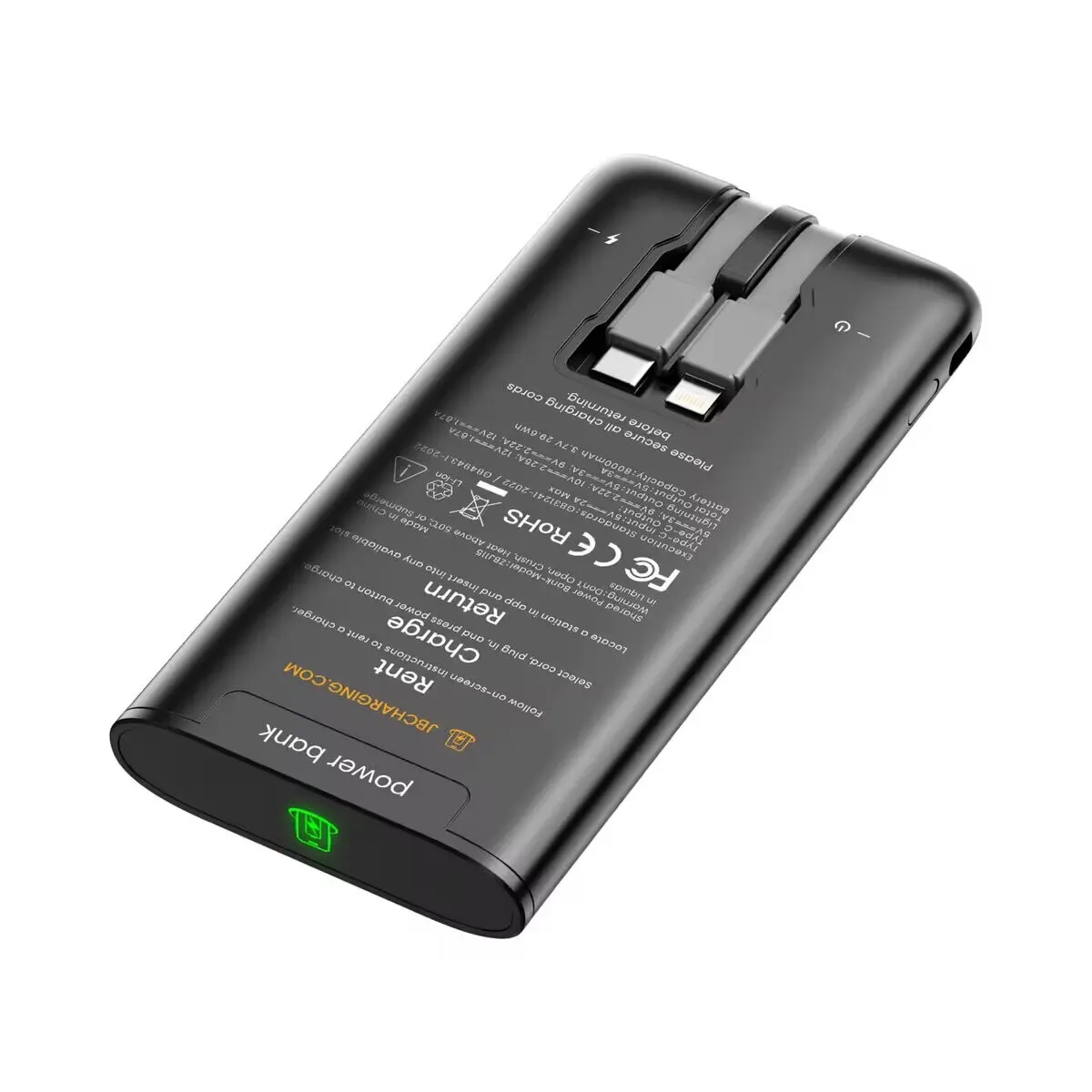
A guest whose phone is already dead will need a physical card, so keep the ride-home exception even with a station.
Pricing is set per station. The common default is $3 per 30 minutes with a $20 daily maximum. A guest who keeps a bank past the return window (24 hours by default) pays a non-return fee and keeps the bank. The bar is never charged. For a plain-English guide to share with your staff, see how power bank rental works.
Who does what: the operator owns, stocks and services the station, so restocking and repairs aren't your staff's job. We handle renter payments and support through the machine, the app or the receipt, so a guest with a problem doesn't need your bartender. The operator's dashboard flags a station that goes offline or runs low on charged banks. Before install, ask who to call and how often they'll visit.
What the bar does: provide a spot and a standard wall outlet, and cover the electricity. The J8 Pro countertop station runs on a 60-watt adapter, about what a laptop charger draws. It's about 9 inches square at the base and 16 inches tall, and it can go on a floor stand or a wall mount if counter space is tight. It runs on built-in 4G and uses Wi-Fi only as a backup where the cell signal is weak, so there's usually no IT ticket. Staff can register with the station's staff code for a free rental each day, within a weekly limit.
Where it goes: somewhere a guest can see it from a stool and reach it without asking staff. That means the hallway to the restrooms, the host stand, near the entrance, or on a stand or wall mount just past the end of the bar, on the restroom path. Never put it on the bar top where drinks are poured or set down, never in an exit path, and always plug it straight into a wall outlet, with no extension cord. In a dark room, the lit "Charge Your Phone" header does the advertising.
If your insurer or fire marshal asks: the station plugs straight into the wall and stays out of exit paths, and the power banks charge inside it and carry FCC, CE and RoHS marks. We can also name your venue as an additional insured on our general liability policy on request.
The terms: under our standard terms, hosting is free to the bar apart from the electricity. The local operator who places the station signs the agreement with you. All terms, including any share of rental revenue (paid monthly by direct deposit), are agreed in writing before install. The standard agreement runs 6 months, then month to month, with 30 days' notice to end it and removal at no cost to you. It says you aren't liable if a guest steals or misuses a bank, and that you won't host a competing charger during the term. An operator's terms can differ, so read what you sign against our venue agreement checklist.
Prefer to own one? A countertop J8 Pro lists at around $1,200 on its own at the time of writing. Your team then does the operator's work: keeping it stocked, online and serviced.
When a station isn't worth the counter space
A station makes sense where people stay for hours and leave late: sports bars on game days, late-night bars, packed weekend rooms. There, a charged phone is one less reason for a guest to close out early. A lunch counter where guests stay 40 minutes rarely needs one; USB outlets at the rail will do.
A station also won't end every request. Staff still get asked, but the answer takes 2 seconds: "Charging station by the restrooms. Tap your card." Still weighing hardware? Compare charging lockers, power bank rental and cable stations side by side.
Next step
See how a station would fit your room on our bars and restaurants page.
Frequently Asked Questions
Do bars have to charge your phone?
No. Charging a guest's phone is a favor, not a service a bar owes you, so it comes down to the bartender's judgment and the house policy. Restaurants work the same way. Some bars do it gladly, some only when it's quiet, and some say no to every request. Bring your own cable and ask early in the night.
Is a bar responsible if my phone gets damaged while charging behind the bar?
It depends on what happened and on local law. Whether the bar's insurance pays is a separate question. The standard commercial general liability form excludes personal property in the insured's care, custody or control, so a bar's policy may not pay for a phone it was holding, even as a free favor. That's one reason some bars won't take phones. If the phone matters, keep it with you and charge at your seat or with a rental power bank.
How can a bar offer phone charging without staff handling phones?
Two options keep the phone in the guest's hands: outlets or cables at the seats, or a self-service power bank station. With a station, the guest taps a card or phone, takes a charged power bank with built-in Lightning and USB-C cables, and returns it to any free slot. Staff don't hand anything over.
What does a phone charging station cost a bar?
Under our standard terms, hosting a JB Charging station is free to the bar. The bar provides a spot and a standard wall outlet and pays for the electricity the station uses. Before install, the local operator who places the station agrees all terms with you in writing, including any share of rental revenue. If you'd rather own a station, a countertop J8 Pro lists at around $1,200 on its own at the time of writing.
What happens if a guest walks off with the power bank?
If a bank isn't returned within the station's return window (24 hours by default), the renter pays a non-return fee and keeps the bank. The bar is never charged.
Do bar staff have to do anything once a station is installed?
Day to day, no. Guests rent and return power banks themselves, and renters get help through the machine, the app or the receipt. The local operator who places the station stocks and maintains it. Staff can register with the station's staff code for a free rental each day, within a weekly limit.