Casino Phone Charging Stations: A Playbook for Operators
JB Charging Team

Casinos are among the strongest venues for paid power bank rentals we've observed across the industry, and the ones you can win aren't on the Strip. Regional, tribal, racino and card-room properties decide close to the floor and keep guests for hours. Below: who signs off on a casino phone charging station, what to say, the paperwork bars never ask for, and what one tower has to rent to cover its cost.
Skip the famous resorts. They buy through corporate, and many already have a charging vendor. If you manage a casino, our casino page is written for you.
Why casinos work, and which ones to call
Picture 1:15am on a Saturday at a regional casino. A guest two hours into the slots is at 6%, and her phone holds her players-club offers and her ride home. She can cash out early, or hand the phone to the players-club desk and make it a staff problem. That moment is what you're selling.
| Property type | Why it fits | Watch for |
|---|---|---|
| Regional casinos, including riverboats | Regulars, long sessions, often a buffet and hotel | Steel hulls can weaken signal |
| Tribal casinos | Over half are small properties (see below) | The tribal gaming commission may license vendors |
| Racinos | Simulcast crowds who sit for hours | Seasonal race calendars |
| Card rooms | Poker players hold one seat for hours; the owner or GM decides | One J8 may be enough |
For fiscal 2025, the National Indian Gaming Commission counted 545 tribal gaming operations in 29 states, and just over half reported less than $25 million in gaming revenue. Target the ones with a players club, a restaurant and a 24-hour floor.
Why put up with a longer sales cycle? Here's the hypothetical math. Say one J24 Pro costs about $3,550 delivered at list price at the time of writing, and each rental (an hour at the default $6) leaves you about $4.20 after JB's 20% and a hypothetical 10% venue share. About 850 rentals cover the tower: about 11 months at 3 rentals a day with $40 a month in costs, or closer to three and a half years at 1 a day. The spot matters more than the property.
Who decides at a casino
A bar owner decides on the spot. At a casino, marketing champions it, security can veto any spot, and purchasing sets the timeline.
| Role | What they care about | Their part |
|---|---|---|
| Marketing or guest-experience director | Guests staying on property; players-club growth | Your champion |
| Players-club manager | A desk that lends cables and holds phones | Strong ally |
| F&B or hotel operations | Buffet lines, bars, the lobby | Adds placements |
| Security and surveillance | Camera coverage, exit paths, who restocks | Can veto any spot |
| IT | Devices on their network; card data | Can rule out a spot with no signal |
| Risk, compliance, purchasing | Insurance, contracts, vendor registration | Sets your timeline |
| GM | The whole property | Signs at smaller properties |
| Tribal gaming commission | Vendor licensing | Separate from the casino |
Getting the first meeting. Ask the players-club desk who handles guest amenities, then call that office. Bring a charged J8 Pro to the meeting room, not the floor, tell security at the door what's in the case, and rent a bank on your own card. Then ask who else needs to see it.
The pitch: guests stay on property, and nobody at the desk holds phones
Lead with the guest and the staff, never with the revenue share.
Subject: Where do guests charge phones on your floor?
Hi [name], when a guest's phone dies on your floor, where do they charge it? I run phone charging stations in [area]. Guests tap a card, take a charged power bank back to the game, and return it to any free slot. Each station needs one standard outlet, runs on its own cellular connection, and costs the property nothing but electricity. Could I bring one by for 15 minutes on Tuesday or Wednesday?
One line per person:
- Marketing: "A guest at 5% doesn't have to leave the floor to fix it."
- Players club: "When someone asks your desk for a charger, staff point at the station. Nobody has to mind anyone's phone."
- Security: "It sits where your cameras can see it, on one outlet, out of exit paths, and runs on its own 4G, so it doesn't touch your systems."
- IT: "It takes cards on its own reader, never through your point of sale, and uses your Wi-Fi only if you offer it."
The screen offer. Give the property the first screen slots (shows, buffet hours, players-club sign-up) in files their compliance team approved. Expect a ban on other casinos and unapproved gambling ads, so agree in writing which outside ads you may sell. Here the screen often works better as a trade for a better spot than as ad space.
The ask. Close on one station at one spot, with a start date and a 60-day check-in where you show marketing its rentals from your portal and ask for a second spot. Any venue share comes out of your 80%; see how much revenue share to offer a venue. Within a day of each meeting, send one short email that ends on one question, such as "Tuesday or Thursday for the site walk with security?"
Casino objections, answered
"We already have a charging vendor." Ask when that agreement renews and offer to be the second quote. Don't knock the other company.
"Who fixes it at 3am?" You do, on the schedule you agreed with security; the portal flags a station that's offline or out of charged banks. Don't promise a response time.
"Lithium batteries? Is it UL listed?" Answer with what's documented: FCC, CE and RoHS markings on the power banks, and a wall outlet clear of exits. Never claim a listing you can't show on paper. Some risk teams require a specific listing, so ask early what theirs requires, and check with us before you promise anything.
Bring the vendor packet to the first meeting
- A W-9 and your business entity details.
- A certificate of insurance from your own liability policy, naming the property as additional insured if asked. JB Charging's insurance doesn't cover you; see insurance and COIs for operators.
- A spec sheet: footprint, weight, power draw, one standard outlet; built-in 4G, so it doesn't need their network (Wi-Fi is an optional backup, used only if they provide it); the card reader; FCC, CE and RoHS markings on the banks.
- How a rental works, including the default non-return rule: a bank not back within 24 hours puts a $40 fee on the renter's card, never the property's. You set both per station.
- A one-page summary for the GM, in five lines: what it is, where it goes, what it costs the property, who services it and when, and the term and exit.
- The agreement. JB's standard venue agreement runs 6 months, then month to month, with 30 days' notice and removal at no cost to the venue. If the property uses its own, have your attorney check indemnity, insurance and removal. A tribal casino can generally claim sovereign immunity unless it has clearly waived it, so the contract should spell out how disputes are settled and how you get your stations back.
Ask early whether vendor registration applies. In New Jersey, the casino files a Vendor Registration Form for any enterprise it does business with. Pennsylvania's board ties paperwork for non-gaming suppliers to the dollar amount of business with a casino over 12 months. Tribal commissions set their own rules, and one commission's licensing rules require at least a permit for every non-gaming vendor, plus background checks on its on-site representatives. Then ask compliance two questions:
- Does registration apply to a vendor the property doesn't pay? Here the money usually flows the other way: renters pay you, and you may pay the property a share. Don't assume a threshold exempts you.
- Does each person who restocks need a registration or badge? In Pennsylvania, a registered vendor's employees who work on the gaming floor without touching gaming equipment need a non-gaming employee registration. Don't send a new helper until you know.
Placing a casino phone charging station: the site walk
Pick the first spot to prove the property: the sportsbook, the players-club desk, or the corridor in from the hotel or garage. Then check five things:
- Security signs off. In camera view; out of slot aisles, the pit and exit paths; never behind the cage counter. A J24 stands about 71 inches tall, so check it doesn't block a camera's view, and agree how it will be secured.
- Signal works. Casinos are heavy on concrete and steel, so check cell signal at the exact spot and run a test rental there on install day. If 4G is weak, move the spot before you ask IT for Wi-Fi; many will say no.
- An outlet is in reach, with no extension cord and the cord clear of foot traffic.
- Returns flow. Guests pass the spot again on the way out. For bus day-trippers, that's just inside the door to the pickup.
- You can restock it. Know which door you'll use and who escorts you, especially overnight.
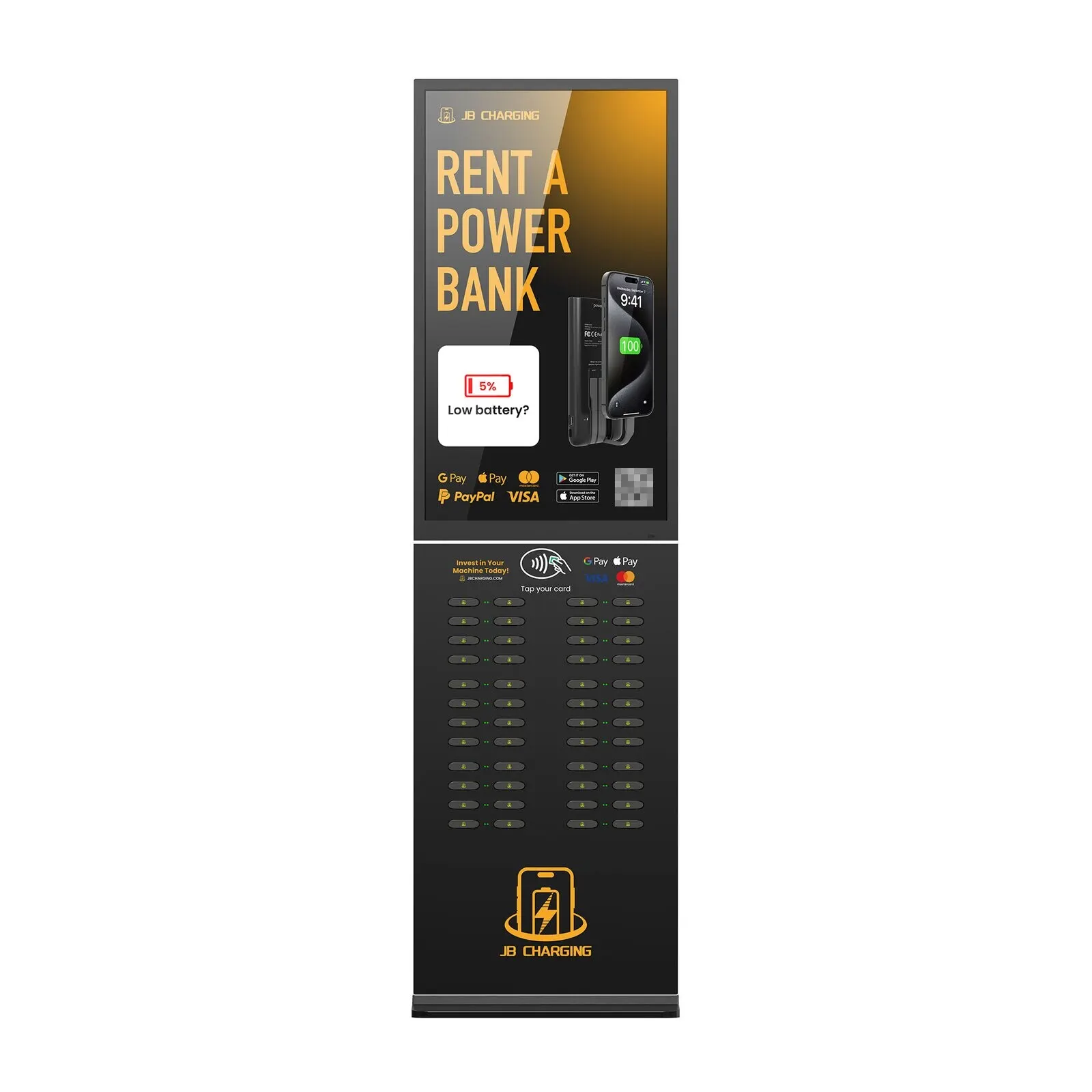
Start with a J24 Pro (24 banks) at the busiest pause point. A J8 Pro (8 banks) fits the players-club counter, a lounge or a card room. Save the J48 Pro (48 banks, built to order) for the largest floors. At list price at the time of writing, plus shipping at checkout, a J24 is $3,299, a J48 $4,299, and a J8 about $1,200 on its own, less in bundles.
Pricing and running a 24-hour floor
- Restock in the property's quiet hours, on a schedule security has signed off. The portal shows each station's charged banks and flags one that's offline, low or out.
- Treat the daily maximum as your price for night players. At the default $3 per 30 minutes, any rental past three hours hits the $20 daily maximum, so a bank kept from 9pm to 3am costs $20. Set it with marketing before install, since a night player who feels overcharged complains at the players-club desk.
- Use a free first period as a bargaining chip. Up to 60 free minutes per rental makes charging feel like a perk, but it's revenue you give up, so trade it for a second spot or no venue share.
- Set up the staff code. Registered staff get a free rental each day, within weekly limits. Dealers and cage staff often can't carry phones on shift, so offer it to players-club, F&B and hotel staff first.
The math, for illustration
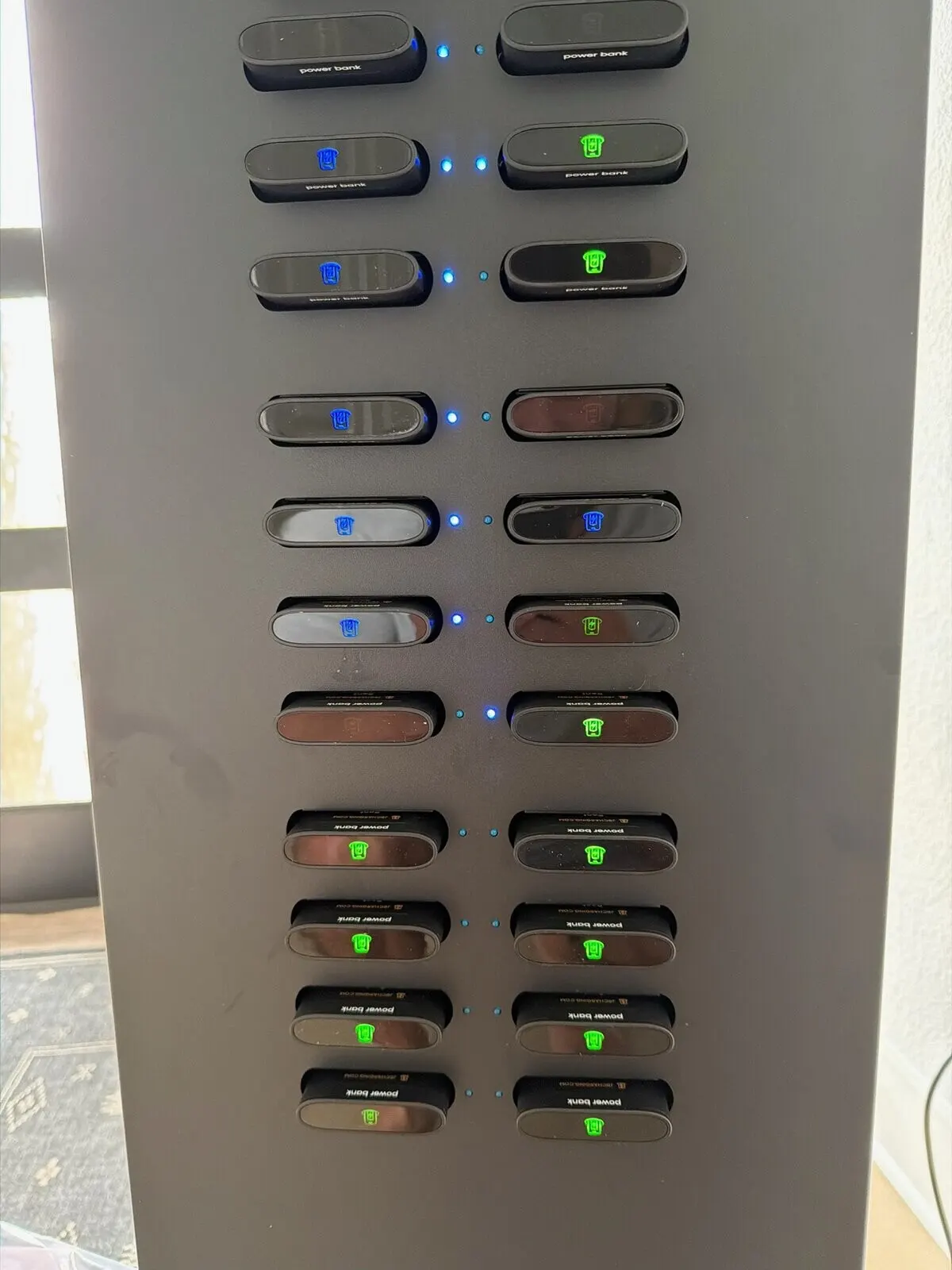
Assume one J24 Pro at $3,299 list price at the time of writing plus $250 freight as shown at checkout: about $3,550. Each rental is an hour at the default $6. You keep 80%, or $4.80, and a hypothetical 10% venue share of gross (not a standard rate) leaves you $4.20. Costs run $40 a month for replacement banks, fuel, parking and your share of insurance, not counting your time or taxes. No screen ads.
| Hypothetical rentals a day | Rentals a month | You keep | After $40 costs | Months to cover $3,550 |
|---|---|---|---|---|
| 1 | 30 | $126 | $86 | About 41 (3.5 years) |
| 2 | 60 | $252 | $212 | About 17 |
| 3 | 90 | $378 | $338 | About 11 |
| 6 | 180 | $756 | $716 | About 5 |
None of these rows is a prediction. Revenue isn't promised, a station can earn less than its costs, and a property can say no.
- A slow spot is a lever, not a verdict. If a tower sits near the bottom row after a fair test, try another spot on the property before giving up; see when to move a charging station.
- Staying online matters more than the share. A 20% venue share instead of 10% stretches the 3-a-day row from about 11 months to about 13. Offline or out of charged banks half of every month, it takes about 24.
- Add a second tower once the first runs short of charged banks on busy nights. Two towers ($7,100, $75 a month in costs) sharing the same 3 rentals a day take about 23 months.
Costs that pull the other way: banks that walk off need replacing (check what your distributor agreement covers), paperwork and security check-ins take your time, and a property can remodel, close a wing or move you. The revenue calculator shows gross scenarios, so apply your 80%, the venue share and your costs to its answer.
Next step
Have a regional, tribal or card-room casino within driving distance? Book a call and bring the property type and the spots you'd pitch. We'll go through station choice, what belongs in your vendor packet, and the costs to plan for. Or see the stations first.
Examples are illustrative only, not a forecast or a typical result. What a station earns depends on the venue, placement, pricing, local demand, and how actively you run it.
Frequently Asked Questions
Will a casino let me put a phone charging station on the gaming floor?
Plan on spots just off the gaming floor rather than in it: the players-club desk, the sportsbook, buffet lines, lounges, and the corridors in from the hotel or garage. Security and surveillance approve each spot and will want it in camera view and clear of slot aisles, the pit and exit paths. Each station needs one standard outlet and runs on its own 4G, so it needs nothing from the casino's network.
Do I need a gaming license to put charging stations in a casino?
A charging station isn't gaming equipment, but some regulators still register companies that sell non-gaming goods or services to a casino. In New Jersey, the casino files a vendor registration form for enterprises it does business with. Pennsylvania ties its paperwork to the dollar amount of business with a casino over 12 months. Here the money usually flows the other way, since renters pay you and you may pay the property a share, so don't assume a threshold exempts you. Tribal gaming commissions set their own rules, and some require a vendor permit and background checks on a vendor's on-site representatives. Ask the property's purchasing or compliance office what applies before you plan a start date.
What insurance will a casino ask a charging station operator for?
Expect to be asked for a certificate of insurance from your own general liability policy, often naming the property as additional insured. JB Charging's insurance doesn't cover you as the operator, so carry your own policy. Larger properties often set insurance minimums in their vendor agreement, so check them with your agent before you sign, and ask how fast your agent can issue a certificate, because a slow one can hold up the whole approval.
Can casino guests rent a power bank with cash?
Not with cash, chips or tickets. Guests pay with Apple Pay, Google Pay or a contactless card at the station's built-in reader, or rent through the app by scanning the QR code. Payment never goes through the cage or the casino's point of sale. Pitch spots where guests already have a card or phone out, like the players-club desk and food lines.
How long does it take to get a charging station into a casino?
Longer than a bar. Expect several meetings, a security walk, and insurance and vendor paperwork before anything is installed, and at a tribal property a vendor license can add more time. Bring your vendor packet to the first meeting so the paperwork never waits on you, and keep your other stations placed elsewhere while the casino decides, not sitting in your garage.
Will a casino want a share of power bank rental revenue?
Some will and some won't. Many venues host a station as a guest amenity; others negotiate a share, which comes out of your 80%. You set the venue share per station in your portal. Lead with what the station does for guests and staff, and trade concessions such as a free first period or the first screen slots before you offer money.

