Building a Long-Wait Charging Route: Dealership Lounges, Salons and Laundromats
JB Charging Team

A phone charging station for a car dealership waiting room, a salon or a laundromat won't see a Saturday-night rush. What it gets is time: customers who often sit 45 minutes or more on a weekday morning, waiting on a car, a color or a dryer, who can tap a card and carry a charged power bank back to their seat. Here's which waits are worth a station, who signs, what to say, and how to fit them into the daytime half of a route.
The upside, as a hypothetical: say two dealer lounges on one road each pay you $100 a month to keep the first hour free, and a salon, a tire shop and a laundromat nearby get three paid rentals a week each. After $30 a month per station for gas and replacement banks, a five-station J8 Pro pack (about $4,745 with shipping, at list price at the time of writing) is covered in about 21 months, or about 10 at a rental a day per paid stop.
Is a charging station for a car dealership waiting room worth it?
Picture yourself in a dealership service lounge at 10:20 on a Tuesday, counting. Nine people in the chairs, one outlet behind the coffee machine, and a man on a call, phone at 8%, whose car sits on a lift until noon. He can't leave. He's the customer you're counting.
Dealer waits are long. J.D. Power's 2026 U.S. Customer Service Index (CSI) Study, released in March 2026, found that mass-market customers wait 1.61 hours for maintenance work at the dealer, and premium-brand customers 2.46 hours. Independent shops are quicker: 62% of similar aftermarket visits take under an hour. That sets the order of your list: dealer lounges first, premium stores before mass-market, and tire or repair shops only where the jobs run long.
Plenty of dealer customers take a shuttle or a loaner instead, so the rule for any stop is the same: waits of 45 minutes or more, with customers who stay seated. Shorter than that, most people decide their phone will make it home.
Which waiting businesses work, and which don't
| Business | Why customers wait | What to check when you scout | Verdict |
|---|---|---|---|
| Dealership service lounge | The car is in the shop | Seats filled mid-morning; who sits versus takes the shuttle or a loaner | Worth a station where most customers wait |
| Tire or repair shop with a lobby | Tires, brakes, inspections | Time three jobs (many finish in under an hour); count who stays in the lobby | Only where jobs run long |
| Salon doing color, extensions and other long services | The client is in the chair | How much of the book is long services | The sleeper: the outlet doesn't reach the chair, a bank does |
| Laundromat | Wash, then dry | Time a few customers; count who stays versus leaves and comes back | Worth a station where people stay |
| Quick lube, dry cleaner, bank, quick-service counter | In and out, or the customer stays in the car | Skip | |
| Offices, gyms, medical and dental offices | Short or scheduled visits | Skip for paid rentals |
Hospitals and urgent care turn on who pays; see the hospital playbook.
Run it as the day half of your route
Different hours, same streets. Bar rentals cluster at night; waiting rooms rent during business hours, weekdays included. Dealerships tend to line up along the same commercial roads, and salons and laundromats share strip centers with the bars you already serve. A bank can go back into any JB Charging station, so each station you add nearby is another return slot for the rest.
A route day, hypothetically. Say your stops sit along one commercial road. Check the portal first, then:
- 9:45 a.m.: the first dealer lounge, after the drop-off rush. Swap worn banks, check the screen, say hello to the service manager.
- 10:15: the group's second store, a mile up the road.
- 11:00: the tire shop lobby.
- 1:30 p.m.: the salon, between appointments.
- 2:15: the laundromat in the same strip center.
- 4:00: your bars, while staff set up for the evening.
One loop, and you never visit a stop during its rush.
One yes, several stations. A dealer group, or a laundromat owner with three stores, can place several stations on one decision. Not every owner says yes, so pilot one location, bring the owner its first 30 days from your portal's Venue Insights, then ask for the rest.
Who decides at each stop
| Stop | Start with | Who signs | When to walk in | What they care about |
|---|---|---|---|---|
| Single-store dealership | Service manager, at the service drive, not the sales floor | General manager or dealer principal (the owner) | Weekday mid-morning, after the drop-off rush | The wait, advisors' time, customers coming back for service |
| Dealer group | Service manager at one store | Fixed operations director (service and parts across the group) | Same | One pilot store, then the others |
| Tire or repair shop | The owner, usually on site | Owner | Weekday mid-afternoon | Customers asking "how much longer?" |
| Salon | Front desk, to learn when the owner is in | Owner | The slow hours the desk gives you | Long-service clients; outlets kept free for styling tools |
| Laundromat | The attendant, or the posted service number | Owner, who may run several stores | When the owner stops by; call ahead | No work for the attendant |
The person who loves the idea often can't sign, and franchised stores may have brand rules for the lounge, so ask who approves anything new there. Bring a one-page summary they can forward: station size, the outlet it needs, what staff do (nothing), the terms, and your certificate of insurance. Dealer groups often ask every vendor for one, so carry your own general liability policy. See getting past "corporate has to approve".
Pitch lines for service managers, salon owners and laundromat owners
To a service manager: "Quick question: when a customer's phone dies in the lounge, what happens?" Listen for a cable lent from the advisor desk. Then: "I'd put a small station by the cashier. Customers tap a card, take a charged power bank to their seat, and drop it in when they pick up their keys. Your advisors stop lending cables, and the customer can still answer the text with the inspection video. Under standard terms, agreed in writing with me, it costs the store nothing but the electricity. Or you can make the first hour free with a flat monthly fee, and I invoice you for it."
To a salon owner: "Your color clients sit a long time, and the outlet doesn't reach the chair. A power bank does, with the cables built in. They tap, take one, and drop it back when they pay. Your front desk does nothing, and your stylists can register for a free rental each day."
To a laundromat owner: "This one needs an outlet, takes nothing from your attendant, and stops customers asking for a charger. If someone keeps a bank, their card pays the fee, not you."
For an owner who wants something to read, send our page on phone charging for dealership lounges, salons and other waiting areas.
Free first hour or paid rentals: which to offer where
Paid rentals. The default is $3 per 30 minutes with a $20 daily maximum, set per station. The business hosts it as an amenity or takes a share you agree on in writing, and any share comes out of your 80%.
A business-paid first hour. Give every rental on the station a free opening period of up to 60 minutes, and the business pays you a flat monthly fee for it, on your own invoice, separate from the station's rentals. There's no JB Charging price for this; you and the business agree the number in writing. Customers still tap or scan to start, and anyone who keeps a bank past the hour pays your normal price. Don't promise free charging all day: the free period tops out at 60 minutes.
Which to offer where. Bring the fee option to dealerships, premium stores first: they already pay for coffee, Wi-Fi and shuttles. Bring paid rentals to salons, laundromats and tire shops, where a monthly invoice is a harder ask than a spare outlet.
Price the fee for what it gives up. At the default price, a 90-minute wait costs the customer $9 on a paid station and $3 with the first hour free. Set the fee to cover the station's costs plus the rentals you give up.
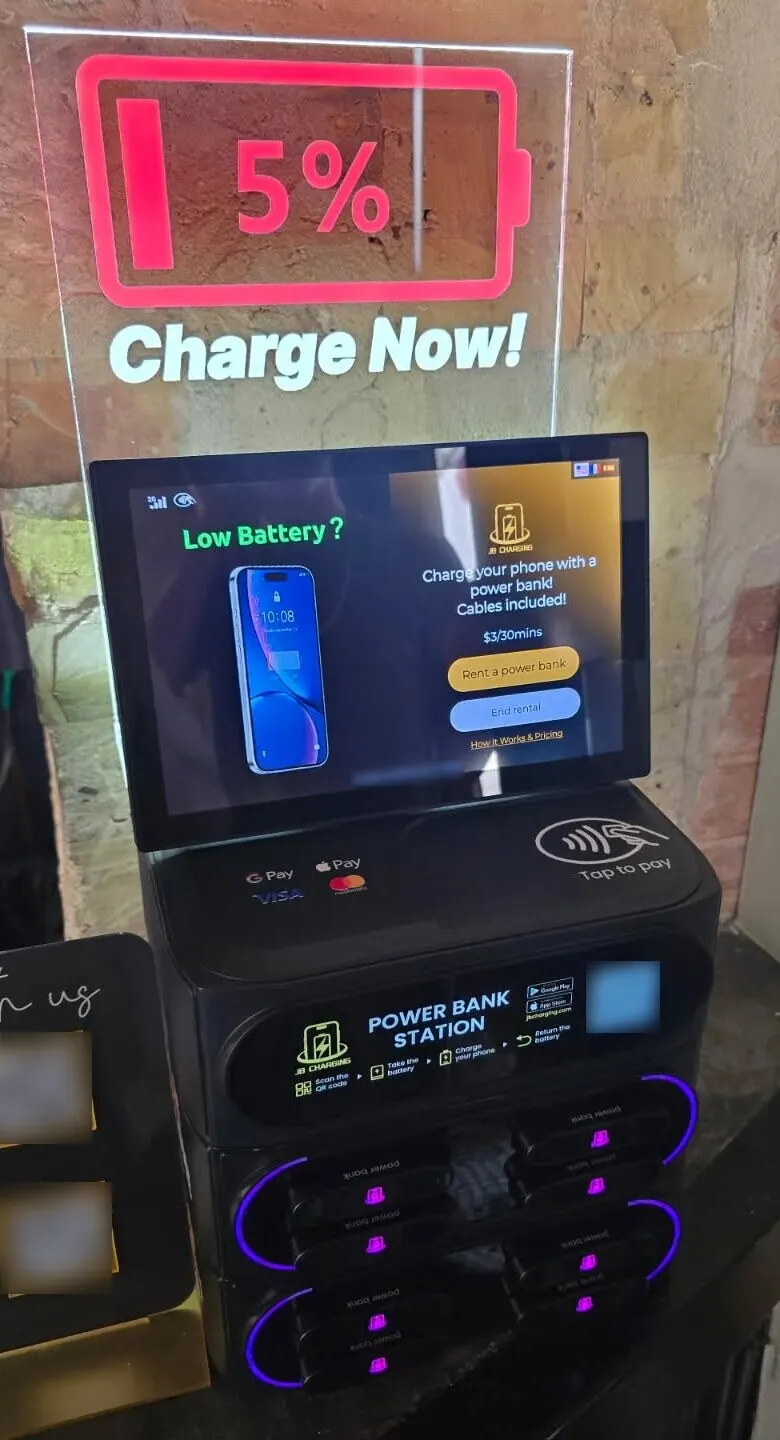
The math on a long-wait route, hypothetically
Say you place one J8 Pro 5-pack (about $4,745 with shipping at list price at the time of writing; a single J8 Pro is about $1,235) along one road: two dealer lounges that each pay you $100 a month for a free first hour, plus a salon, a tire shop and a laundromat on paid rentals. Assume each paid rental runs an hour ($6 at the default price), no venue share or screen ads, nothing counted past the free hour at the dealers, and $30 a month per station for gas and replacement banks ($150 in all, not counting your time).
| If each paid stop gets | Your 80% of rentals | Plus $200 in dealer fees | After $150 in costs | Months to cover $4,745 |
|---|---|---|---|---|
| 1 rental a week (12 a month in all) | $57.60 | $257.60 | $107.60 | About 44 |
| 3 a week (36 in all) | $172.80 | $372.80 | $222.80 | About 21 |
| About 1 a day (90 in all) | $432 | $632 | $482 | About 10 |
- The fees are the floor. Without them, five paid stations at one rental a week give you $96, short of $150 in costs.
- Venue choice moves it most. Each paid stop that goes from one rental a week to three adds about $38 a month, so time the tire shop's jobs before you pitch.
- Any venue share comes out of your 80%. A 10% share of gross on the busy row takes $54 a month off it.
To run your own: rentals a month × average rental × (80% minus any venue share) − monthly costs = monthly net. Divide the station cost by that. The revenue calculator shows gross, before JB's 20%, any share and your costs.
Setting up: one station, at the checkpoint
Nearly every waiting room takes a J8 Pro: 8 banks in about 9 by 9 inches, on a countertop, a $150 stand or an optional wall mount. Size by how many people sit at once, since a bank stays out for the whole wait. A J24 Pro tower (24 banks) earns its floor space only in a big dealership lounge that fills on Saturday mornings.
- Put it where the visit ends. Dealer customers stop at the cashier or advisor desk for their keys, so that counter, or the coffee bar beside it, gets banks back. At a salon, use the guest side of reception.
- Laundromats have no checkpoint. Customers walk out with a basket and nobody sees them off. Put the station by the folding tables nearest the door, in view of the attendant or a camera, on a stand or wall mount. Don't loosen the non-return window there, and skip any store you wouldn't leave a vending machine in.
- Rent a bank before you leave. Stations run on built-in 4G with Wi-Fi as a backup, and a lounge deep inside a big building can be a weak spot. Do a test rental at the exact spot: standard outlet, no extension cord, nothing in a walkway.
- Give staff one line, and put it on the screen: "Leave the power bank in the station when you get your keys." Have staff register with the station's staff code. The rest of the screen is ad space: you keep 100% of any ads you sell, but you find the advertisers yourself and sales aren't guaranteed. Or show the business's own specials, and agree in writing what won't run there, like rival service departments.
Service. A daytime lounge with staff around is easier on a station than a packed bar at 1 a.m. Check in every two weeks or so, sooner when the portal flags a station offline, a card reader down or banks running low, and leave a couple of slots empty for returns.
Objections you'll hear in a waiting room
"We're trying to cut wait times, not make the lounge nicer." Keep cutting them. Today's customer still waits, and if your advisors text inspection videos or quotes, a customer at 3% can't approve one.
"We give away coffee and Wi-Fi. Charging customers looks cheap." Then offer the business-paid first hour, and let the screen say "First hour free."
"We already have outlets, or USB at the tables." Those tie a customer to one seat and a cable they had to bring. A bank, Lightning and USB-C built in, goes to the chair by the TV or outside on a call, and the store buys nothing.
For staff time, space and safety questions, see 12 venue objections and how to answer them.
Next step
Have a dealer row, a busy salon or a laundromat owner in mind? Book a call and bring the list. We'll talk through which stops to pitch first and which station fits each room. Or compare the stations first.
Examples are illustrative only, not a forecast or a typical result. What a station earns depends on the venue, placement, pricing, local demand, and how actively you run it.
Frequently Asked Questions
Is a charging station worth it in a car dealership waiting room?
It can be, where most service customers wait on site instead of dropping the car off or taking a shuttle or a loaner. Dealer maintenance waits run long: J.D. Power's 2026 U.S. Customer Service Index (CSI) Study (March 2026) found that mass-market customers wait 1.61 hours for maintenance work at the dealer, and premium-brand customers 2.46 hours. Before you pitch, count seated customers at 10 a.m. and 2 p.m. on two weekdays, and ask an advisor how many customers wait rather than drop off. A lounge that's mostly empty won't give a station much to do.
Who do I pitch at a car dealership?
Ask for the service manager at the service drive, not the sales floor, because the service department runs the lounge. At a single store, the general manager or the dealer principal usually signs. At a dealer group, the fixed operations director, who oversees service and parts across the group, can approve a pilot at one store and then the others. Walk in mid-morning on a weekday, after the drop-off rush, with a one-page summary they can forward.
Can a business pay so its customers charge for free?
Partly. You can give every rental on a station a free opening period of up to 60 minutes, and the business can pay you a flat monthly fee for it, on your own invoice and agreed in writing. There's no JB Charging price for this, so you and the business set the number. Customers still tap or scan to start, and anyone who keeps a bank past the first hour pays the station's normal price. Don't promise free charging all day: the free period tops out at 60 minutes.
What happens if a customer drives off with a power bank?
The business is never charged. By default, if a bank isn't back within 24 hours, the renter's card is charged a $40 non-return fee, and you can set both the window and the fee per station. Replacing the bank may be on you, so check the replacement coverage in your distributor agreement; power banks list at $200 for 10. A station by the cashier, where customers pick up their keys, plus a one-line reminder from staff, makes returning the easy habit.
Does the station need the dealership's Wi-Fi?
No. Every station we sell ships with built-in 4G at no charge, with Wi-Fi only as a backup, so it never has to join the dealer's network. Do a test rental at the exact spot first, because a lounge deep inside a big building can have weak signal.
Do laundromats work for power bank rentals?
They can, when customers stay through the wash and the dry instead of leaving and coming back. Time a few customers on a busy morning and count how many stay. A laundromat has no checkout counter to catch returns, so put the station near the door, in view of the attendant or a camera. Some owners run several stores, so one yes can place more than one station. You set pricing per station; the default is $3 per 30 minutes with a $20 daily maximum.

