
Phone Charging Stations for Waiting Rooms: Service Lounges, Salons, Laundromats and More
Customers tap a card and charge at their seat through the brake job, the color or the dry cycle. Where a local operator serves your area, they install and service the station at no cost to you beyond electricity, under our standard terms.
Charge from any seat
Customers take the power bank to the lounge chair, the salon chair or the laundromat bench. Nobody has to camp beside the one outlet behind the couch.
The 'it's ready' text lands
Inspection videos, pickup texts and your-turn alerts reach a phone that's still charged, not one that died in the lounge.
Nothing for staff to run
Customers tap, take and return on their own. A bank that isn't returned is billed to the renter's card, never to your business.
A phone charging station for waiting rooms makes the most sense wherever customers sit for 45 minutes or more: a service lounge during a brake job, a salon chair during a color, a laundromat bench through the dry cycle. Customers tap a card and carry a charged power bank back to their seat. Where a local operator serves your area, our standard hosting terms cost you nothing beyond electricity, and your staff don't run it.
Why customers run low while they wait
- Dealership service lounges. Picture 9:40 on a Thursday. Your advisor texts a front-brake inspection video to a customer who has spent the morning on calls in the lounge, her phone at 3%. In the Cox Automotive 2026 Fixed Operations and Ownership Study, 49% of consumers said photos or videos make them more likely to approve recommended services. If her phone dies, the approval waits until someone walks out to find her.
- Salons and barbershops. A color client sits through processing, often under a dryer, while the outlet at the chair runs the blow-dryer and flat iron. On a walk-in Saturday, the whole line is on their phones.
- Laundromats. A wash plus a dry is a long sit. If your machines take app payments, a dead phone can mean no next load.
Where it doesn't work. An express oil change or a drop-off counter is over before a phone runs low. In our experience, people in medical waiting rooms rarely pay to charge; clinics should start with our hospital page.
How a customer rents a power bank
- Tap a card or phone (Apple Pay, Google Pay or any contactless card) on the station's reader (every station we sell has one), or scan the QR code. No app or account needed.
- Take a charged power bank with Lightning and USB-C cables built in.
- Sit anywhere: the salon chair, the laptop table, outside on a call.
- Return it to any free slot at any JB Charging station, and billing stops.
It takes about 30 seconds. At a common setting of $3 per 30 minutes with a $20 daily maximum (the operator sets the price), an hour costs the customer $6.

Power bank station, cable tower or lockers?
| Option | In a waiting room | Watch out for |
|---|---|---|
| Cable tower or wall hub | Free to customers once bought | People must sit beside it; cables break or walk off |
| Charging lockers | The phone charges behind a locked door | The customer can't see the "it's ready" text |
| Power bank station | The phone stays in hand at any seat; staff lend nothing | Customers pay per rental beyond any free first period |
Where a phone charging station goes in a waiting room
Put it in sight of the seats, on the customer's side of the counter, on the way to where people pay. A bank rented on arrival then goes back as the customer settles up, not out to the car.
| Venue | Best spot | Skip |
|---|---|---|
| Dealership service lounge | Coffee bar, or the counter on the way to the service cashier | The service drive, where people stand for minutes |
| Tire shop or barbershop | Wall-mounted beside the waiting chairs | Behind the counter, where staff end up lending banks |
| Salon or spa | Reception counter, guest side, or on a stand by the retail shelves | The shampoo and color area: water and chemicals |
| Laundromat | Wall or attendant counter facing the seats, in view of staff or a camera | On a washer or dryer (vibration, heat, water), or an unwatched back corner |
| Licensing or take-a-number office | In the seats facing the now-serving board, where a dead phone means a missed turn | The ticket kiosk, where people walk through |
Every spot needs a standard outlet within cord reach: no extension cords, nothing in an exit path. It plugs in: no electrician, no construction. Deep inside a large building, ask the installer to test a rental at that spot; cell signal can be weak there.
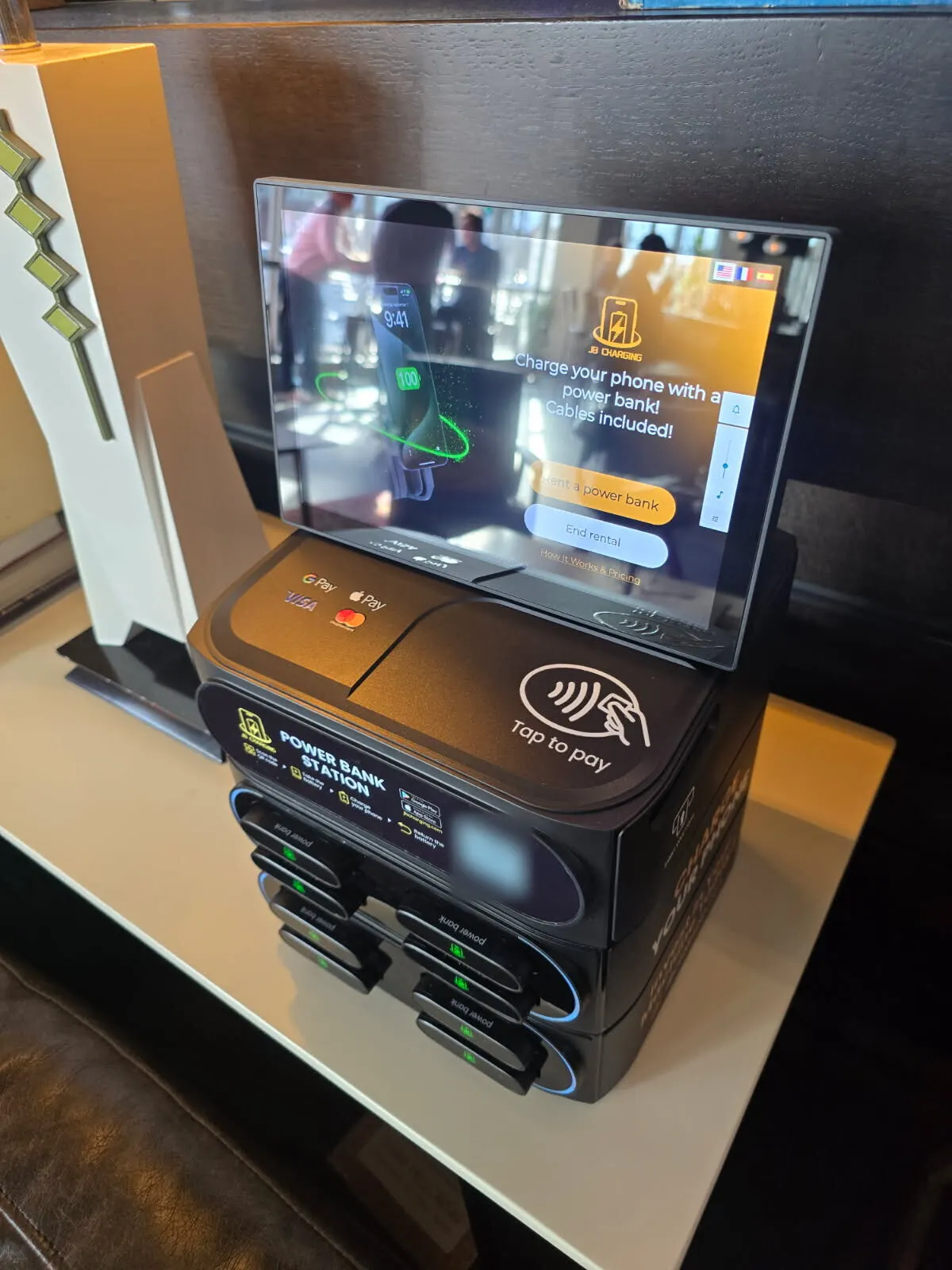
Which station fits your waiting room
A bank stays out for the whole wait, so size by how many people sit at once, not by daily visits.
| Your waiting area | Start with | Add a station when |
|---|---|---|
| Barbershop, tire shop, salon, spa or laundromat | One J8 Pro (8 banks, about 9 x 9 inches of counter) at reception or wall-mounted | Your operator sees it run out of banks on busy days, or a second room can't see it |
| Dealership service lounge | One J8 Pro at the coffee bar | Saturday mornings empty it: add a J8 by the cashier, or a J24 tower (14 x 18-inch footprint) in a large lounge |
What your staff do (and don't)
You provide the spot and the electricity. Staff don't hand out banks, take payments or chase returns; monitoring and restocking are the operator's job. If the station is empty or offline, call your operator; they own it and handle repairs. Staff who register with the station's staff code get a free rental each day, within a weekly limit.
A service advisor's line at check-in:
"We'll text you when it's ready. If your phone's low, the charging station is by the coffee. Tap your card, and drop the bank back when you pay."
At an unattended laundromat, the lit "Charge Your Phone" header and pitch cards on the folding tables do the talking; ask your operator for a stack.
Hosting terms in plain words
- Who does the work. Where one serves your area, a local, independent operator on the JB Charging network supplies, installs, stocks and services the station. If none does, we'll tell you.
- What it costs you. Under our standard terms, nothing beyond electricity. The operator is paid from rentals and any screen ads it sells. Many venues host it as an amenity; others agree a share of rentals, paid monthly by direct deposit.
- Free for the first hour. You already give away coffee and Wi-Fi. Ask your operator for up to 60 free minutes per rental and you can post "First hour of phone charging free," with normal pricing after that. It's outside the standard terms, so whether it's offered, and on what terms, goes in writing before install.
- Term and exit. Our standard agreement runs 6 months, then month to month on 30 days' notice, with free removal. You aren't liable for customer theft or misuse, and you agree not to host a competing charger during the term. Operators may vary these; check changes against our agreement checklist.
- The screen. Beyond the price and rent button, the operator controls the display. Ask for the agreement to say what may run there, such as your service specials and no competitors.
- Or own your stations. Buy them and you become the operator: you set the price, service and restock them, and keep 80% of rental revenue before your own costs. See stations and list prices.
To start, email team@jbcharging.com or request a station with your business name, city, usual wait and the number waiting at your busiest hour. We'll reply to tell you whether a JB Charging operator serves your area. Nothing is installed until you sign.
Run charging stations yourself? Read our operator playbook for long-wait routes.
Frequently Asked Questions
How much does a phone charging station cost our business?
Under our standard hosting terms, it costs nothing beyond the electricity it uses, where an operator serves your area. A local, independent operator on the JB Charging network supplies, installs, stocks and services the station, and is paid from customer rentals and any screen ads it sells. A J8 runs on a 60-watt adapter, so even drawing that much around the clock it would use about 43 kWh a month, which is under $10 at 20 cents per kWh. If you'd rather own stations, list prices at the time of writing are about $1,200 for a J8 Pro and about $3,300 for a J24 Pro tower, plus shipping, with no monthly fees, and you'd stock and service them yourself.
What if a customer leaves with a power bank when their car is ready?
The customer's card pays, never your business. Billing follows the station's pricing up to its daily maximum. By default, a bank that isn't back within 24 hours triggers a $40 non-return fee charged to the renter, who then keeps the bank. The operator can set a different window and fee. Placement helps: put the station on the way to where customers pay, so the bank goes back in a slot as they settle up.
We give away coffee and Wi-Fi. Can charging be free too?
For the first hour, yes, if your operator agrees. They can set a free first period of up to 60 minutes: a customer who returns the bank within it pays nothing, and the normal price applies after that. Customers still tap to start, so a bank that never comes back is still billed to them. A free period is outside our standard terms, so whether it's offered, and on what terms, is agreed in writing before install. Free all day isn't a standard setting. If you own your stations, you set the free period yourself. Either way, the price shows on the screen before anyone taps, and customers who'd rather use your outlets still can.
Do our staff or IT have to do anything?
Usually nothing. Customers rent and return on their own, the machine shows the steps in pictures, and renters get help from JB Charging through the machine, the app or their receipt. Every station we sell takes payment on its own card reader over a built-in 4G connection, with no monthly fee to you, so it doesn't rely on your network. If cell signal is weak at your spot, the operator may ask to join your guest Wi-Fi as a backup.
Is it worth it if most of our visits are short?
Probably not. In our experience, stations get used where customers sit long enough for a low phone to matter, roughly 45 minutes or more. In an express lane where most visits are over in minutes, people leave before they'd rent. If you run both, such as a quick-lube lane and a full-service bay with a lounge, put the station where the long waits happen.
Is it safe to keep a station of lithium power banks in our waiting room?
The power banks carry FCC, CE and RoHS markings and charge in their own slots in the station. It plugs straight into a standard wall outlet with no extension cord, and it should stay out of exit paths and away from water and heat, so not on a washer, a dryer or a shampoo station. If your insurer, landlord or fire marshal needs a specific listing or safety document, ask before install and we'll tell you plainly what we have.
We have several locations, or a franchise. Who has to approve it?
That depends on your franchise, dealer or lease agreements. Tell us each address and who signs off, whether that's the dealer principal, the franchise owner, the property manager or, for a public office, the agency that runs it, and we'll send spec sheets and product photos for their review. Each location gets its own station, and a bank rented at one can be returned at any JB Charging station, including another of yours.
Does JB Charging carry insurance, and can you add our business to the certificate?
JB Charging carries general liability insurance of $2 million per occurrence, and on request we can ask to have your business named as an additional insured on it. That policy covers JB Charging, not your operator. The operator is an independent local business that owns and services the station, so ask them for their own certificate of insurance, as you would any vendor working on your premises. Send us the exact entity names you need.