Low-Battery Anxiety: What the Research Actually Says
JB Charging Team

The "9 in 10 people have low battery anxiety" line on charging vendors' sites comes from a 2016 LG Electronics poll promoting a phone with a swappable battery, and LG's own release says it isn't a real disorder. The smaller studies are more useful to a venue: people say they start worrying at around 38% battery, the last 10% feels worth about double, and a dying phone pushes people to head home. Here's who ran each one, what it measured, and where it shows up in your room.
Short answer: the worry is common but mostly mild, it bites hardest when a guest needs the phone to get home, and no independent study shows a charger makes guests spend more. What a self-service station can do is take phone-charging requests off your staff.
Where "9 in 10" comes from
The number goes back to a May 2016 press release from LG Electronics. LG ran an online survey of 2,000 U.S. adult smartphone users, fielded by the research firm Ebiquity from February 26 to March 2, 2016, with a stated margin of error of plus or minus 2.2 points. Nearly 9 in 10 respondents said they "felt panic" when their battery dropped to 20% or lower.
Three things about that survey matter:
- It was marketing. The release promoted the LG G5, a phone sold on its removable battery. LG dubbed the concept "Low Battery Anxiety" for the campaign and said in the same release that it isn't a real illness or anxiety disorder.
- It measured a feeling. People reported how they feel at 20%. Nobody watched what they did.
- It's 10 years old. Batteries have improved since 2016, but so has the list of things that stop working when the phone dies, so the age cuts both ways.
Two lines in the release matter to a venue, both self-reported. 32% said they'd "drop everything" and make a U-turn to go home and charge. LG also listed ordering something at a bar or restaurant just to use its outlet as one of five "symptoms", with no percentage.
The seven numbers you'll see quoted
| The claim you'll see | Who's behind it | What it measured | How to quote it honestly |
|---|---|---|---|
| Nearly 9 in 10 panic at 20% or lower | LG Electronics, selling a phone with a swappable battery | How 2,000 U.S. adults said they feel at 20% battery, online, 2016 | "In a 2016 LG poll, nearly 9 in 10 U.S. adults said they felt panic at 20% battery or lower." |
| Worry starts at 38% | Talker Research online poll; the write-up names no sponsor | The battery level where 2,000 Americans say worry starts, Jan 31–Feb 3, 2025: 44% for Gen Z, 34% for boomers | "Americans say they start to worry at about 38% battery, in a 2025 online poll." |
| About 92% have low-battery anxiety | Zhang et al., IEEE iThings 2022, university and research-lab authors (open preprint) | About 2,000 answers via WeChat, mostly in China, half from college students. Asked about a battery "around 20%": 8% not at all, 58% a little, 28% clearly, 6% severely | "In a peer-reviewed survey of about 2,000 mostly Chinese phone users, about a third said they clearly suffer from low-battery anxiety." |
| The last 10% of battery is worth about double | Hosio et al., ACM CHI 2016, University of Oulu researchers (university write-up) | Real-money auctions in Finland: a small group of volunteers, 1,000+ bids over about a week, on what they'd accept to have 10% of their battery drained | "In a small Finnish experiment, people asked about twice as much to give up their last 10% of battery." |
| Riders with a dying phone stop waiting out surge pricing | Uber's head of economic research, on NPR's Hidden Brain | Not disclosed; described in a May 2016 interview, no numbers given. He added that Uber doesn't use battery level to raise prices | Quote it as a company's observation in an interview, not a study. |
| "Running out of battery in my smartphone would scare me" | Nomophobia Questionnaire, Yildirim and Correia, Iowa State University, 2015 | One of 20 statements in a scale measuring fear of being without a phone, tested with 301 university students | It's a questionnaire, not a count. Don't turn it into a percentage. |
| Shoppers who charged stayed longer and spent more | A market-research firm, paid for by a charging-kiosk company | Retail stores. We couldn't find the method or sample published in a form we could check | Say "a vendor-paid retail study". We found no independent repeat. |
| "Guests stay X minutes longer", "charging doubles dwell time", rounded variants like "93%" | Charging vendors' sites | Nothing we could trace to a published, independent study | Don't repeat it. |
The most-quoted rows are the weakest kind of evidence: one-off polls of how people say they feel. The two that watched behavior, the auctions and Uber's observation, are small or unpublished, but they point the same way.
Is low battery anxiety real? What's measured and what's marketing
The thresholds disagree because the questions differ. LG asked about 20%. Talker's respondents put the average worry point at 38%. In the academic survey, the share of people who say they'd plug in jumps between about 30% and 20%. The fair summary: people start worrying well before the phone dies.
The 92% figure is mostly mild. Of all respondents, 58% said "a little", and only about a third said they clearly or severely suffer from it.
Low battery is a moment, not a constant. In the auction study, volunteers' bids climbed sharply as their own battery got close to zero. In the 2025 poll, a third of Americans (34%) said they don't worry until the phone drops below 20%. The worry tracks a particular low moment, and what matters to a venue is whether that moment happens on your premises.
When it lands, decisions change. In the auctions, people asked about twice as much to give up the last 10% of their battery as they did for an average 10% (€4.41 vs €2.22). And Uber's economist described riders whose phones were below about 5% being less willing to wait out a surge price, because they needed to get home while the phone still worked.
The spending claim has two links, and only one has been tested independently. Longer stays do go with more spending in at least one independent study: across 89 U.S. airports (Wu, Morlotti and Mantin, 2024), 10% more dwell time went with about 5% more non-aeronautical revenue and about 8% more food and beverage revenue. What we couldn't find is independent evidence for the first link, that a charging station makes people stay longer. The best-known study on that is the vendor-paid retail one in the table. So if anyone quotes you minutes or dollars per guest, and that includes us, ask four questions. Who paid? How old is it? What kind of venue was it? Did it measure spending, or ask people how they felt?
What low battery anxiety means for a venue
When the worry turns into a change of plans, it can show up in a venue in three ways: guests leave early, crowd the bar asking for an outlet, or stay pinned to the one seat near a plug.
Picture one guest at two points in the same day. At 3pm her phone is at 70% and she doesn't think about it. At 10:30pm, after dinner and a show, it's at 15%, and her ride home lives on it. She's nearly into the stretch of battery the auction volunteers priced at double. Say she and two friends close their tab early to book the ride while the phone still works. That's a round you didn't pour, and nobody tells you why.
Here's where a dead phone costs a guest something, and where that tends to happen:
| The moment | What breaks if the phone dies | Where you'll see it |
|---|---|---|
| Getting home late | Ride-hail and transit apps, calling a friend for a pickup | Bars, nightclubs, casinos, events |
| Getting in | Mobile tickets, boarding passes, digital room keys | Stadiums, festivals, hotels |
| Paying | Mobile wallets, splitting the tab, parking apps | Bars, malls, events |
| Finding people | Meeting up with friends, picking up kids, regrouping after a show | Festivals, family entertainment centers, malls |
| Waiting for news | Updates on a patient, a delayed flight, a "your table is ready" text | Hospitals, waiting rooms, busy restaurants |
A quick check for your venue
| True for your venue? | Why it counts |
|---|---|
| Many guests leave by ride-hail or need the phone to get home | Uber's economist: riders below about 5% stop waiting out surge prices so they can get home |
| Guests stay 2+ hours, arrive after a full day out, or you're open late | Hours away from a charger are how phones reach the last 10%, the stretch people priced at double |
| Staff get asked to charge phones | LG listed ordering something at a bar or restaurant just to use the outlet as a "symptom" |
| Entry, tickets, parking or payment runs through a phone | A dead phone here stops the visit, not just the scrolling |
| Outlets are scarce, or cords would cross walkways | Guests camp at the one plug, or leave |
If three or more are true, a low battery may already be shaping when some of your guests leave, whether or not anyone mentions it. That's a rule of thumb, not a study, so measure it: for two busy weekends, have staff tally every "can you charge my phone?" and every guest hunting for an outlet. Say it's 10 requests a night at 2 minutes each. That's 20 minutes of staff time, plus a stranger's phone behind your counter. For the custody and liability side, read should bartenders charge customers' phones.
How a station covers that moment
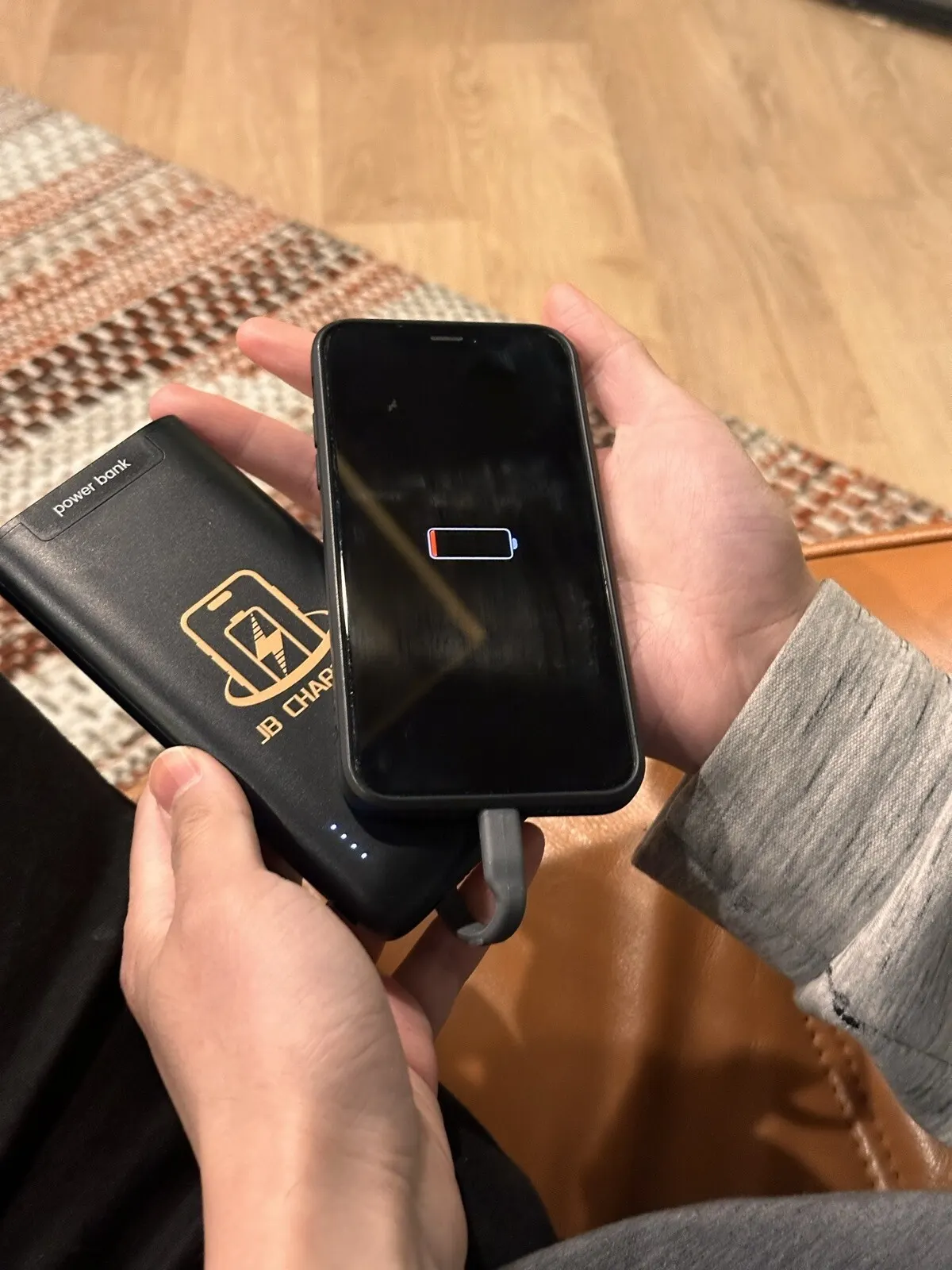
A self-service station handles it without your staff. A guest taps a card or phone (no app or account needed), takes a charged power bank with Lightning and USB-C cables built in, and returns it to any free slot at any JB Charging station. The operator who places it sets the price, commonly $3 per 30 minutes with a $20 daily maximum. Renters get help from us through the machine, the app, or the receipt, so your staff don't have to troubleshoot rentals. A bank that isn't returned is charged to the renter, never to the venue. To brief your team, see how power bank rental works.
What hosting looks like on your side:
- What you provide: a spot and a standard wall outlet. The station connects over its own built-in 4G, so it doesn't need your Wi-Fi (Wi-Fi is only a backup).
- Who you deal with: where one serves your area, the independent local operator who places and maintains the station signs the agreement with you.
- What it costs: under our standard terms, hosting costs the venue nothing beyond the electricity. All terms, including any share of rental revenue, are agreed in writing before install. If you'd rather, you can own stations outright.
- How you get out: our standard venue agreement runs 6 months, then month to month with 30 days' notice, and the station is removed at no cost to you. Operators can vary these terms.
- Insurance: JB Charging carries general liability insurance and can name a venue as additional insured on request.
Before you sign anything, use what to check before signing a phone charging station agreement.
Next step
Run a bar or restaurant? The bars and restaurants page shows where a station goes and what your staff do (and don't). Other rooms: all venue types.
Frequently Asked Questions
What is low battery anxiety?
It's a popular name for the worry people feel as their phone battery runs down. LG Electronics popularized the term in a 2016 marketing campaign and said in its own release that it isn't a real illness or anxiety disorder. Researchers study a related idea, nomophobia, the fear of being without a phone.
Is it true that 9 out of 10 people have low battery anxiety?
Partly. LG's 2016 online poll of 2,000 U.S. adults found nearly 9 in 10 said they "felt panic" when their battery dropped to 20% or lower. A peer-reviewed study of about 2,000 mostly Chinese phone users, published in 2022, found about 92% reported at least a little, but only about a third said they clearly suffer from it. Both measured how people say they feel, not what they do, and LG's poll was run to promote a phone.
At what battery percentage do people start to worry?
It depends on how you ask. LG's survey asked about 20%. A 2025 Talker Research poll of 2,000 Americans put the average worry point at 38%, and 44% for Gen Z. In the same poll, 24% said they start worrying before the battery is half full, while 34% don't worry until it drops below 20%. An academic survey found the share of people ready to plug in jumps between about 30% and 20%.
Does a phone charging station make guests stay longer or spend more?
Longer stays do go with more spending in an independent study of 89 U.S. airports, but we haven't found an independent study showing that a charging station makes guests stay longer. The best-known study on that was paid for by a charging-kiosk company and ran in retail stores. The research does suggest a low battery changes decisions about getting home: an Uber economist described riders below about 5% giving up on waiting out surge prices, and a third of LG's respondents said they'd turn around to go home and charge. A guest with a dying phone may cut a night short.
Do my staff have to do anything if we host a charging station?
No. Guests tap a card or phone, take a power bank with built-in cables, and return it to any free slot at any JB Charging station. Renters get help from us through the machine, the app or the receipt, and the local operator who places the station maintains it. The venue provides a spot and a standard wall outlet, and is never charged if a guest keeps a bank.
What does a guest pay to rent a power bank?
The operator who places the station sets the price for each station. The common default is $3 per 30 minutes with a $20 daily maximum, and an operator can add a free first period of up to 60 minutes. Guests pay by tapping a card, Apple Pay or Google Pay, with no app or account needed.