
Phone Charging Stations for Hotels and Resorts
Guests tap to rent a charged power bank at the front desk, lobby or pool entrance, and under our standard terms a local operator installs and services the station at no cost to the hotel beyond electricity.
Charging outside the room
The bank goes where the guest goes: a pool lounger, a ballroom seat, the airport shuttle line. A low phone no longer sends them upstairs or to the desk.
Close the cable drawer
Guests tap a card or phone, take a bank with Lightning and USB-C built in, and return it themselves. Staff hand nothing out and chase nothing back.
Lost banks aren't your bill
A bank that doesn't come back is charged to the renter's card, never the hotel. The standard agreement runs 6 months, then month to month on 30 days' notice, with removal at no cost.
A phone charging station for hotels covers the hours in-room USB ports can't reach: checkout, the pool, a day in a ballroom. Those are the hours your front desk starts lending cables. Under our standard hosting terms it costs the hotel nothing beyond electricity, your staff don't run it, and a bank that doesn't come back is charged to the guest's card, never to you.
Why hotel guests run out of battery
- Checkout to flight. A guest checks out at 11, leaves bags with the bell desk and flies at 7, on a phone that started the day at 60%. The boarding pass and the airport ride live on it.
- Mobile keys and brand apps. At a mobile-key property, a dead phone means a lost key and a dark brand app, and the guest ends up back in the check-in line for a plastic key.
- Pool, cabana and rooftop. Outlets are scarce near water, often on purpose. Guests sit at 9% or go back upstairs.
- Conference days. The event app, a digital badge and photos of every slide run on one phone from 8 to 5, and pre-function outlets are gone by the first coffee break.
Flying has made it worse: since March 27, 2026, international air-safety rules have capped passengers at two power banks and banned recharging them on board (ICAO), and ICAO recommends against using them to charge phones in flight. Guests can arrive low, right when they need the mobile key.
How a guest rents a power bank
- Tap a card or phone (Apple Pay, Google Pay or any contactless card) on the built-in reader, or scan the QR code. No app or account needed.
- Take a charged power bank with Lightning and USB-C cables built in.
- Go. The phone charges in the guest's pocket wherever the day goes.
- Return it to any free slot at any JB Charging station. The app shows where they are.
It takes about 30 seconds. The operator sets each station's price; at a common setting of $3 per 30 minutes with a $20 daily maximum, a 90-minute pool afternoon costs the guest $9. Renters get help from JB Charging through the machine, the app or the receipt, so your desk isn't the support line.
Where to put a phone charging station in a hotel
Put it where guests stand still, phone in hand. A full-service hotel or resort can use three or four spots, and a bank taken at the desk can go back at the pool. A boutique property may need only the desk.
| Spot | Who's there, and when | Placement notes |
|---|---|---|
| Front desk or concierge | Checkouts before 11, arrivals after 3, cable requests | Guest side of the counter's end, or wall-mounted beside it. Behind the desk, staff end up handing banks out. |
| Lobby seating or lobby bar | Guests waiting on bags or rides; drinks after 5 | In sight of the seating, back to a wall. A J8's lit header reads across a dim bar. |
| Pool entrance | Pool guests, late morning to late afternoon | Inside the entrance or at an indoor towel desk, never on the deck or a covered patio. |
| Conference pre-function | Registration and every coffee break | Near coffee and registration, clear of ballroom doors and exits. |
Skip guest-floor corridors and elevator lobbies (people pass through), the fitness center (short visits), the spa (phones go in lockers) and parking levels (weak signal).
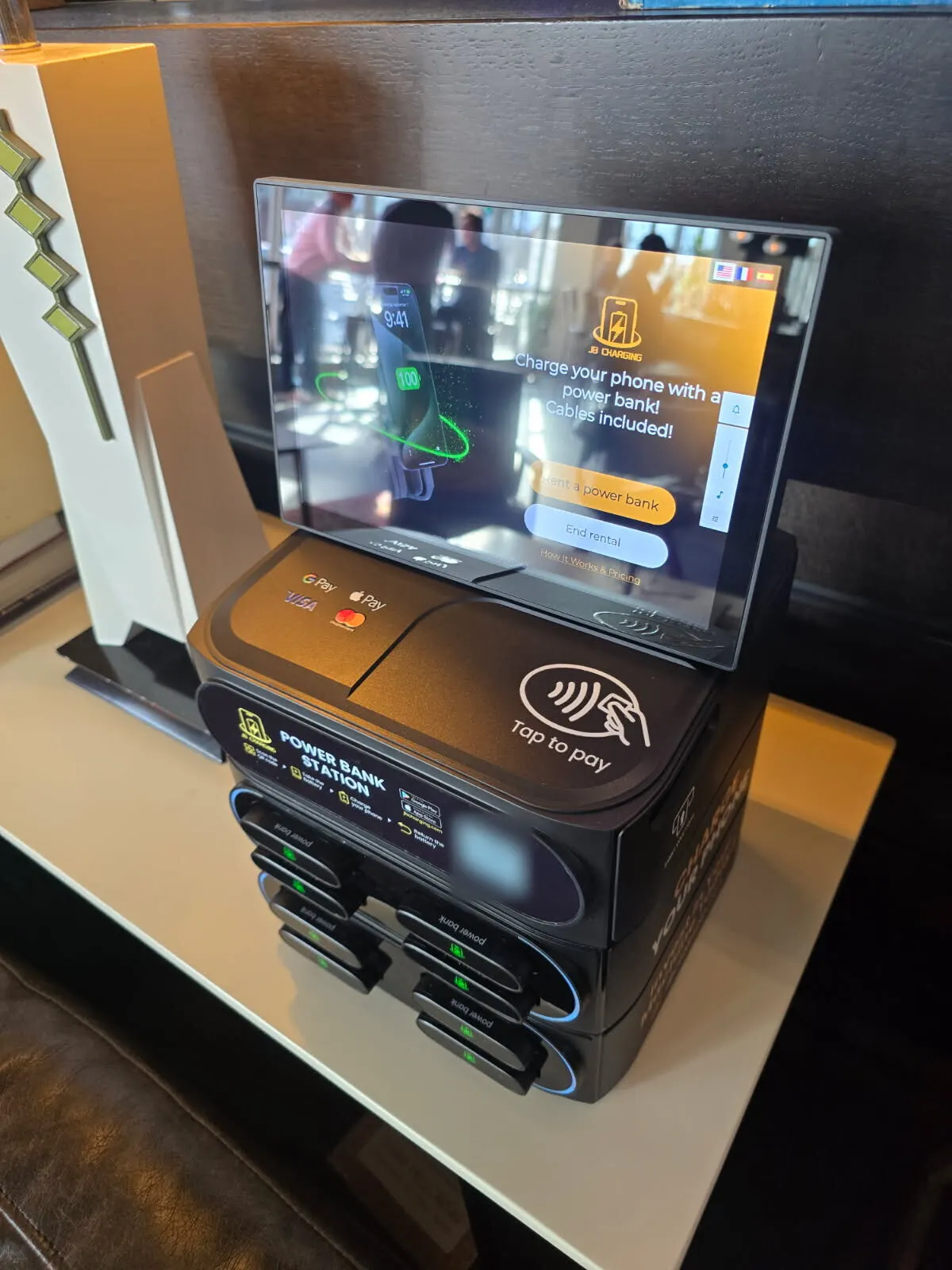
Choose the spot for guests first, then find one standard outlet within cord reach: no extension cords, nothing in an exit path. Stations run on built-in 4G; in a basement ballroom with weak signal, one can use your Wi-Fi as a backup. Keep it lit and in staff view.
Which station fits your property
| Property | Start with | Add a station when |
|---|---|---|
| Boutique or select-service | One J8 at the front desk | The desk still lends cables, or the J8 runs low on charged banks on busy weekends |
| Full-service with meeting rooms | J8 at the desk, J24 in the lobby | Meeting floors are booked most weekdays: add a J24 in pre-function |
| Resort with pool and conference space | J8 at the desk, J8 at the pool entrance, J24 in pre-function | You add an indoor rooftop bar, a second pool entrance or a gaming floor |
- J8 Pro: 8 banks, about 9 x 9 inches of counter and 16 inches tall, 10-inch touchscreen. Counter, stand or wall mount.
- J24 Pro: 24 banks in a 71-inch floor tower on a 14 x 18-inch footprint, 24-inch screen.
- J48 Pro: 48 banks, built to order for the largest rooms; few hotels need one.
What your staff do (and don't)
The hotel provides a spot, a standard outlet and the electricity. The station runs on its own 4G; Wi-Fi is only a backup. Staff don't hand out banks, take payments, track returns or troubleshoot. The operator monitors it remotely and restocks it.
The one habit worth adding is a line at check-in, said with the Wi-Fi password:
"Phone running low later? There's a charging station by the desk. Tap your card, take a bank to the pool, and drop it in any free slot before you head out."
Put the same line in the in-room directory, and ask your operator for pitch cards: guest steps on the front, a staff cheat sheet on the back. For a fuller staff brief, share how power bank rental works.
What it costs the hotel, and the agreement
Terms are agreed in writing before install.
- Who does the work. Where one serves your area, a local, independent operator on the JB Charging network supplies, installs, stocks and services the station. If none does yet, we'll tell you.
- What it costs. Under our standard terms, nothing beyond electricity. The operator is paid from rentals and any screen ads it sells. Many venues host it purely as a guest amenity; others agree a share of rental revenue, paid monthly by direct deposit.
- Term and exit. Our standard agreement runs 6 months, then month to month with 30 days' notice, and removal costs you nothing. The hotel isn't liable for theft or misuse by guests, and agrees not to host a competing charger during the term. Operators may propose different terms; check them with our agreement checklist.
- The screen. Beyond the price and the rent button, it's display space the operator controls. Ask for the agreement to say what may run there: your restaurant, spa or late checkout, and no competing hotels.
- A free first period. To feature charging as an amenity, ask for up to an hour free, or a lower rate. Normal pricing applies after that, and your operator decides whether to offer it.
- Or own your stations. Buy them and you become the operator: you set the price, keep 80% of rental revenue before your own costs (JB keeps 20% for payment processing, 4G and support), and restock them yourself. Stations and list prices.
To start, request a station with your property name, city and rough daily guest count. We'll reply with who would install it and the terms. Nothing is installed until you sign.
Run charging stations yourself? Read our hotel playbook for operators.
Frequently Asked Questions
How much does a phone charging station cost a hotel?
Under our standard hosting terms, it costs nothing beyond the electricity it uses, where an operator serves your area. A local, independent operator on the JB Charging network supplies, installs, stocks and services the station, and is paid from guest rentals and any screen ads it sells. The electricity is modest. A J8 runs on a 60-watt adapter, so even drawing that much around the clock it would use about 43 kWh a month, which is under $10 at 20 cents per kWh. If you'd rather own stations, list prices at the time of writing are about $1,200 for a J8 Pro countertop unit and about $3,300 for a J24 Pro tower, plus shipping, with no monthly fees. Owners keep 80% of rental revenue before their own costs. JB keeps 20% for payment processing, 4G and support.
What happens if a guest leaves for the airport with a power bank?
The guest's card pays, never the hotel. Billing follows the station's pricing up to its daily maximum. By default, a bank that isn't back within 24 hours triggers a $40 non-return fee charged to the renter, who then keeps the bank. The operator can set a different window and fee. If there's a JB Charging station where the guest is headed, the app shows it. The simplest habit is to charge in the lobby while bags are held, then drop the bank back before the shuttle.
Do our front desk or IT teams have to do anything?
Usually nothing. Guests rent and return on their own, the machine shows the steps in pictures, and renters get help from JB Charging through the machine, the app or their receipt. Every station we sell takes payment on its own card reader over a built-in 4G connection, with no monthly fee to the hotel, so it doesn't rely on your network. Wi-Fi is only a backup where cell signal is weak, such as a below-grade ballroom. Your operator can also set up a staff code, and registered staff get free rentals within daily and weekly limits.
How much do guests pay, and can we make charging free?
The operator sets pricing for each station, and a common setting is $3 per 30 minutes with a $20 daily maximum. Guests pay by tapping a card, Apple Pay or Google Pay, and no app is needed. Free charging isn't a standard option, but you can ask your operator to set a free first period of up to 60 minutes, or a lower rate. After that, the station's normal pricing applies. Whether they offer it, and on what terms, is agreed in writing before install.
How long is the agreement, and what if a guest damages a bank?
Our standard venue agreement runs 6 months, then continues month to month, with 30 days' notice to end it, and the station is removed at no cost to the hotel. The station and banks belong to the operator. The standard agreement says the hotel isn't liable for theft or misuse by guests, so a bank dropped in the pool isn't the hotel's bill. Your operator may propose different terms. The term, the exit and any revenue share are all in writing before install.
Does JB Charging carry insurance, and can you add our company to the certificate?
JB Charging carries general liability insurance of $2 million per occurrence. On request, a hotel or its management company can be named as an additional insured on JB's policy. Your operator is an independent local business that owns and services the station, so ask them for their own certificate too, as you would any vendor working on your property. Send us the exact entity names you need.
What about lithium batteries and fire codes?
The power banks carry FCC, CE and RoHS markings and charge in their own slots in the station. The station plugs straight into a standard wall outlet with no extension cord, and it should stay clear of exits and doorways. If your brand standards, insurer or fire marshal need a specific listing or safety document, ask before install and we'll tell you plainly what we have.
We're a flagged or managed property. Who has to approve it?
That depends on your franchise and management agreements. Tell us who signs off, whether that's the GM, the management company or the brand, and we'll send specs and photos for their review.