
Phone Charging Stations for Stadiums, Ballparks and Sports Complexes
Fans tap to rent a charged power bank and take it to the stands. Where a local operator serves your area, our standard terms mean they install and service the station at no cost to you beyond electricity.
Charge without leaving the game
Mobile tickets, tap-to-pay concessions, the bracket app and the livestream all run on one phone. A rented bank charges it in the bleachers, where there are no outlets.
Staff stop charging phones
Phones stop piling up behind the concession counter. Fans rent and return on their own, and a bank that doesn't come back is charged to the renter's card, never the venue.
Your say on the screen
The station's screen sits where fans wait in line. Agree in writing what runs there: your promo nights and registration dates, and nothing that competes with your sponsors.
A phone charging station for stadiums and sports complexes lets fans take a charged battery to the bleachers, where there are no outlets and the phone is the ticket, wallet, bracket and livestream. Below: placement, sizing and terms for ballparks, college venues, tournament complexes and racetracks. Where a local operator serves your area, our standard terms mean they install and restock it at no cost to you beyond electricity, and after 6 months you can end it on 30 days' notice.
Why fans run out of battery at a ballpark or tournament
- The gate. If your gates scan phone tickets, a fan at 4% is a box-office problem before they're inside.
- The concession line. If your stands are cashless, a fan whose card lives in a phone wallet can't buy a hot dog at 0%.
- The livestream. Picture a 12U tournament with games at 8, 11:30 and 3, each streamed to the grandparents. By 3 o'clock the phone is at 9%.
- The way home. After a night game or a race, the ride-share and the map out of a grass lot need a phone.
The few outlets sit in the concession stand or press box, so staff end up holding phones behind the counter.
How a fan rents a power bank
- Tap a contactless card or phone on the built-in reader, or scan the QR code. No app or account.
- Take a charged power bank, with Lightning and USB-C cables built in, back to the seat.
- Return it to any free slot at any JB Charging station. With two stations on site, take it at the gate and return it at concessions.
The operator sets each station's price. At a common setting of $3 per 30 minutes with a $20 daily maximum, a 90-minute game costs a fan $9, and a parent who keeps a bank from 8am to 3pm pays the $20 maximum, not $42.
Where a phone charging station goes in a stadium or sports complex
Put it where fans stand still with a phone out, not where they walk.
| Spot (venue) | Who's there | Placement notes |
|---|---|---|
| Entry: guest services or box office (ballparks, college venues) | Fans with ticket trouble | Fan side of the window |
| Field map or schedule board (multi-field complexes) | Parents finding the next field | Often at the central pavilion, near outlets |
| Main concession line (all) | Breaks and between games | Along the wall beside the line |
| Covered spot nearest family seating (all) | Parents staying all day | The bank goes to the seats; the station stays under the roof |
| Near the main exit (all) | Fans heading out | Back to a wall: a last chance to return banks |
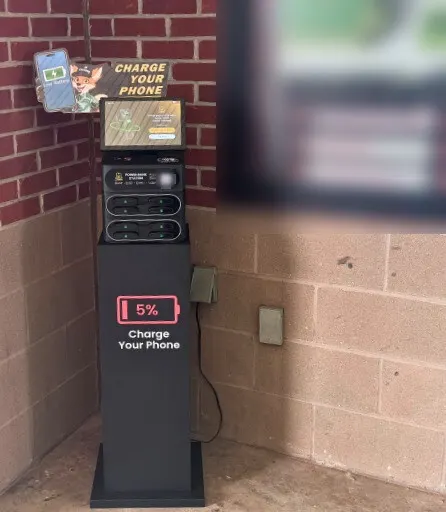
Skip the seating bowl (no outlets; a line blocks the aisle), tunnels and gates (everyone's moving) and parking lots. Each spot needs a roof, one standard outlet within cord reach, no extension cord and a clear exit path. Install is a plug-in with no construction; how a tower is secured gets settled on the site walk.
Which station fits, and how many
Size for banks out at once, not the day's total: a tournament parent can keep one for hours, so banks leave in the morning rush and may not return until the last game. Say 10 people an hour rent and each keeps one 3 hours: about 30 are out at once, more than one J24 holds.
| Venue | Start with | Add a station when |
|---|---|---|
| Indoor courts, turf or rink | J8 at the front desk or viewing window | Tournaments run back to back: add a J24 in the lobby |
| Outdoor youth complex, several fields | J8 at the field map, J24 at the main concession building | A far cluster of fields has its own concession stand |
| Minor-league or college ballpark, stadium or arena | J24 on each main concourse (or a J48 where there's room), J8 at guest services | Far-side fans pass two concession stands to reach it |
| Racetrack | J24 at the main grandstand concourse | Race weekends fill a second concession area |
Capacity: J8 Pro, 8 banks on about 9 x 9 inches of counter, stand or wall; J24 Pro, 24 in a 71-inch tower; J48 Pro, 48, built to order.
What your staff do (and don't)
Your side is a spot, one standard outlet and the electricity. Keep that circuit on between events, or the station goes offline and its banks stop charging. Name a contact for event-morning access, and list the operator in the agreement as your service contact.
It runs on its own 4G rather than your Wi-Fi, which is only a fallback where signal is weak. Staff don't hand out banks, take payments or chase returns.
Add a PA read before the start and late in the game, and put it in the schedule email:
"Phone running low? Charging stations are at guest services and the main concession stand. Tap your card, take a battery to your seat, and drop it in any free slot on your way out."
The screen and your sponsors
Beyond the price and the rent button, the screen is the operator's display space: they sell the ads and keep that revenue. Agree in writing what may run there: your promos (fireworks night, tournament registration), and nothing that competes with your pouring-rights or financial-services sponsor. To add the screens to your sponsor packages, agree who sells which slots and who keeps that money.
What it costs the venue, and the agreement
Terms are agreed in writing before install.
- Who does the work. Where one serves your area, a local, independent operator on the JB Charging network supplies, installs, stocks and services the station. Where none does yet, owning stations (below) is the other route.
- What it costs. Under our standard terms, nothing beyond electricity. The operator is paid from rentals and any screen ads it sells. Many venues host it as a fan amenity; others agree a rental share, paid monthly by direct deposit.
- Term and exit. Our standard agreement runs 6 months, then month to month on 30 days' notice, and removal costs you nothing. Under it, the venue isn't liable for theft or misuse by fans and agrees not to host a competing charger during the term. An operator's agreement may differ; whatever you sign governs, so check it with our agreement checklist.
- Off-season. If you close for winter, agree whether the station stays powered, moves indoors or comes out until opening day.
- Who else signs off. A city or county complex may need a vendor permit or board vote; college athletics may route it through procurement. If a concessionaire or sponsor holds vending, signage or charging rights, check those contracts first, given the no-competing-charger clause.
- Or own your stations. Buy and run them yourself: you set the price, restock on event days and keep 80% of rental revenue, before your own costs such as stations, replacement banks, upkeep and taxes. JB keeps 20% for payment processing, 4G and support. Stations and list prices.
To start, request a station. We'll reply with your options and the terms; nothing is installed until you sign.
Run charging stations yourself? Read the operator playbook for youth tournaments and minor-league parks.
Frequently Asked Questions
How much does a phone charging station cost a stadium or sports complex?
Under our standard hosting terms, it costs nothing beyond the electricity it uses, where an operator serves your area. A local, independent operator on the JB Charging network supplies, installs, stocks and services the station, and is paid from fan rentals and any screen ads it sells. Even at full rated draw around the clock, a J8 (60-watt adapter) would use about 43 kWh a month and a J24 (160 watts) about 115 kWh. At an assumed 20 cents per kWh, that's roughly $9 and $23 a month; a J48 (290 watts) would use about 209 kWh, roughly $42. If you'd rather own stations, list prices at the time of writing are about $1,200 for a J8 Pro, $3,300 for a J24 Pro and $4,300 for a J48 Pro, plus shipping, with no monthly fees.
Who do we call if a station runs low or stops working on game day?
Your operator. They own and service the station, their name and number belong in the agreement, and their dashboard flags a station that's offline, has a card reader down, or is low on charged banks. Before a tournament weekend or a big game, send them your schedule so they can restock around it. If you can't reach them, email team@jbcharging.com. Fans with a rental or billing question get help from JB Charging through the machine, the app or their receipt, not at your guest services window.
What happens if a fan leaves with a power bank?
The fan's card pays, never the venue. Billing follows the station's pricing up to its daily maximum. By default, a bank that isn't back within 24 hours triggers a $40 non-return fee charged to the renter, who then keeps the bank. The operator can set a different window and fee; for a two-day tournament, you can ask for a window that fits the weekend. A station near the main exit and a reminder in the PA read are the simplest ways to get banks back before fans reach the parking lot.
How much do fans pay, and can we make charging free for a tournament?
The operator sets pricing for each station, and a common setting is $3 per 30 minutes with a $20 daily maximum. Fans pay by tapping a card, Apple Pay or Google Pay, with no app. Free charging isn't a standard option, but you can ask your operator for a free first period of up to 60 minutes, or a lower rate. Normal pricing applies after that, and your operator decides whether to offer it. Whatever is agreed goes in writing before install.
Does a charging station work with our clear-bag policy, and can fans bring their own power banks?
Yes, with one choice to make. A bank rented inside your gates is picked up after security, so it doesn't go through bag check and fans don't need to pack a charger. A station at an outside box office catches fans whose phone ticket is dying, but those banks then pass through security like any small power bank, so check that against your policy. Whether fans may bring their own power banks stays your call.
Can a station go outdoors, next to the fields?
Plan on indoor or fully covered spots for the station itself: inside the concession building, at guest services, in the team store or in a field-house lobby. The power bank goes out to the bleachers, so the station doesn't have to. It needs one standard outlet within cord reach, no extension cord, and a spot clear of exits. If your best location has no roof, say so when you request a station.
Does JB Charging carry insurance, and can our organization be named on the certificate?
JB Charging carries general liability insurance of $2 million per occurrence. On request, we can ask our insurer to name the venue, or the entity that owns or runs the facility, as an additional insured on JB's policy. Each request is approved individually, so send us the exact entity names you need. Your operator is an independent local business that owns and services the station, so ask them for their own certificate too, as you would any vendor on your property.
What about lithium batteries and the fire marshal?
The power banks carry FCC, CE and RoHS markings and charge in their own slots in the station. The station plugs straight into a standard wall outlet with no extension cord, and it should stay clear of exits, gates and egress routes. If your fire marshal, insurer or athletic department needs a specific listing or safety document, ask for it before you sign, and don't install until they're satisfied.